2026 Trends: Medical Equipment Manufacturers in India Go Modular
Discover how medical equipment manufacturers in India leverage modular production lines to slash changeover times and scale flexible medtech capacity.
The Indian medical device sector is undergoing a structural transformation. Driven by the Production Linked Incentive (PLI) scheme and a strategic push to reduce import dependency, medical equipment manufacturers in India are rapidly scaling domestic production. However, the traditional model of dedicated, fixed-automation assembly lines is proving inadequate for the volatile SKU demands of modern medtech. In 2026, the industry standard has shifted decisively toward Reconfigurable Manufacturing Systems (RMS) and modular production cells.
Modular manufacturing equipment allows facilities to decouple mechanical tooling from digital control architectures. By utilizing plug-and-produce I/O systems and autonomous material routing, factories can pivot from assembling auto-disable syringes to manufacturing IV cannulas or glucometer test strips in a matter of hours, rather than weeks. This architectural shift is particularly critical in high-density manufacturing clusters like Baddi, Hyderabad, and Pune, where floor space is at a premium and product lifecycles are accelerating.
The Economics of Reconfigurable Manufacturing Systems (RMS)
Transitioning from fixed transfer lines to modular cells requires a fundamental recalibration of capital expenditure (CapEx) and operational expenditure (OpEx) models. A traditional fixed-automation line for high-volume syringe assembly typically requires an initial CapEx of $1.2 million to $1.6 million, with a lead time of 14 to 18 months for design, fabrication, and validation. If product demand shifts or a new SKU is introduced, the line requires physical teardown and mechanical re-tooling, resulting in 3 to 4 weeks of downtime.
2026 CapEx vs. Flexibility Metrics:A modular cell-based system utilizing standardized base frames (e.g., Bosch Rexroth Xcellon) and distributed automation requires an initial CapEx of approximately $850,000 for equivalent baseline throughput. While the per-unit cost at maximum theoretical speed is marginally higher (roughly 1.4 cents per unit vs. 0.9 cents on a fixed line), the ability to execute a full SKU changeover in under 6 hours yields an ROI break-even point 22 months faster than fixed automation in multi-SKU environments.
According to industry analyses on manufacturing flexibility, reconfigurable systems reduce the risk of stranded assets. When a specific medical device reaches end-of-life or faces regulatory obsolescence, the modular actuators, vision systems, and PLCs can be redeployed to a new product line with up to 85% component reuse.
Fixed Automation vs. Modular Cells: A Technical Comparison
Factory managers evaluating production upgrades must weigh the mechanical rigidity of legacy systems against the digital agility of modular architectures. The following matrix outlines the operational differences for a standard Class II medical device assembly environment.
| Parameter | Fixed Transfer Line | Modular Flexible Cell |
|---|---|---|
| Mechanical Footprint | 45 - 60 meters (linear) | 12 - 15 square meters (clustered) |
| SKU Changeover Time | 18 - 25 days | 4 - 8 hours |
| Control Architecture | Centralized PLC (single point of failure) | Distributed Edge Controllers / IPC |
| Material Transport | Hard-coded conveyor pallets | AMRs or Flexible MagLev movers |
| Validation Protocol | Full line re-validation (IQ/OQ/PQ) | Cell-level modular validation |
Core Hardware Driving Flexible Medtech Assembly
The viability of modular manufacturing in the Indian medtech sector relies heavily on the maturation of specific industrial hardware ecosystems. Off-the-shelf integration is no longer experimental; it is the baseline requirement for new facility builds.
Distributed I/O and Plug-and-Produce Sensors
Legacy systems rely on massive cable trays routing hundreds of discrete analog and digital signals back to a centralized cabinet. Modern modular cells utilize distributed I/O blocks, such as the Siemens SIMATIC ET 200SP or Balluff IO-Link masters. When a manufacturer needs to swap a pneumatic pick-and-place module for a servo-driven dispensing module, the IO-Link master automatically detects the new sensor array, downloads the parameterization from the central PLC (e.g., Siemens S7-1500), and resumes operation without manual wiring or ladder-logic recompilation. This plug-and-produce capability is the primary driver of the sub-8-hour changeover metric.
Independent Cart Technology (ICT)
Replacing mechanical chains and timing belts, Independent Cart Technology (such as B&R's ACOPOStrak or Beckhoff's XTS) uses linear electromagnetic motors to move individual shuttles independently. For medical equipment manufacturers in India producing varying volumes of diagnostic cassettes or surgical staplers, ICT allows asynchronous processing. A shuttle can be routed to a rejection lane for a failed vision inspection without stopping the main line, and changeovers require only a software profile update rather than physical cam replacement.
Regulatory Compliance in Modular Environments
A common misconception is that modular, frequently reconfigured lines complicate compliance with ISO 13485:2016 and FDA 21 CFR Part 820. In reality, digital modularity enhances traceability. Because every modular cell operates on an independent edge controller, process parameters (torque limits for screwdriving, exact dispensing volumes for reagents) are logged at the station level with cryptographic timestamps.
Compliance Insight: The World Health Organization's guidelines on Good Manufacturing Practices for medical devices emphasize the need for validated, reproducible processes. In a modular setup, validation is executed per 'recipe' rather than per physical line. Once a specific cell configuration and software recipe pass Installation, Operational, and Performance Qualification (IQ/OQ/PQ), that digital twin is locked. Re-assembling the same physical modules and loading the locked recipe guarantees identical output, drastically reducing the regulatory burden of line reconfigurations.
Step-by-Step Integration Blueprint for Indian Facilities
For operations directors planning to retrofit existing facilities or build greenfield sites, a phased approach mitigates technical risk and manages cash flow.
- Digital Twin Simulation (Months 1-2): Before procuring hardware, model the production flow using Siemens Tecnomatix or Rockwell Arena. Simulate bottleneck scenarios when switching between high-volume/low-mix (e.g., standard syringes) and low-volume/high-mix (e.g., specialized biopsy needles) SKUs.
- Pilot Cell Deployment (Months 3-5): Isolate one sub-assembly process (such as needle shielding or cap application). Build a single modular cell using standardized aluminum extrusions (e.g., Item Industrietechnik profiles) and test the IO-Link auto-configuration protocols.
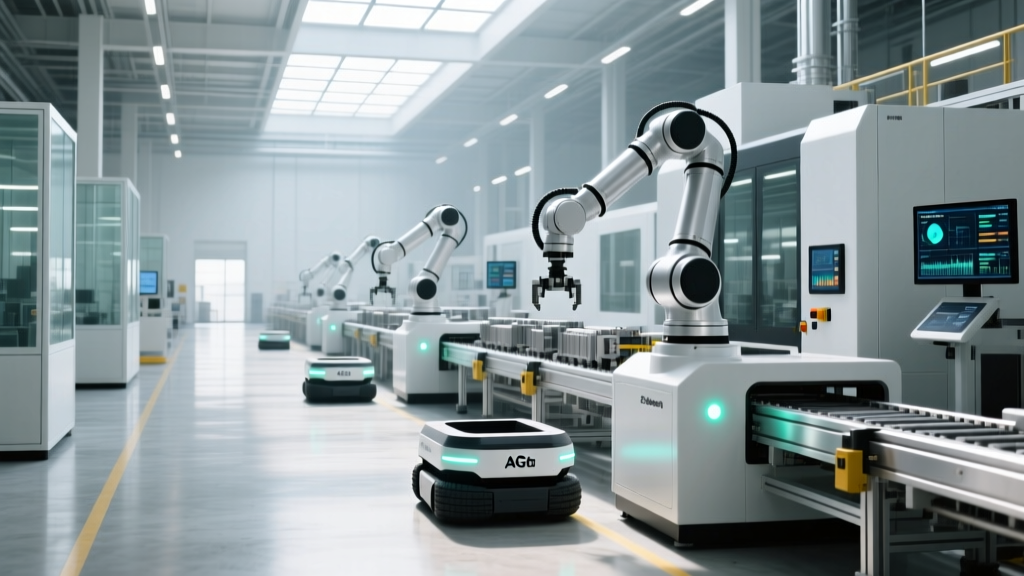
- AMR Integration (Months 6-8): Decouple the cells from fixed conveyors. Deploy Autonomous Mobile Robots (like the Omron LD-250 or local equivalents from Indian robotics startups) to transport WIP (Work in Progress) trays between modular stations based on real-time cell availability.
- Full Line Scaling and MES Handshake (Months 9-12): Scale the pilot cell architecture to the full line. Integrate the distributed edge controllers with the facility's Manufacturing Execution System (MES) to ensure batch genealogy and electronic batch records (EBR) are automatically generated per modular recipe.
Strategic Takeaways
The mandate for medical equipment manufacturers in India is clear: rigid, single-purpose automation is a liability in a market characterized by rapid technological iteration and shifting public health procurement priorities. By investing in modular manufacturing equipment, distributed control architectures, and independent cart technologies, facilities can achieve the high throughput required for commodity consumables while retaining the agility to pivot toward high-margin, complex diagnostic devices. The transition requires rigorous digital twin planning and a shift toward recipe-based validation, but the resulting operational resilience provides a decisive competitive advantage in the global medtech supply chain.