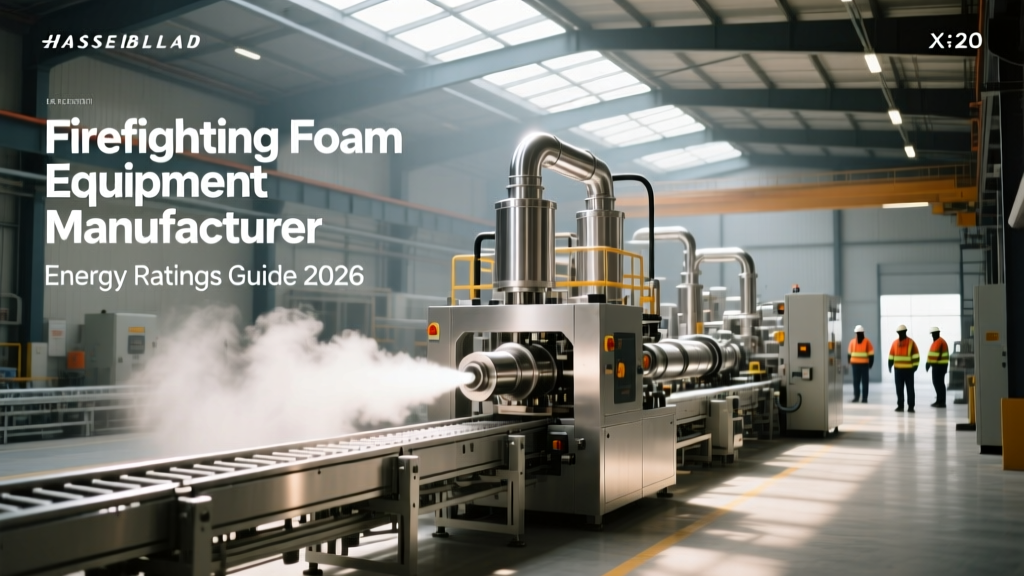
Firefighting Foam Equipment Manufacturer Energy Ratings Guide 2026
Evaluate energy efficiency ratings from a firefighting foam equipment manufacturer. Cut OPEX on F3 mixers, VFD pumps, and IE4 motors.
The Hidden OPEX in Foam Production Lines
When commissioning a new production line for aqueous film-forming foam (AFFF) or alcohol-resistant concentrates, facility managers typically prioritize material compatibility (such as 316L stainless steel wetted parts) and batch throughput (liters per hour). However, ignoring manufacturing equipment energy efficiency ratings when selecting a firefighting foam equipment manufacturer leads to severe operational expenditure (OPEX) bleed. Industrial mixing, high-shear homogenization, and viscous fluid transfer account for up to 75% of a foam plant's total electrical load. In 2026, with industrial electricity rates averaging $0.12 to $0.18 per kWh across major manufacturing hubs, a poorly specified 30 kW mixer running on a standard 5-day shift can waste over $6,000 annually in avoidable energy costs compared to a high-efficiency configuration.
⚠️ The Fluorine-Free Foam (F3) Viscosity TrapThe industry-wide transition to fluorine-free foams (F3) has fundamentally altered equipment energy requirements. Legacy AFFF formulations typically exhibit viscosities between 5 and 20 cP. Modern F3 formulations rely on polysaccharide thickeners and complex synthetic surfactants, pushing viscosities to 500–1,500 cP. If your manufacturer supplies standard IE2 motors and fixed-speed gear pumps based on legacy AFFF specs, the increased torque demand will cause continuous thermal throttling, cavitation, and a 30% to 45% spike in kWh consumption. Always mandate F3-specific torque curves in the equipment selection phase.
Decoding Motor and Pump Efficiency Ratings
When reviewing proposals from a firefighting foam equipment manufacturer, you must audit the specific efficiency classes of the drive systems. Do not accept generic claims of 'high efficiency.' Demand documentation based on international standards.
1. IEC 60034-30-1 Motor Classifications
The International Electrotechnical Commission (IEC) defines motor efficiency classes. For foam manufacturing, specifically for main batch agitators and inline high-shear mixers, you must specify IE4 (Super Premium) or IE5 (Ultra Premium) motors. An IE4 motor operates at roughly 94.5% efficiency, whereas a standard IE2 motor operates at 91.5%. While the 3% delta seems marginal, on a 45 kW mixer running 4,000 hours a year, it translates to 1,200 kWh saved annually per unit. Furthermore, IE4/IE5 motors run cooler, extending the lifespan of mechanical seals in the mixing shafts—a critical factor when handling corrosive surfactant blends.
2. Hydraulic Institute Energy Rating (ER) for Pumps
Transfer pumps move raw surfactants, glycol ethers, and finished concentrates. The Hydraulic Institute's Energy Rating (ER) program provides a standardized metric for pump efficiency. According to the Hydraulic Institute's Pump Efficiency guidelines, the ER value represents how much a specific pump model exceeds the minimum baseline efficiency. When evaluating progressive cavity pumps (ideal for high-viscosity F3) or positive displacement gear pumps, require an ER value of at least 1.15 (meaning the pump exceeds the baseline standard by 15%).
Energy Consumption Comparison: Mixer & Pump Configurations
The following matrix illustrates the real-world energy impact of different equipment configurations typically offered by foam system integrators. Calculations assume 4,000 operating hours/year at $0.14/kWh.
| Equipment Configuration | Rated Power | Avg. Load Factor | Annual kWh | Est. Annual Cost |
|---|---|---|---|---|
| Standard IE2 Agitator + Fixed Speed | 30 kW | 85% | 102,000 | $14,280 |
| IE4 Agitator + VFD (Variable Load) | 30 kW | 65% | 78,000 | $10,920 |
| Standard Gear Pump (Fixed Speed) | 11 kW | 90% | 39,600 | $5,544 |
| Progressive Cavity + VFD (ER 1.20) | 11 kW | 55% | 24,200 | $3,388 |
High-Shear Mixing: The Biggest Energy Sink
Producing stable firefighting foam requires intense homogenization to disperse fluorosurfactants or F3 polymeric thickeners into the aqueous base. High-shear rotor-stator mixers are the industry standard, but they are notoriously inefficient if improperly sized. The key metric to evaluate is the tip speed (m/s) relative to the motor draw.
Many manufacturers oversize the motor to guarantee batch completion times, resulting in a 45 kW motor running at a 40% load factor during the final 20 minutes of a batch cycle. At partial loads, standard AC motors suffer a severe drop in power factor and efficiency. To counter this, specify inline high-shear mixers equipped with Variable Frequency Drives (VFDs) featuring sensorless vector control (e.g., ABB ACS880 or Siemens SINAMICS G120 series). These drives dynamically adjust the motor frequency to maintain optimal torque as the batch viscosity changes during the surfactant addition phase, reducing mixing energy consumption by up to 22%.
Clean-in-Place (CIP) Energy Recovery
Foam production lines require rigorous CIP cycles to prevent cross-contamination between F3 and AFFF batches. CIP pumps often run at full capacity even during low-flow rinse phases. Mandate that your manufacturer integrates VFDs on all CIP supply pumps, tied to flow-meter feedback loops, ensuring the pump only draws the exact kW required to maintain the required 1.5 m/s pipe-scouring velocity.
A 4-Step Framework for Auditing Manufacturer Specs
Before signing a purchase order for a foam proportioning or mixing skid, run the manufacturer's proposal through this technical audit:
- Demand the Motor Nameplate Data: Verify the IEC efficiency class (IE3 minimum, IE4 preferred). Cross-reference the nominal efficiency percentage at 100%, 75%, and 50% load. If the manufacturer cannot provide these specific data points, they are sourcing commodity-grade drives.
- Review the Pump Affinity Laws Application: For centrifugal transfer pumps used in water-base prep, ensure the manufacturer has applied the pump affinity laws to justify VFD sizing. A 20% reduction in pump speed yields a ~50% reduction in power consumption. If they are using throttling valves to control flow instead of VFDs, reject the design.
- Check PLC Sleep Modes: The skid's PLC (e.g., Allen-Bradley ControlLogix or Siemens S7-1500) must be programmed with automated 'sleep' sequences for agitators and pumps during idle holding phases, rather than idling at full RPM.
- Verify ISO 50001 Alignment: Ensure the equipment's energy monitoring points (kW meters on main drives) can integrate seamlessly via PROFINET or EtherNet/IP into your plant's broader energy management system. As noted by the ISO 50001 Energy Management standards, you cannot optimize what you cannot measure at the asset level.
"Upgrading to premium efficiency motors and advanced drive systems in fluid handling applications remains one of the highest ROI investments in chemical processing, with payback periods frequently under 18 months due to the continuous duty cycles required." — U.S. Department of Energy, Advanced Manufacturing Office (DOE Motor Systems Guidelines)
Real-World Cost Analysis: Standard vs. High-Efficiency Skids
Consider a mid-sized facility upgrading its 5,000-liter batch mixing and transfer skid. The proposal from the firefighting foam equipment manufacturer offers two tiers:
- Tier 1 (Standard): $145,000 capital cost. Includes IE2 motors, fixed-speed gear pumps, and manual valve throttling. Estimated annual electrical OPEX: $38,500.
- Tier 2 (High-Efficiency): $172,000 capital cost. Includes IE4 motors, progressive cavity pumps with ER 1.20 ratings, integrated VFDs, and automated PLC sleep modes. Estimated annual electrical OPEX: $24,100.
The capital premium for Tier 2 is $27,000. The annual energy savings amount to $14,400. This results in a simple payback period of just 22.5 months. Over a 10-year equipment lifecycle, the Tier 2 skid saves the facility $117,000 in pure energy costs, not including the secondary savings from reduced maintenance on mechanical seals and drive belts due to lower operating temperatures and soft-start VFD ramps.
Final Procurement Directive
Never evaluate a firefighting foam equipment manufacturer solely on the initial skid price. Mandate a 5-year Total Cost of Ownership (TCO) model in the RFP response. By strictly enforcing IE4 motor requirements, VFD integration on all dynamic loads, and Hydraulic Institute ER benchmarks for pumps, you will secure a production line that remains highly profitable and resilient against fluctuating industrial energy grids.