Energy Efficiency Ratings from Top Fencing Equipment Manufacturers
Compare energy efficiency ratings from leading fencing equipment manufacturers. Learn how IE4 motors and regenerative drives cut wire mesh production costs.
The Energy Reality of Fencing Production Lines
Manufacturing chain-link, welded mesh, and ornamental iron fencing is an inherently energy-intensive process. A standard integrated fencing plant—encompassing wire rod drawing, mesh weaving or welding, and PVC or zinc coating—can easily consume upwards of 2.5 megawatts of continuous power during a three-shift operation. When sourcing new production lines, plant managers must scrutinize the energy efficiency ratings provided by fencing equipment manufacturers to protect margins against volatile industrial electricity rates.
Historically, OEMs in the wire and mesh sector prioritized throughput speed and tensile accuracy over power consumption. However, with global industrial electricity prices averaging between $0.14 and $0.18 per kWh in 2026, energy efficiency has shifted from a secondary benefit to a primary capital expenditure (CapEx) justification. Understanding how to decode OEM spec sheets, motor classifications, and thermal management systems is critical for making a financially sound equipment purchase.
Key Metric to Demand: Do not rely on total connected load (kW) listed on the nameplate. Require the OEM to provide the Specific Energy Consumption (SEC), measured in kWh per metric ton of finished wire or mesh, tested under standard ISO 50001 operational parameters.Motor Efficiency Classes in Wire Drawing Capstans
The most power-hungry stage of fencing manufacturing is the wire drawing process. An 11-block continuous wire drawing machine, pulling 5.5mm hot-rolled rod down to 2.0mm high-carbon wire, relies on massive capstan motors. The efficiency class of these motors dictates the baseline power draw of the entire line.
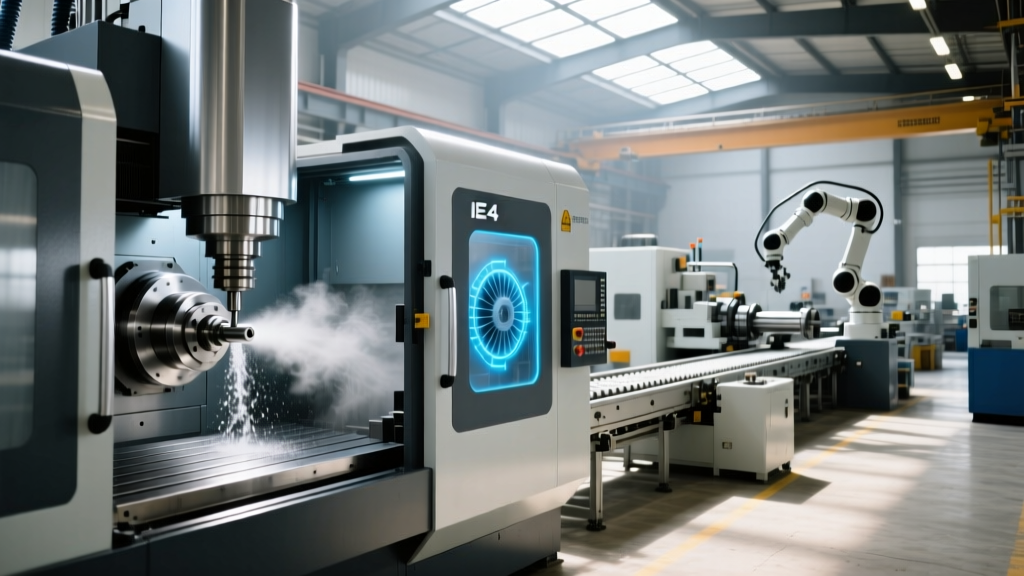
Leading fencing equipment manufacturers now offer options ranging from IE3 (Premium Efficiency) to IE5 (Ultra-Premium Efficiency). According to the U.S. Department of Energy's Advanced Manufacturing Office, upgrading from standard IE2 to IE4 motors in continuous-duty applications reduces electrical losses by up to 20%, which translates to massive savings in high-friction wire drawing.
| Motor Class | Typical Efficiency (at 75% Load) | Upfront Cost Premium | ROI Timeline (3-Shift Plant) | Best Application in Fencing |
|---|---|---|---|---|
| IE3 (Premium) | 94.5% | Baseline | N/A | Intermittent take-up spoolers |
| IE4 (Super Premium) | 96.0% | +15% to 20% | 14 - 18 Months | Main capstan drives, continuous drawing |
| IE5 (Ultra Premium) | 97.2% | +35% to 45% | 24 - 30 Months | High-torque primary payoff stands |
Buyer's Insight: While IE5 synchronous reluctance motors offer the highest efficiency, their complex variable frequency drive (VFD) requirements can complicate maintenance. For 90% of chain-link and welded mesh producers, specifying IE4 induction motors paired with regenerative VFDs on the capstans provides the optimal balance of CapEx and operational expenditure (OpEx).
Thermal Management in Coating and Extrusion
Fencing products require corrosion resistance, achieved either through hot-dip galvanizing or PVC powder coating. Both processes demand intense thermal energy, and the efficiency ratings of the heating elements vary drastically between manufacturers.
PVC Extrusion: Ceramic IR vs. Mica Band Heaters
When applying PVC to chain-link wire, the extruder barrel must maintain a precise 185°C to 210°C. Older or budget-tier fencing equipment manufacturers still utilize mica band heaters, which suffer from high thermal radiation loss and slow response times. Top-tier OEMs have transitioned to Ceramic Infrared (IR) Band Heaters.
- Mica Band Heaters: 60-65% thermal transfer efficiency. High ambient heat loss increases factory HVAC loads.
- Ceramic IR Heaters: 85-90% thermal transfer efficiency. Direct radiant heat penetrates the barrel wall, reducing warm-up times by 35% and lowering steady-state power draw by 25%.
Hot-Dip Galvanizing: Induction vs. Gas-Fired Pots
For agricultural and security fencing requiring zinc coating, the galvanizing kettle is a massive energy sink. Modern OEMs are replacing traditional gas-fired kettles with Coreless Induction Heating Systems. While an induction zinc pot requires a higher initial electrical infrastructure investment (often necessitating a dedicated 2000A transformer feed), it operates at 85% thermal efficiency compared to the 45-55% efficiency of natural gas burners, completely eliminating localized overheating that degrades the kettle walls.
Regenerative Braking and Servo-Driven Welding
Welded mesh production relies on multi-spot pneumatic or servo-driven welders. A standard 24-head mesh welder operating at 60 cycles per minute requires immense bursts of power, followed by rapid deceleration of the wire feed mechanisms.
Advanced fencing equipment manufacturers now integrate Regenerative Braking Systems into the wire feed servos and take-up spoolers. When the take-up spooler decelerates to swap a finished 2-ton coil, the kinetic energy is converted back into electrical energy and fed into the plant's internal microgrid or shared DC bus, rather than being dissipated as waste heat through braking resistors.
'In a high-speed welded mesh line producing 3mm x 3mm grids, implementing a shared DC bus with regenerative braking on the payoff and take-up stands reduces the line's net electrical consumption by 11% to 14%. The energy recaptured during deceleration is instantly reused by the weld transformers during the next acceleration phase.'
— 2025 Industrial Wire Machinery Energy Report
Furthermore, transitioning from pneumatic weld heads to servo-driven mechanical weld heads eliminates the need for massive industrial air compressors. Compressed air is notoriously inefficient, with only 10% of the electrical energy used to generate it actually performing work at the weld head. Servo-driven heads reduce total line energy consumption by up to 18%.
The Buyer’s Evaluation Matrix: Auditing OEM Claims
When reviewing proposals from fencing equipment manufacturers, use this decision matrix to separate marketing claims from verifiable engineering data. Ensure your procurement contracts include performance guarantees tied to these specific metrics.
Procurement Checklist for Energy Efficiency
- Motor Nameplates: Verify IEC 60034-30-1 certification for IE4 or higher on all continuous-duty drives.
- Weld Transformer Duty Cycle: Demand MFDC (Medium Frequency Direct Current) weld transformers over traditional AC. MFDC reduces peak kVA demand by 30%, lowering utility demand charges.
- Thermal Insulation Specs: Require OEMs to specify the R-value or thermal conductivity of the insulation used on PVC extruder barrels and annealing furnaces.
- Software Telemetry: The HMI (Human-Machine Interface) must include real-time kWh/ton tracking dashboards. If the machine cannot report its own specific energy consumption, it is not a modern, efficient system.
Verifying Compliance and Financial Modeling
To ensure that the equipment you purchase aligns with global sustainability standards and qualifies for local energy rebates, verify that the manufacturer's facility and testing protocols adhere to ISO 50001 Energy Management Systems. OEMs certified to this standard are required to continuously monitor and improve the energy performance of the machinery they design, providing you with audited, reliable SEC data.
2026 ROI Calculation Example
Consider a plant upgrading a 15-draft wire drawing line. The older line draws 380 kW continuously. A new line from a top-tier manufacturer, equipped with IE4 motors, regenerative VFDs, and optimized gearboxes, draws 320 kW under the same load.
- Power Savings: 60 kW continuous
- Annual Operating Hours: 6,500 hours (roughly 2.5 shifts, 5 days/week)
- Total Annual kWh Saved: 390,000 kWh
- 2026 Average Industrial Rate: $0.15 / kWh
- Annual Financial Savings: $58,500
If the energy-efficient drivetrain package costs a $75,000 premium over the base model, the simple payback period is just 15.3 months. After year two, that $58,500 drops directly to the bottom line, completely insulating the fencing manufacturer from future utility rate hikes.
Final Specifications for the Modern Fencing Plant
Do not accept generic power ratings from fencing equipment manufacturers. Demand granular data on motor slip, thermal transfer efficiency, and regenerative capabilities. By mandating IE4 motors, MFDC welding, ceramic IR heating, and shared DC bus architectures, plant managers can reduce the carbon footprint of their fencing operations while securing a distinct cost advantage in a highly competitive building materials market.