Extrusion Downstream Equipment Manufacturers: Energy Ratings
Compare energy efficiency ratings from top extrusion downstream equipment manufacturers. Learn to evaluate IE4/IE5 motors, VFDs, and SEC metrics for 2026.
Downstream equipment accounts for up to 35% of a plastic extrusion line's total energy footprint, yet it rarely receives the engineering scrutiny applied to the main extruder barrel heaters and primary drive motors. When evaluating extrusion downstream equipment manufacturers in 2026, procurement teams must look beyond the base price of cooling tanks, haul-offs, and cutters. The true cost of ownership is dictated by how these manufacturers engineer for energy efficiency, manage parasitic loads, and integrate smart motor controls.
This guide decodes the energy efficiency ratings, motor standards, and system-level metrics you need to evaluate when selecting downstream extrusion equipment, ensuring your production line meets modern sustainability and operational cost targets.
The Hidden Energy Drain in Downstream Extrusion
The extrusion process does not end at the die. Downstream operations—specifically vacuum calibration, cooling, pulling, and cutting—are continuous, high-duty-cycle processes. A standard 20-foot stainless steel vacuum calibration tank, for instance, requires a 5 HP to 10 HP water circulation pump and a 3 HP to 7.5 HP liquid ring vacuum pump. If these pumps operate at full speed 24/7 using manual throttling valves rather than Variable Frequency Drives (VFDs), the line wastes thousands of kilowatt-hours annually.
Similarly, traditional pneumatic planetary saws used for pipe cutting rely on plant-wide compressed air systems. Compressed air is notoriously inefficient, costing roughly $0.30 to $0.50 per 1,000 cubic feet generated. Leading extrusion downstream equipment manufacturers have shifted toward all-electric servo-driven cutters to eliminate this parasitic pneumatic load entirely.
Decoding Motor Efficiency Standards: IE3 vs. IE4 vs. IE5
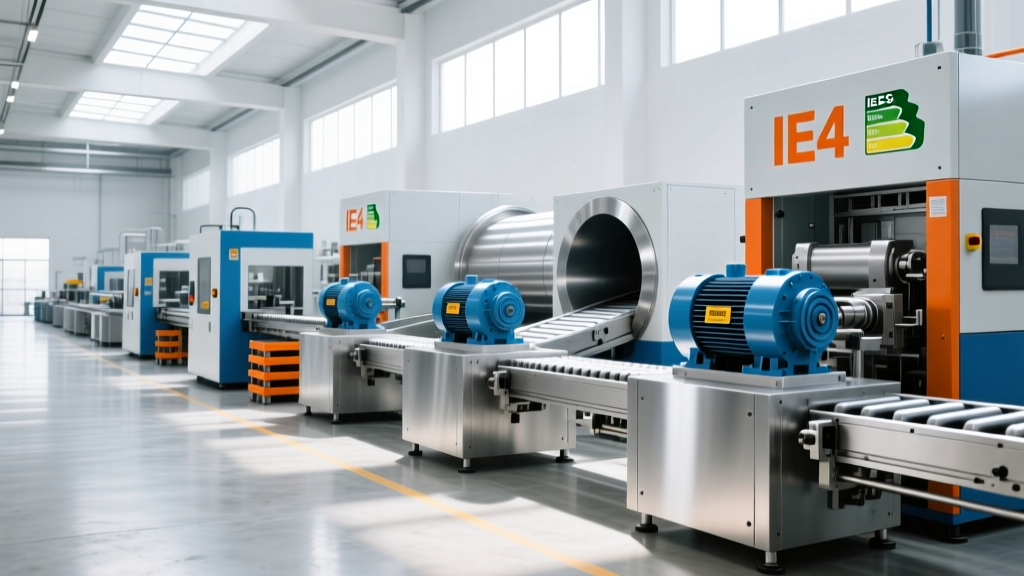
The International Electrotechnical Commission (IEC) standard 60034-30-1 defines the efficiency classes for line-operated AC motors. While IE3 (Premium Efficiency) remains the legal minimum in many jurisdictions, top-tier manufacturers are now standardizing IE4 (Super Premium) and IE5 (Ultra Premium) for haul-off crawlers and high-torque pullers.
| IEC Class | Efficiency Rating | Motor Technology | Best Downstream Application |
|---|---|---|---|
| IE3 | Premium (Baseline) | Standard Induction (Squirrel Cage) | Conveyor belts, low-load scrap grinders |
| IE4 | Super Premium | Advanced Induction / Early Synchronous | Water pumps, vacuum pumps, standard haul-offs |
| IE5 | Ultra Premium | Permanent Magnet (PMSM) / Synchronous Reluctance | High-torque multi-track haul-offs, servo cutters |
According to the U.S. Department of Energy's Advanced Manufacturing Office, upgrading from an IE3 to an IE5 permanent magnet motor in a continuous-duty haul-off application can reduce motor energy losses by up to 40%. For a 15 kW haul-off running 6,000 hours a year, this translates to direct savings of over $1,200 annually per motor, yielding an ROI of under 18 months.
Real-World Cost Impact: Pneumatic vs. Servo Cutters
Data Highlight: The Servo Cutter AdvantageA mid-sized HDPE pipe manufacturer replaced three pneumatic planetary saws with Sica-style all-electric servo cutters. The elimination of the dedicated 50 HP rotary screw air compressor required to run the pneumatic cylinders reduced the downstream cutting energy consumption by 82%. The capital premium for the servo units was recovered in 14 months through energy savings and reduced maintenance on air seals and filters.
Evaluating Manufacturer Energy Claims (The BS Filter)
When reviewing proposals from extrusion downstream equipment manufacturers, beware of 'greenwashing'—where a vendor highlights an IE4 motor but pairs it with a poorly designed, high-friction gearbox that negates the electrical gains. True energy efficiency must be measured at the system level, not just the component level.
The International Electrotechnical Commission (IEC) emphasizes that extended product systems (motor + driven equipment) must be evaluated together. A high-efficiency water pump is useless if the downstream cooling tank features restrictive plumbing, sharp 90-degree elbows, and undersized return lines that force the pump to work against excessive static head pressure.
Warning: The VFD IllusionSome manufacturers claim energy savings by simply slapping a VFD onto an existing standard AC motor. If the motor is not specifically rated for inverter duty (e.g., lacking insulated bearings and a VFD-rated cooling fan), running it at low speeds will cause the shaft-mounted cooling fan to fail, leading to premature motor burnout. Always verify that the motor nameplate explicitly states 'Inverter Duty' or 'VFD Rated' when a VFD is included in the downstream package.
Top Extrusion Downstream Equipment Manufacturers & 2026 Energy Tech
Market leaders are differentiating themselves through integrated, closed-loop energy management systems rather than isolated component upgrades.
- Conair: Known for their central cooling and vacuum systems, Conair's latest SmartVacuum technology utilizes centralized liquid ring vacuum pumps equipped with automated VFDs. Instead of running individual vacuum pumps per tank at 100% capacity, the central system modulates pump speed based on real-time pressure transducers in the calibration tanks, reducing vacuum energy use by up to 35%.
- Sica: A pioneer in downstream pipe extrusion, Sica's servo-driven planetary saws and belling machines eliminate pneumatic dependencies. Their proprietary motion control algorithms optimize the acceleration and deceleration curves of the cutting carriage, minimizing peak current draw and reducing overall specific energy consumption (SEC) during the cutting cycle.
- Davis-Standard: Their downstream cooling tanks feature advanced water-flow management. By utilizing computational fluid dynamics (CFD) to design internal spray nozzle arrays, they achieve faster profile cooling with lower water flow rates, allowing for the use of smaller, lower-horsepower circulation pumps without sacrificing line speed.
The Buyer’s Matrix: Scoring Downstream Equipment for Energy ROI
Use this weighted matrix when comparing bids from different extrusion downstream equipment manufacturers. Do not accept vague promises of 'high efficiency'; require quantifiable data.
| Evaluation Criteria | Weight | What to Look For (Green Flags) | Red Flags to Reject |
|---|---|---|---|
| Drive Motor Efficiency | 30% | IE4 or IE5 Permanent Magnet motors standard on all haul-offs. | IE2 motors, or IE3 motors without VFD integration. |
| Pump & Fluid Management | 25% | VFD-controlled vacuum and water pumps; CFD-optimized tank internals. | Manual throttling valves; fixed-speed pumps; restrictive internal piping. |
| Cutting & Belling Tech | 20% | All-electric servo actuators; regenerative braking on heavy carriages. | Heavy reliance on plant compressed air; oversized pneumatic cylinders. |
| Controls & Telemetry | 15% | Integrated power meters on the HMI; SEC (kWh/kg) calculation dashboards. | No energy monitoring; requires third-party power analyzers to track use. |
| Thermal Insulation | 10% | Insulated water tanks for hot-water belling operations to prevent heat loss. | Uninsulated stainless steel tanks in hot-water belling stations. |
Required RFP Questions for Manufacturers
To force vendors to provide actionable data rather than marketing fluff, include these exact technical questions in your Request for Proposal:
- 'Provide the Specific Energy Consumption (SEC) in kWh/kg for the haul-off unit operating at 80% nominal line speed with a standard HDPE pipe profile, inclusive of all auxiliary drives and controls.'
- 'Specify the IP rating and inverter duty classification (e.g., VFD-rated with insulated bearings) of the cooling fan on the main tractor drive motor.'
- 'Do the vacuum calibration tanks utilize integrated VFDs on the liquid ring pumps, and what is the turndown ratio of the vacuum control system?'
- 'For the planetary saw, quantify the peak kW draw during the acceleration phase of the cutting carriage and confirm if regenerative braking is utilized to feed power back to the DC bus.'
Selecting the right downstream equipment requires a shift in perspective. By prioritizing system-level energy ratings, demanding IE4/IE5 motor architectures, and eliminating pneumatic dependencies, manufacturing engineers can drastically reduce the operational overhead of their extrusion lines. The initial capital premium for advanced, energy-optimized downstream equipment is consistently offset by the compounding energy savings realized over the first 24 months of continuous operation.