Plastic Manufacturing Battery Equipment Costs
Analyze 2026 CapEx and OpEx for custom plastic manufacturing for battery equipment. Extrusion, molding, and tooling costs.
Custom plastic manufacturing for battery equipment typically requires $15,000 to $85,000 for initial steel tooling, with per-part production costs ranging from $0.45 to $12.50 depending on polymer grade and geometric complexity. This analysis is specifically written for electric vehicle (EV) battery procurement managers, hardware engineers, and energy storage system designers who need to budget and source custom plastic casings, connectors, and insulation components for 2026 battery architectures.
Key Takeaways
- Tooling Costs: Hardened steel molds for battery casings range from $15,000 to $85,000 based on cavity count and cooling complexity.
- Per-Part Costs: High-volume injection molded components cost between $0.45 and $12.50 each.
- Material Requirements: Polymers must meet Underwriters Laboratories (UL) 94 V-0 flammability ratings and withstand continuous thermal loads.
- Next Step: Conduct a Design for Manufacturability (DFM) review to optimize wall thickness and reduce cycle times.
Material Selection for Battery Equipment Plastics
Battery environments demand polymers that resist thermal runaway, chemical off-gassing, and high-voltage arcing. Selecting the correct resin directly impacts both the safety certification timeline and the final piece price.
Flame-Retardant Polycarbonate Blends
Polycarbonate and Acrylonitrile Butadiene Styrene (PC/ABS) blends are the industry standard for structural battery module housings. These blends offer high impact resistance and can be compounded with halogen-free flame retardants. To achieve the mandatory Underwriters Laboratories (UL) 94 V-0 flammability rating, manufacturers typically add 15% to 30% glass fiber reinforcement. This reinforcement increases the material cost by approximately $1.20 per kilogram but reduces molding cycle times by improving thermal conductivity.
High-Temperature Thermoplastics
Polyether ether ketone (PEEK) is a high-performance, semi-crystalline thermoplastic known for exceptional thermal stability, mechanical strength, and chemical resistance. Engineers specify PEEK for high-voltage battery insulation components because it maintains structural integrity at continuous operating temperatures exceeding 250 degrees Celsius. While PEEK resin costs upwards of $90.00 per kilogram, its use is restricted to critical internal insulators where standard polycarbonates would melt during a thermal event.
Manufacturing Processes and Associated Costs
The chosen manufacturing method dictates the upfront capital expenditure and the scalability of the production run. Battery equipment manufacturers primarily rely on two high-volume processes.
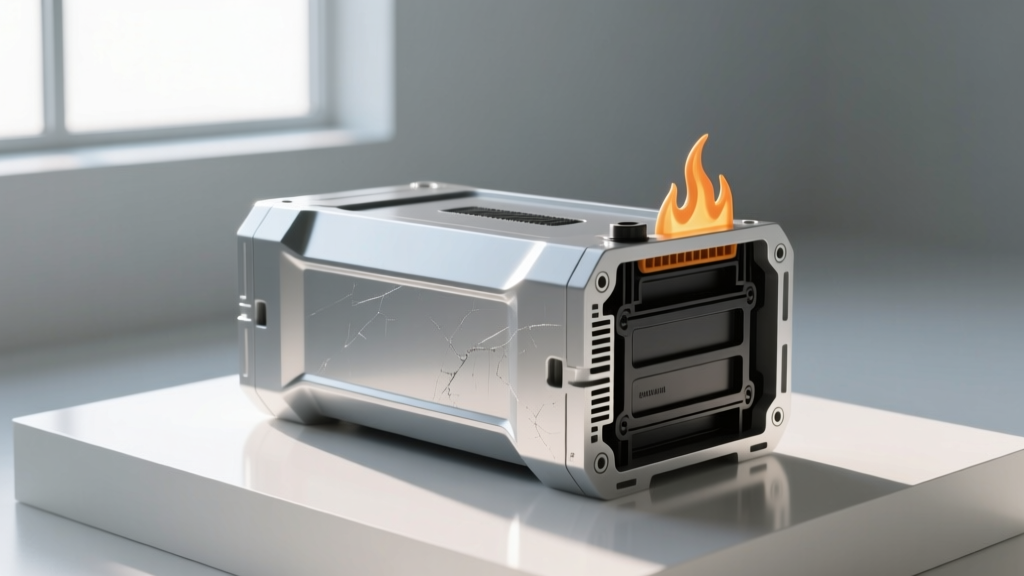
Injection Molding for Casings and Connectors
Injection molding is the dominant process for producing complex, three-dimensional battery casings and high-voltage connectors. The process requires CNC-machined hardened steel molds. A single-cavity mold for a standard 400-volt EV battery end-plate costs approximately $18,000. Multi-cavity molds designed for high-volume connector production can reach $85,000. Once the tool is built, the per-part cost drops significantly, with cycle times averaging 45 to 60 seconds per shot.
Extrusion for Separators and Edge Insulation
Profile extrusion is utilized for continuous, uniform cross-section parts such as battery cell spacers and edge protectors. Tooling for extrusion dies is substantially cheaper, typically ranging from $2,500 to $6,000. The continuous nature of extrusion allows for production speeds of up to 30 meters per minute, making it highly cost-effective for linear insulation components.
2026 Cost Breakdown and Decision Framework
Procurement teams must evaluate manufacturing methods against production volume and geometric complexity. The following comparison matrix outlines the financial and technical parameters for custom plastic battery components.
| Manufacturing Process | Initial Tooling Cost | Per-Part Cost (at 50k units) | Best Application |
|---|---|---|---|
| Injection Molding | $15,000 - $85,000 | $0.45 - $12.50 | Complex casings, structural end-plates, high-voltage connectors |
| Profile Extrusion | $2,500 - $6,000 | $0.15 - $1.80 per meter | Cell spacers, edge insulation, continuous thermal barriers |
| Industrial 3D Printing (SLS) | $0 (No tooling) | $25.00 - $150.00 | Pre-production prototyping, custom low-volume test fixtures |
According to United States Department of Energy (DOE) battery lifecycle research, optimizing plastic component weight through advanced molding techniques directly improves overall vehicle range. Utilizing gas-assisted injection molding can reduce the weight of structural battery housings by 20% without sacrificing rigidity, directly impacting the energy density metrics of the final battery pack.
Frequently Asked Questions
What plastics are used in lithium-ion battery equipment?
Lithium-ion battery equipment primarily utilizes flame-retardant Polycarbonate/Acrylonitrile Butadiene Styrene (PC/ABS) blends for outer casings and structural modules. For internal high-temperature insulation, engineers rely on Polyether ether ketone (PEEK) and Polyphenylene sulfide (PPS) due to their exceptional thermal stability and dielectric strength.
How much does custom tooling cost for EV battery casings?
Custom hardened steel tooling for electric vehicle battery casings typically costs between $25,000 and $85,000. The final price depends on the physical dimensions of the casing, the number of mold cavities required to meet production quotas, and the complexity of the internal cooling channels needed to manage the heat generated by thick-walled flame-retardant resins.
What are the safety standards for plastic battery components?
Plastic components in battery systems must comply with stringent flammability and electrical insulation standards. The most critical benchmark is the Underwriters Laboratories (UL) 94 V-0 rating, which ensures the plastic self-extinguishes within 10 seconds after the ignition source is removed. Additionally, materials must pass specific dielectric breakdown voltage tests to prevent high-voltage arcing.
Conclusion and Next Steps
Custom plastic manufacturing for battery equipment requires balancing upfront tooling investments with stringent thermal and flammability requirements. While initial mold costs can reach $85,000 for complex geometries, the resulting per-part economics and safety compliance justify the expenditure for high-volume production. To move forward, compile your 3D CAD files and request a Design for Manufacturability (DFM) assessment from a certified injection molding partner to validate your specific tooling geometry and finalize your per-part cost projections.