CE, UL, and CSA Compliance for Confectionery Equipment Manufacturers
How confectionery equipment manufacturers navigate CE, UL, and CSA marks. Real costs, EN 1672-2 hygiene standards, and UL 508A case studies.
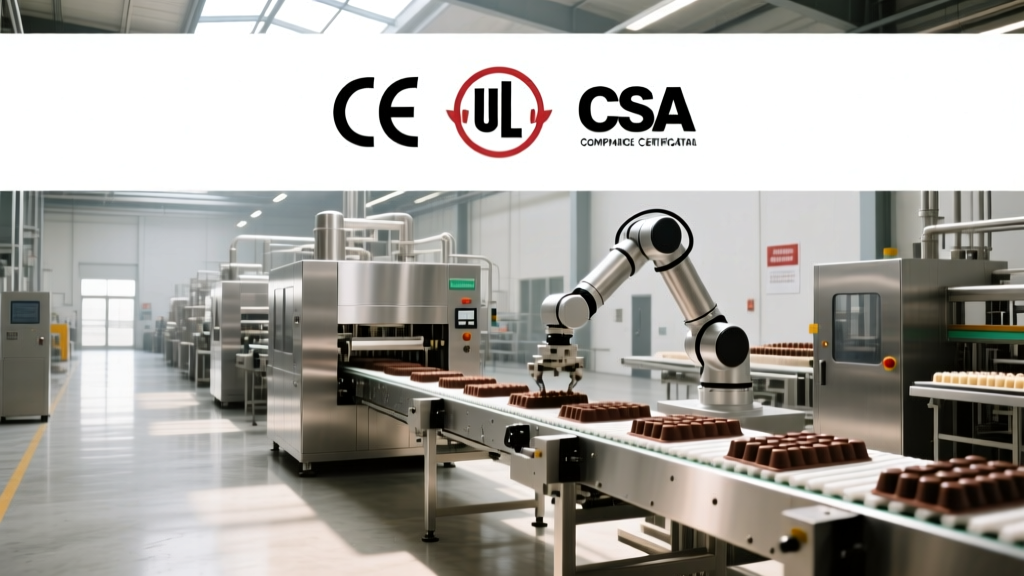
For confectionery equipment manufacturers, the gap between mechanical design and regulatory compliance is where profit margins disappear. Building a continuous chocolate enrober or a high-speed gummy depositor requires mastering fluid dynamics, thermodynamics, and sanitary design. However, shipping that machinery across international borders introduces a rigid matrix of safety certifications: the CE mark for Europe, UL for the United States, and CSA for Canada.
Navigating these marks is not merely a paperwork exercise. It dictates component selection, control panel architecture, and machine guarding geometry. This guide dissects the exact compliance frameworks, real-world retrofit costs, and combustible dust considerations that OEMs must engineer into their confectionery lines from day one.
Warning: The 'Self-Certification' TrapMany OEMs assume the CE mark is a simple self-declaration process. While the EU Commission Machinery Directive allows self-declaration for many food machines, if your equipment incorporates high-speed rotary cutters or specialized pressing mechanisms that fall under Annex IV, third-party Notified Body review is legally mandatory. Falsely self-certifying Annex IV machinery results in immediate border impoundment and fines exceeding €50,000.
The Compliance Matrix: CE vs. UL vs. CSA
Understanding the jurisdictional boundaries of each mark prevents redundant testing and wasted engineering hours. The OSHA Nationally Recognized Testing Laboratory (NRTL) program mandates specific marks for US workplaces, while Canada requires SCC-accredited marks.
| Mark | Jurisdiction | Primary Standard (Food/Elec) | Average Timeline | Estimated Base Cost |
|---|---|---|---|---|
| CE | EU / EEA | EN 1672-2 / EN ISO 12100 | 8 - 14 weeks | $8,000 - $18,000 |
| UL | United States | UL 508A / NFPA 79 | 12 - 20 weeks | $15,000 - $30,000 |
| CSA | Canada | CSA C22.2 No. 14 / 300 | 10 - 16 weeks | $12,000 - $25,000 |
| cULus | US & Canada | Dual Harmonized Standards | 14 - 24 weeks | $20,000 - $40,000 |
EN 1672-2 and the Hygiene-Safety Paradox
In confectionery manufacturing, safety guards and sanitary design are often at odds. EN 1672-2 (Food processing machinery - Basic concepts - Part 2: Hygiene requirements) mandates that machinery must be cleanable, prevent microbial harborage, and resist corrosion. However, physical safety guards required by EN ISO 12100 can create crevices where sugar dust and chocolate residue accumulate.
Case Study 1: The $45,000 Enrober Guarding Retrofit
A mid-sized European OEM designed a continuous chocolate enrobing line with polycarbonate tunnel guards to contain heat and prevent operator contact with the wire-mesh belt. During the CE technical file review, the Notified Body flagged the guards: the overlapping polycarbonate sheets created a 3mm gap, violating EN 1672-2's requirement that joints must be continuous or sealed to prevent biological contamination.
The Fix: The OEM had to redesign the guards using single-piece, thermoformed PETG with IP69K-rated magnetic safety interlocks (Schmersal MZM series). The redesign, new tooling, and re-validation cost €41,500 and delayed shipment by 11 weeks. Information Gain: Always specify IP69K-rated, flush-mounted magnetic interlocks for washdown zones on enrobers and tempering machines to satisfy both safety and hygiene auditors simultaneously.
UL 508A and the Combustible Dust Trap
For confectionery equipment manufacturers exporting to North America, the electrical control panel is the most frequent point of failure. UL 508A covers Industrial Control Panels, but it does not account for the environment in which the panel operates. Sugar, cocoa powder, and cornstarch are highly combustible dusts.
"A UL 508A listed panel installed in a Class II, Division 1 sugar sifting area without proper purging or pressurization is a code violation. The UL mark applies to the panel's construction, not its suitability for a hazardous location."
— Senior Field Engineer, Industrial Automation Safety
According to NFPA 79: Electrical Standard for Industrial Machinery and NEC Article 502, control panels located in areas where combustible dust is present must be NEMA 12 (dust-tight) at a minimum, or NEMA 8 (purged and pressurized) if located in the direct hazard zone.
Top 3 UL 508A Failures in Gummy Depositor Lines
- Undersized Short Circuit Current Rating (SCCR): OEMs frequently use standard motor starters without calculating the available fault current of the client's facility. If a facility has 65kA available fault current and the panel is only rated for 10kA, the UL inspector will red-tag the machine upon startup.
- Non-Listed Components: Using cheap, non-UL-recognized terminal blocks or relays voids the entire panel's UL 508A listing. Every component inside the enclosure must have a UL Recognized Component (UR) mark.
- Improper Wire Bending Space: UL 508A Table 13.4 dictates exact millimeter requirements for wire bending space inside the enclosure. Overcrowding a 400x400mm enclosure with VFDs and PLCs routinely results in failed inspections.
Case Study 2: Dual-Marking a Starch Mogul Line for Canada
An OEM building a starch mogul line for a Canadian gummy manufacturer opted for a standard UL mark, assuming it would be accepted in Ontario. The local Electrical Safety Authority (ESA) halted the installation because the machine lacked the 'c' prefix (cUL or CSA), indicating Canadian electrical code compliance (specifically regarding 600V vs 480V three-phase configurations and specific grounding requirements).
The OEM had to fly a UL field inspector to the Canadian facility for a Field Evaluation, costing $4,800 in travel and inspection fees, plus $12,000 in emergency panel rewiring to meet CSA C22.2 standards. Actionable Advice: Always specify cULus dual certification at the design phase if the end-user is in North America; the incremental design cost is less than 5% of a field retrofit.
Budgeting for Certification: Real-World Cost Breakdown
Confectionery equipment manufacturers must line-item compliance costs accurately. Below is a realistic budget framework for a mid-sized, automated production line (e.g., a continuous aerator or cooling tunnel) requiring global compliance.
| Expense Category | CE (Europe) | cULus (North America) |
|---|---|---|
| Risk Assessment & Tech File Compilation | $6,000 - $10,000 | $4,000 - $8,000 |
| Third-Party Testing / Notified Body Fees | $5,000 - $15,000 | $12,000 - $25,000 |
| Component Upgrades (IP69K, UR listed) | $2,500 - $6,000 | $4,000 - $9,000 |
| Annual Factory Follow-Up Audits | $0 (Self-declared) | $3,500 - $6,000 / year |
| Total First-Year Estimated Burden | $13,500 - $31,000 | $23,500 - $48,000 |
Step-by-Step Compliance Integration Framework
To prevent margin erosion, integrate compliance into the CAD and procurement phases using this sequence:
- Phase 1: Hazard & Dust Classification (Weeks 1-2): Map the machine into zones. Identify where sugar dust accumulation exceeds 1/32 inch (the NFPA threshold for hazard classification). Specify NEMA 12 or NEMA 8 enclosures for these zones immediately.
- Phase 2: SCCR Calculation (Week 3): Use the IEEE 1584 or UL 508A SB101 method to calculate the panel's Short Circuit Current Rating. Target a minimum 65kA rating to ensure compatibility with 95% of North American food processing facilities.
- Phase 3: Sanitary Guarding Design (Weeks 4-6): Design physical guards using 304-grade stainless steel with a minimum 18/8 chromium-nickel ratio. Ensure all welds are continuous and ground to a 32 Ra micro-inch finish to meet EHEDG and 3-A sanitary principles, preventing Listeria harborage while satisfying mechanical safety directives.
- Phase 4: BOM Lock & UR Verification (Week 8): Before issuing the Bill of Materials to procurement, run every electrical component through the UL Product iQ database. Reject any motor contactor, VFD, or terminal block that lacks a recognized component file number.
For confectionery equipment manufacturers, treating CE, UL, and CSA marks as an afterthought guarantees expensive delays, failed site acceptances, and compromised sanitary environments. By engineering to EN 1672-2 and UL 508A simultaneously, OEMs can build machinery that is legally compliant, electrically safe, and biologically secure from the first day of production.