How China Gym Equipment Manufacturers Use Modular Production Lines
Discover how China gym equipment manufacturers leverage modular manufacturing equipment for flexible production to scale custom fitness gear efficiently.
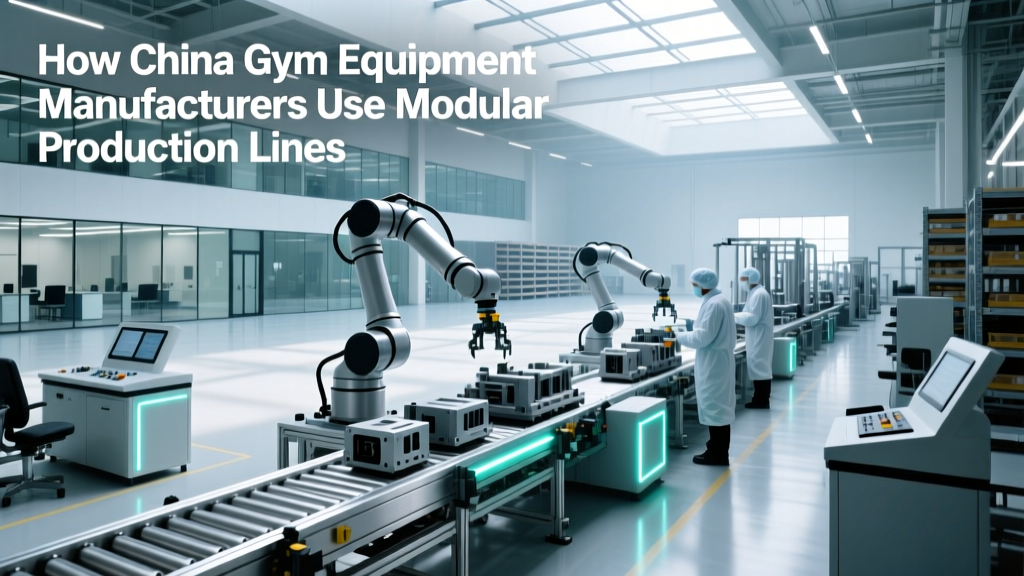
The global fitness equipment market demands unprecedented customization. Commercial gym owners require specific pulley ratios and heavy-duty 7-gauge steel frames, while home-gym buyers need compact, adjustable footprints with 11-gauge tubing. To meet these divergent requirements without destroying margins, China gym equipment manufacturers have largely abandoned rigid, dedicated assembly lines. Instead, they are deploying modular manufacturing equipment for flexible production, allowing factories in Shandong and Guangdong provinces to switch from welding commercial power racks to assembling residential adjustable benches in under 20 minutes.
The Shift to High-Mix, Low-Volume Fitness Manufacturing
Historically, fitness equipment manufacturing relied on high-volume, low-mix production runs. A single factory would dedicate three months to producing one model of a lat pulldown machine. In 2026, the dominance of direct-to-consumer fitness brands and the rapid iteration of commercial gym layouts require high-mix, low-volume (HMLV) agility. According to frameworks outlined by NIST Advanced Manufacturing, flexible manufacturing systems (FMS) are critical for reducing work-in-progress (WIP) inventory and minimizing changeover downtime in HMLV environments.
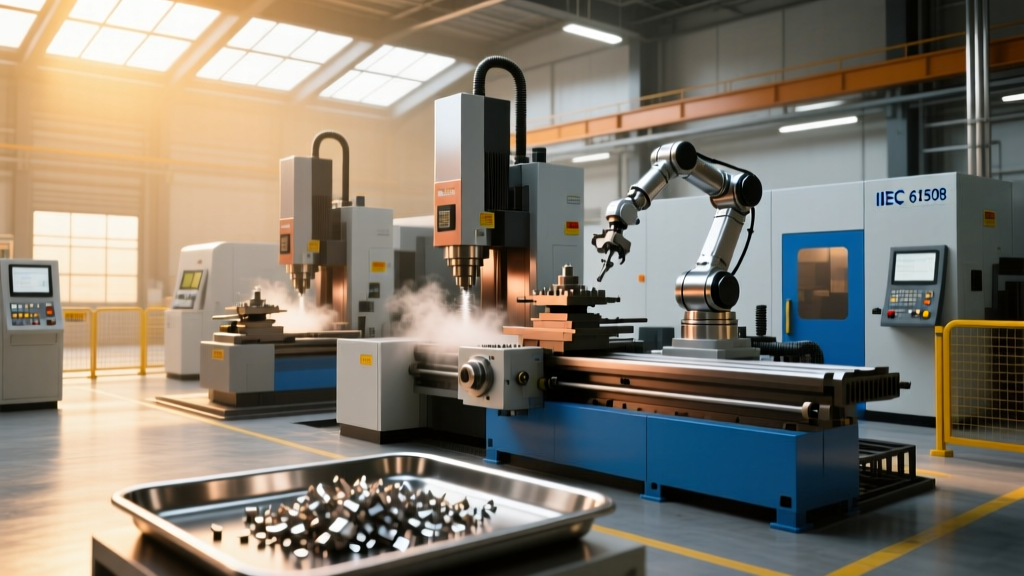
For Chinese OEMs producing functional trainers, cable crossovers, and plate-loaded machines, modular manufacturing equipment provides the exact mechanism needed to achieve this agility. By utilizing quick-change tooling, standardized pallet systems, and software-driven machine parameters, these manufacturers maintain the low unit costs associated with mass production while offering the variety of a custom job shop.
2026 Flexibility Benchmark: Tier-1 Chinese fitness OEMs now target an Overall Equipment Effectiveness (OEE) of 85% on mixed-model runs, with physical changeover times capped at 18 minutes per manufacturing cell.Core Modular Technologies Powering Chinese Fitness OEMs
The transition to flexible production relies on three primary categories of modular manufacturing equipment, each addressing a specific bottleneck in gym equipment fabrication.
1. Modular Tube Laser Cutting Systems
Gym equipment relies heavily on structural tubing, particularly 3x3-inch and 2x3-inch 11-gauge steel. Traditional saw-and-drill methods require hours of physical fixture changes and deburring. Modern Chinese OEMs deploy modular tube laser systems, such as those featured in BLM GROUP tube laser technologies. These systems utilize automated loading magazines and software-driven chuck jaws that automatically adjust to square, round, or elliptical profiles. The cutting head reads a barcode on the raw material bundle and instantly loads the correct CNC program, eliminating manual tooling swaps entirely.
2. Quick-Change Robotic Welding Cells
Welding is the most labor-intensive and quality-critical step in power rack and machine frame production. Flexible welding cells utilize robotic arms, such as the FANUC ARC Mate series, paired with servo-driven positioners. The true modularity lies in the fixturing. Instead of welding a dedicated jig to the positioner table, manufacturers use standardized T-slot tables with magnetic or pneumatic quick-release clamps. When the production schedule shifts from a leg press frame to a Smith machine carriage, the operator unclamps the old fixture and drops in the new one, while the robot controller automatically switches the weld schedule via a single PLC input.
3. Decentralized PLC and Conveyor Routing
Rigid conveyors force a single routing path. Modular production lines use autonomous mobile robots (AMRs) and decentralized motorized rollers controlled by modular PLCs like the Siemens SIMATIC S7-1500. If a specific cable crossover station requires an extra step for custom upholstery bracket attachment, the AMR simply routes the sub-assembly to a specialized side-station before returning to the main assembly flow.
Comparison Matrix: Traditional Fixed Lines vs. Modular Flexible Cells
| Metric | Traditional Fixed Line | Modular Flexible Cell |
|---|---|---|
| Changeover Time (Model A to B) | 3 to 5 hours | 12 to 25 minutes |
| Minimum Economic Batch Size | 500+ units | 15 to 50 units |
| Floor Space Utilization | Low (dedicated dead space) | High (reconfigurable footprint) |
| Capital Expenditure (Initial) | Lower (manual jigs) | Higher (robotics/sensors) |
| Scalability to New Products | Requires new line build | Requires only new software/fixtures |
Real-World Implementation: Building a Modular Cable Crossover Line
To understand how China gym equipment manufacturers execute this in practice, consider the production of a dual-adjustable pulley (DAP) cable crossover machine. This equipment requires precise tube bending, complex welding for the weight stack carriages, and intricate cable routing.
Step 1: Flexible Tube Processing
The production begins with a modular laser-tube combo cell. Raw 11-gauge 2x3 steel tubes are loaded into a magazine. The system laser-cuts the main upright holes for the pulley adjustment slots, then immediately passes the tube to an integrated CNC bending module. Because the bending dies are mounted on quick-change cassettes, the machine can switch from bending the 86-inch uprights to the 42-inch cross-members without operator intervention.
Step 2: Palletized Welding and Machining
The cut and bent tubes are placed onto standardized steel pallets equipped with RFID tags. An automated guided vehicle (AGV) moves the pallet to a robotic welding cell. The RFID tag tells the cell's PLC exactly which weld program to execute. After welding, the same pallet moves to a modular CNC milling station that faces off the weight stack guide rod mounting points, ensuring tolerances within 0.05mm to prevent the guide rods from binding during use.
Step 3: Modular Powder Coating and Assembly
Instead of a continuous overhead monorail that requires batching by color, flexible lines use modular batch powder-coating booths. The frames are rolled into a booth where electrostatic bells apply the powder. Color changes are executed in under 90 seconds using automated purge cycles. Finally, assembly workers at modular workstations receive digital work instructions via overhead monitors, which update dynamically based on the specific pulley ratio and weight stack configuration (e.g., 2:1 vs. 4:1 ratio) of the unit on their bench.
Sourcing & Integration Costs for Modular Systems
Upgrading to modular manufacturing equipment for flexible production requires significant upfront capital, but the ROI is realized through the elimination of WIP inventory and the ability to accept smaller, higher-margin custom orders. Below is a typical cost breakdown for a mid-sized Chinese OEM retrofitting a single production cell in 2026.
| Equipment / Integration | Estimated Cost (USD) | Payback Period |
|---|---|---|
| CNC Tube Laser with Auto-Loader | $185,000 - $240,000 | 14 - 18 months |
| Robotic Welding Cell (w/ Quick-Change Table) | $95,000 - $130,000 | 10 - 14 months |
| AGV Routing System & Fleet (3 units) | $60,000 - $85,000 | 18 - 24 months |
| Modular PLC & MES Software Integration | $40,000 - $65,000 | Immediate (Quality/Yield gain) |
Strategic Advantages in the Global Market
The adoption of flexible production lines gives Chinese manufacturers a distinct edge in global supply chains. When a North American fitness brand requests a sudden design change—such as altering the hole spacing on a power rack from the Westside standard (1-inch spacing) to a standard 2-inch spacing halfway through a production run—a modular line can accommodate this via a simple CNC program update. A traditional line would require scrapping partially completed inventory and machining new drill jigs.
Furthermore, modular equipment scales gracefully. If demand for functional trainers spikes, manufacturers can simply duplicate a specific modular welding cell and plug it into the existing AGV routing network, rather than engineering an entirely new linear conveyor system. This plug-and-produce capability ensures that China gym equipment manufacturers remain highly responsive to shifting consumer trends, maintaining their position as the dominant force in global fitness equipment OEM production.