Troubleshooting Cheese Manufacturing Equipment Relocation
Expert troubleshooting guide for relocating and installing cheese manufacturing equipment, covering vat jacket leaks, CIP alignment, and pasteurizer recommissioning.
Relocating heavy dairy processing machinery is a high-stakes engineering challenge. Moving a 15,000-liter GEA Casofill cheese vat, an Alfa Laval pasteurization skid, or a multi-tank CIP (Clean-In-Place) system involves far more than standard rigging. The integration of dimple cooling jackets, precision sanitary piping, and delicate heat exchanger plates means that standard forklift and crane operations frequently induce micro-fractures, alignment shifts, and gasket compression failures. When recommissioning relocated cheese manufacturing equipment, facility engineers must systematically isolate mechanical transport stress from process-flow anomalies to maintain both yield efficiency and sanitary compliance.
Rigging-Induced Micro-Fractures in Vat Dimple Jackets
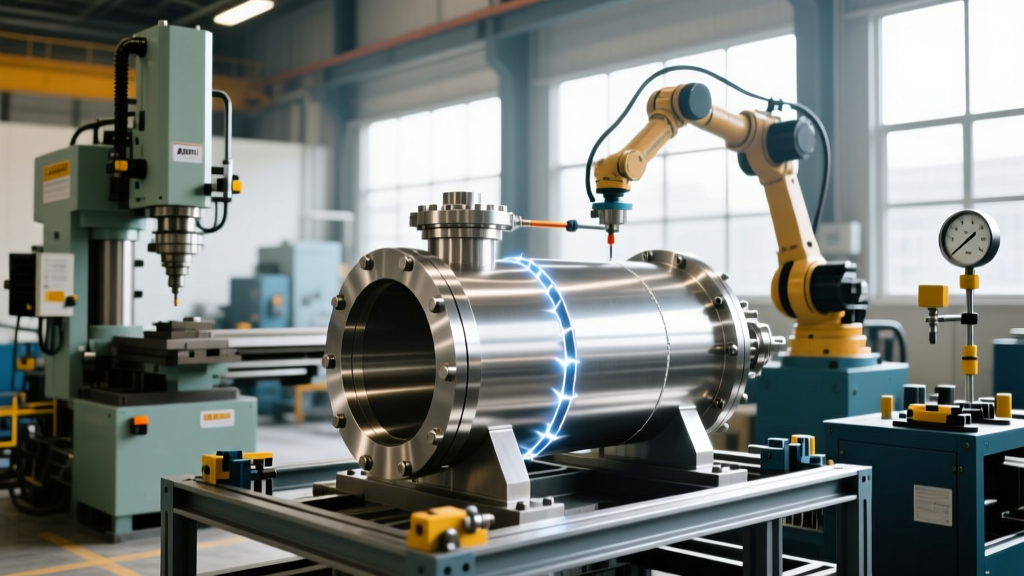
Modern cheese vats rely on dimple or pillow-plate jackets for precise glycol and water cooling during the curd cooking phase. During relocation, improper sling placement or forklift tine pressure against the vat shell transfers kinetic stress directly to the spot-welds of the dimple jacket. Even if the outer shell appears pristine, the internal jacket welds can develop hairline micro-fractures that will leak coolant into the cheese curd once the system is pressurized.
⚠️ CRITICAL WARNING: Never use the vat's external piping, CIP manifolds, or agitator motor mounts as rigging lift points. Doing so will instantly warp the 304L/316L stainless steel shell, voiding sanitary compliance and requiring complete shell re-rolling.Diagnostic Protocol for Jacket Leaks Post-Move
- Dye Penetrant Inspection (DPI): Before applying any hydrostatic pressure, clean the exterior dimple jacket welds with a non-chlorinated solvent. Apply a Type 1 (fluorescent) or Type 2 (visible red) dye penetrant and allow a 15-minute dwell time. Wipe clean and apply the developer. Any red bleeding indicates a compromised spot-weld.
- Hydrostatic Testing: Isolate the jacket from the main glycol chiller loop. Fill the jacket with potable water and pressurize it to 1.5 times its Maximum Allowable Working Pressure (MAWP)—typically around 45 to 60 PSI for standard dairy vats. Hold for 45 minutes while monitoring for pressure drops.
- TIG Weld Repair: If leaks are detected, drain and dry the jacket completely. Repair the micro-fractures using Gas Tungsten Arc Welding (GTAW/TIG) with ER308L or ER316L filler wire, depending on the base metal. Post-weld, the area must be passivated with a nitric/hydrofluoric acid blend to restore the chromium oxide layer and prevent localized crevice corrosion.
CIP Piping Sag and Spray Ball Shadowing
Relocating CIP skids and supply piping often results in subtle pitch changes. Sanitary dairy piping must be self-draining, requiring a minimum slope of 1/4 inch per foot (2%). If the new facility floor is uneven and the piping supports were not laser-leveled during installation, low spots will trap caustic chemicals and rinse water, leading to severe cross-contamination and off-flavors in the final cheese product.
| Symptom | Root Cause Post-Relocation | Engineering Fix |
|---|---|---|
| Low flow alarm at CIP return pump | Piping sag creating an airlock or vacuum break failure in the return line. | Re-map piping pitch with a rotary laser level. Install automatic sanitary air-release valves at all newly identified high points. |
| Inadequate soil removal on vat walls | Spray ball shadowing caused by misaligned drop-tubes or bent rotary jet heads during transit. | Perform a riboflavin (Vitamin B2) coverage test under UV light. Replace bent static spray balls or recalibrate the internal gears of rotary jet heads to ensure 2-3 bar impact pressure. |
| Cavitation noise at CIP supply pump | Insufficient NPSH (Net Positive Suction Head) due to the supply tank being installed lower than the original facility design. | Elevate the CIP chemical tanks on stainless steel stands to increase static head pressure, or reduce the VFD speed on the supply pump to lower the NPSH requirement. |
Pasteurizer Plate Heat Exchanger (PHE) Recommissioning
Transport vibration is the enemy of Plate Heat Exchangers (PHEs). The constant shaking during truck transit causes PHE tie-bolts to lose tension, leading to gasket compression set. In a cheese milk pasteurizer, if the gaskets in the regeneration section lose their seal, raw milk can cross-contaminate the pasteurized milk side, resulting in catastrophic regulatory violations and product recalls.
Step-by-Step PHE Recommissioning
- Measure the A-Dimension: Before applying any pressure, use digital calipers to measure the compressed plate pack thickness (the A-dimension) between the pressure plate and the frame. Compare this to the OEM specification (e.g., an Alfa Laval SR series might require a specific millimeter tolerance based on the number of plates).
- Inspect Gasket Compression Set: If the A-dimension is significantly larger than the OEM spec after transport, the EPDM or Nitrile gaskets have taken a compression set. For high-temperature caustic CIP cycles, EPDM gaskets are mandatory. If they are flattened and hardened, they must be replaced.
- Sequential Torque Sequence: Never tighten tie-bolts sequentially from top to bottom. Use a cross-pattern torque sequence (top-left, bottom-right, top-right, bottom-left) to ensure even compression. Torque the nuts to the manufacturer's exact specification—typically between 45 Nm and 80 Nm depending on the frame size—using a calibrated torque wrench.
- Hydrostatic Seat Test: Pressurize both the raw and pasteurized sides simultaneously to operating pressure to seat the gaskets evenly before introducing thermal shock from the hot water heating loop.
VFD Recalibration and Sensor EMF Interference
Modern cheese manufacturing equipment relies heavily on Variable Frequency Drives (VFDs) for agitator speed control and precise pump dosing. When relocating equipment, control panels are often rewired by local electricians who may not specialize in dairy automation. A common post-relocation failure is temperature fluctuation alarms in the pasteurizer's holding tube, triggered not by actual temperature drops, but by Electromagnetic Field (EMF) interference from unshielded VFD power cables running parallel to low-voltage PT100 RTD sensor cables.
💡 PRO TIP: To eliminate EMF-induced temperature ghosting, ensure all PT100 sensor cables are routed in separate, grounded stainless steel conduits at least 12 inches away from VFD power lines. Use braided, shielded twisted-pair cables and terminate the shield at the control panel ground bus only (single-point grounding) to prevent ground loops.Sanitary Compliance and 3-A Standard Verification
Recommissioning relocated equipment requires strict adherence to hygienic design principles. The 3-A Sanitary Standards dictate that all product contact surfaces must be easily accessible for inspection and cleaning. During reinstallation, ensure that all sanitary clamp (Tri-Clamp) connections utilize proper PTFE or EPDM gaskets with retaining rings to prevent internal gasket intrusion, which creates dead legs where Listeria and biofilms can harbor.
Furthermore, facility engineers must align the recommissioned equipment with the FDA Pasteurized Milk Ordinance (PMO). The PMO mandates specific holding times and temperatures, as well as the installation of automated flow diversion valves (FDVs) that instantly route under-processed milk back to the raw balance tank. Post-relocation, the FDV must be tested with a calibrated thermocouple to verify that the diversion triggers exactly at the legal limit (e.g., 161°F / 71.7°C for HTST pasteurization) within milliseconds. For broader plant operational guidelines and safety protocols during the installation phase, referencing the International Dairy Foods Association (IDFA) resources provides critical context on maintaining chain-of-custody and sanitary integrity during facility transitions.
By treating equipment relocation not merely as a logistical move, but as a complete mechanical and sanitary recommissioning process, dairy engineers can prevent costly downtime, protect product quality, and ensure immediate regulatory compliance in the new facility.