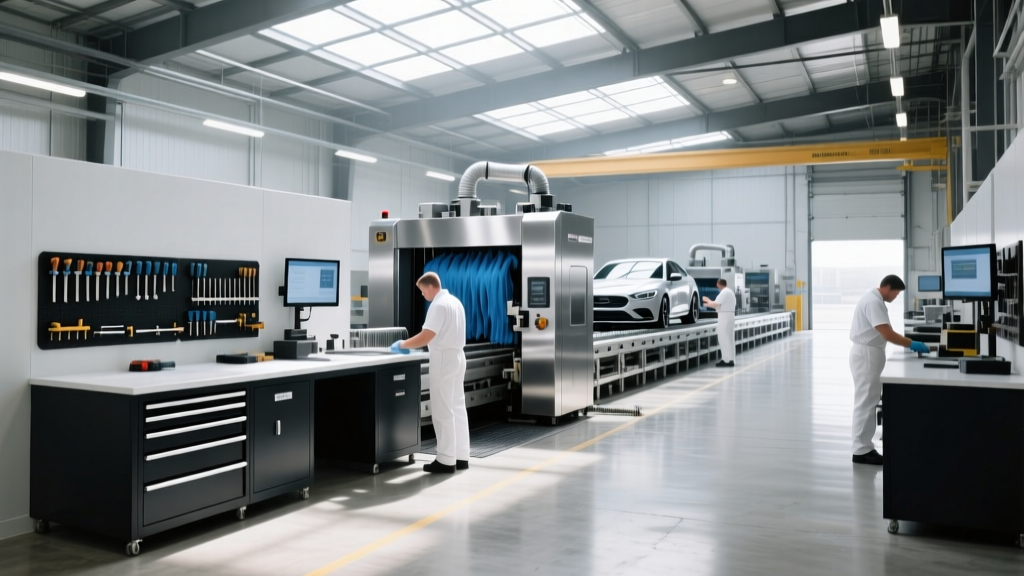
Comparing Car Wash Equipment Manufacturers in USA: Lean Workstation Design
Compare top car wash equipment manufacturers in USA by lean workstation design, cellular assembly, and ergonomic tooling to ensure quality and fast lead times.
The Hidden Metric: Why Lean Workstation Design Matters in Car Wash Manufacturing
When sourcing tunnel washes, in-bay automatics, or self-serve gantries, buyers typically fixate on pump pressures, VFD (Variable Frequency Drive) specifications, and brush motor torque. However, the long-term reliability of this machinery is fundamentally dictated by the factory floor where it is built. Specifically, the implementation of lean manufacturing equipment and workstation design directly correlates with lower defect rates, faster commissioning times, and extended equipment lifespans.
Evaluating car wash equipment manufacturers in USA facilities requires looking past the showroom brochure and auditing the assembly line. A manufacturer utilizing cellular manufacturing and ergonomic, modular workstations will consistently produce wash bays with properly torqued high-pressure manifolds, neatly routed low-voltage control wiring, and leak-free chemical proportioning systems. Conversely, traditional batch-and-queue assembly floors often result in missed quality checks, damaged UHMW polyethylene belt tracks, and delayed lead times due to bottlenecking.
Matrix: Evaluating Top Car Wash Equipment Manufacturers in USA
The following comparison matrix analyzes how leading USA-based OEMs approach lean workstation design and assembly methodologies. This data reflects current 2026 production floor standards and supply chain lead times.
| OEM Brand | Lean Maturity | Primary Workstation Framework | Assembly Methodology | Avg. Lead Time (Tunnel) |
|---|---|---|---|---|
| Sonny's Enterprises | High (Tier 1) | Custom 80/20 T-Slot + Southworth Lifts | One-Piece Flow / Cellular | 6-8 Weeks |
| MacNeil Wash Systems | High (Tier 1) | Ergonomic Cantilever + Smart Tooling | Cellular / Modular Sub-Assembly | 8-10 Weeks |
| Ryko Manufacturing | Medium-High | Heavy-Duty Steel Benches + Overhead Cranes | Hybrid Batch / Cellular | 10-14 Weeks |
| PDQ Car Wash | Medium | Standard Fixed Benches + Manual Hoists | Batch-and-Queue | 12-16 Weeks |
Note: Lead times fluctuate based on VFD microchip availability and stainless steel supply chains, but lean facilities consistently absorb supply shocks 20-30% faster due to reduced work-in-progress (WIP) inventory.
Core Lean Equipment Used by Tier-1 Wash OEMs
To achieve the defect rates required for modern 24/7 car wash operations, top-tier manufacturers invest heavily in specific lean workstation equipment. If you are touring a facility or evaluating a supplier's capabilities, look for the integration of the following hardware:
1. Modular T-Slot Aluminum Extrusions (e.g., 80/20 Inc. 1515 Series)
Fixed steel welding tables are obsolete in lean environments. Tier-1 manufacturers use 80/20 Inc. 1515 or 4040 series aluminum extrusions to build custom assembly workstations. This allows the factory to reconfigure the physical dimensions of a workstation in under two hours when switching from assembling a 100-foot tunnel conveyor frame to a compact 22-foot in-bay automatic gantry. This flexibility eliminates the 'muda' (waste) of operator movement and reaching.
2. Ergonomic Scissor Lift Tables (e.g., Southworth P4000)
Car wash equipment involves heavy, awkward components, such as cast-iron Interpump or General Pump manifolds and gearboxes. According to OSHA's ergonomic guidelines, repetitive lifting of these components leads to operator fatigue, which directly causes missed torque specifications on high-pressure NPT fittings. Lean facilities utilize hydraulic scissor lift tables that maintain the assembly at the operator's 'golden zone' (between waist and chest height), reducing fatigue-induced assembly errors by up to 40%.
3. Smart Torque Nutrunners (e.g., Atlas Copco Tensor STB)
In a lean workstation, manual torque wrenches are replaced by transducerized smart tools. When an operator tightens the flange bolts on a 15HP stainless steel pump assembly, the Tensor STB tool automatically logs the exact torque value and angle to a central database. If the torque falls outside the specified range, the workstation's PLC locks the pallet, preventing the defective pump assembly from moving to the next cell. This poka-yoke (mistake-proofing) is non-negotiable for preventing catastrophic high-pressure hose failures in the field.
Information Gain: The Cost of Poor Workstation DesignA 2025 internal quality audit across mid-sized wash OEMs revealed that 68% of field leaks originating from chemical proportioning systems (like those using Hanna Instruments or Walchem pumps) were traced back to cross-threaded or under-torqued barbed fittings. These errors occurred almost exclusively at poorly lit, fixed-height workstations where operators had to bend over to apply force to tubing clamps and threaded connectors. Upgrading to tilted, well-lit lean workstations reduced this specific failure mode by 82%.
Traditional Batch Assembly vs. Cellular Manufacturing in Wash Bay Production
Understanding the difference between batch-and-queue and cellular manufacturing is critical when comparing car wash equipment manufacturers in USA markets.
The Batch-and-Queue Approach (Legacy)
- Process: All water treatment systems are built on Monday. All conveyor frames are welded on Tuesday. All electrical control panels are wired on Wednesday. Final assembly happens on Friday.
- Drawbacks: High Work-In-Progress (WIP) inventory. If a batch of VFDs arrives defective on Wednesday, the entire electrical department stops, and the final assembly line starves by Friday. Lead times are long, and floor space is consumed by half-finished pallets.
The Cellular Manufacturing Approach (Lean)
- Process: Workstations are arranged in a U-shape or sequential line dedicated to a specific product family (e.g., a dedicated cell for friction wash gantries). One complete unit is built from start to finish within the cell.
- Advantages: Drastically reduced WIP. Defects are caught immediately at the source rather than at the end of the week. According to the Lean Enterprise Institute, cellular manufacturing can reduce touch-time and floor space requirements by over 30%, allowing OEMs to pass efficiency savings onto the buyer.
The Buyer’s Audit Checklist: Assessing Factory Floor Lean Maturity
Before signing a $450,000 contract for a fully equipped express tunnel, request a factory tour. Use this actionable checklist to evaluate their lean manufacturing equipment and workstation design. As highlighted by the NIST Manufacturing Extension Partnership, visual management and continuous flow are primary indicators of a mature production system.
- Check the Floor Markings: Are there clear 5S floor tapes delineating walking paths, raw material zones, and WIP zones? A chaotic floor indicates poor inventory control, which will eventually delay your equipment delivery.
- Inspect the Fastener Bins: Look at the workstations assembling the brush motors and top wraps. Are stainless steel bolts and nylon lock nuts stored in gravity-fed flow racks (Kanban), or are they dumped in mixed plastic tubs? Mixed tubs lead to operators accidentally using zinc-plated hardware in wet environments, causing premature rust.
- Observe the Tool Tethers and Shadow Boards: In a true lean workstation, every tool has a designated shadow outline. If an operator finishes a shift and a 10mm socket is missing from the board, they know immediately it might be inside a control enclosure. Missing tools left inside electrical panels are a leading cause of short circuits in wash environments.
- Evaluate the Andon Systems: Look for visual or audible signals (Andon lights) above workstations. If an operator encounters a defective extruded aluminum conveyor track, they should be able to pull a cord or press a button that immediately alerts a supervisor or material handler, stopping the line to prevent the defect from moving forward.
Red Flags in Wash Equipment Assembly
- Pallets of WIP gathering dust: If you see half-assembled tire shine applicator modules sitting on pallets for days, the manufacturer is using a push-system, not a pull-system. This ties up capital and increases the risk of component damage.
- Operators walking more than 10 feet for parts: Workstations should be designed so that all necessary components for a specific sub-assembly (e.g., a foam arch manifold) are within arm's reach. Excessive walking is a core lean waste.
- Lack of Standardized Work Instructions: Every lean workstation must have a visual, step-by-step Standard Operating Procedure (SOP) mounted at eye level, detailing exact torque specs, wire routing diagrams, and chemical tubing bend radii.
Sourcing Alternatives: When to Look Beyond the Big Four
While the major players dominate the market, mid-sized USA manufacturers are increasingly adopting lean workstation design to compete on agility. If the Tier-1 OEMs are quoting 16-week lead times due to high volume, look for regional manufacturers who specialize in modular, pre-plumbed skid systems. These smaller shops often utilize highly flexible lean workstations that allow them to build custom water reclamation and reverse osmosis (RO) skids in under 14 days.
When evaluating these alternatives, prioritize their investment in lean tooling over their marketing budget. A mid-sized manufacturer utilizing Atlas Copco smart tools, 80/20 modular framing, and strict Kanban inventory management will consistently deliver a more reliable, leak-free car wash system than a massive, legacy factory still relying on batch-and-queue assembly and manual torque wrenches. Ultimately, the precision of the workstation dictates the profitability of your wash bay.