Lean Workstation Specs From The Largest Equipment Manufacturers
Explore the technical specs, load metrics, and ergonomic kinematics of lean workstations engineered by the largest equipment manufacturers.
When analyzing the production floors of the largest equipment manufacturers—such as those producing heavy machinery, automotive drivetrains, or aerospace components—lean workstation design shifts from basic furniture to highly engineered material-flow nodes. True lean manufacturing equipment is not merely a table; it is a calibrated system of structural extrusions, kinematic actuators, and gravity-fed material tracks designed to eliminate micro-wastes (muda) in operator motion.
This technical breakdown details the exact specifications, load-bearing metrics, and ergonomic frameworks utilized by top-tier OEMs to engineer lean workstations in 2026.
Structural Frameworks: Extrusion vs. Welded Steel Metrics
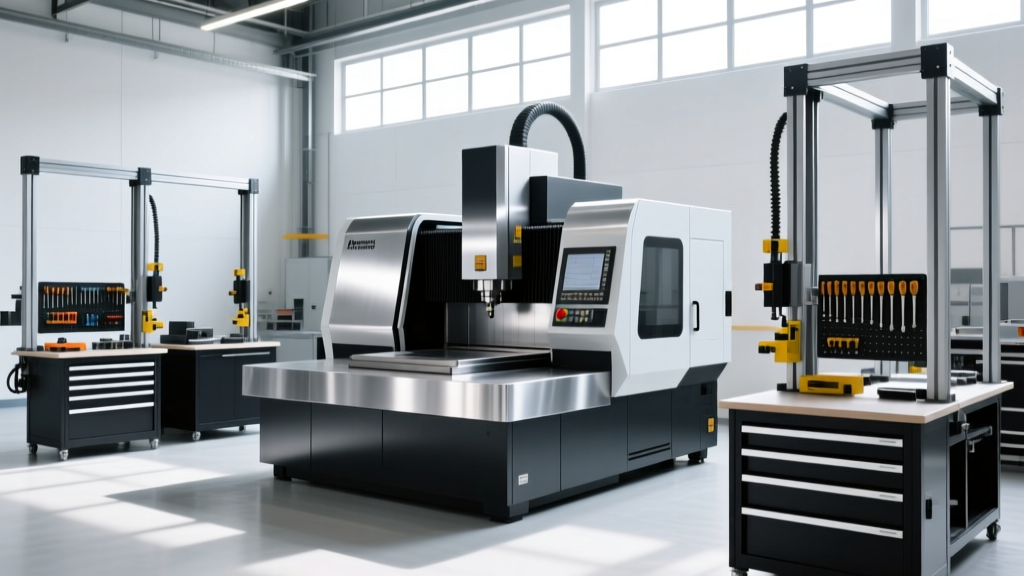
The backbone of modern lean workstations relies on modular aluminum T-slot extrusions rather than welded steel tubes. The largest equipment manufacturers standardize on 45x45mm profiles (such as the Item 8-series or Bosch Rexroth 45-series) due to their superior torsion resistance and reconfigurability.
- Profile Dimensions: 45x45mm with an 8mm slot width.
- Moment of Inertia (I): Approximately 11.3 cm⁴ on both axes, preventing deflection under dynamic torque.
- Fastener Yield Strength: Die-cast zinc alloy connecting joints rated for >200 MPa yield strength, ensuring the frame does not rack or twist when subjected to lateral forces from heavy pneumatic tools.
- Dynamic Load Capacity: A standard 1500mm x 800mm workstation top supported by four 45x45mm legs is rated for 350 kg to 500 kg of dynamic load without requiring cross-bracing.
Facilities attempting to cut costs by using 30x30mm extrusion profiles for heavy assembly workstations frequently experience joint failure. The moment of inertia for a 30x30mm profile drops to roughly 2.2 cm⁴. Under the repetitive vibration of pneumatic torque drivers (typically 4,000–6,000 RPM), the fasteners loosen, leading to frame racking and misalignment of precision jigs.
Ergonomic Kinematics and Height-Adjustable Mechanisms
Static workstations violate core ergonomic principles by forcing operators of varying statures into fixed postures. According to the NIOSH guidelines on occupational ergonomics, adjustable work surfaces reduce musculoskeletal disorders (MSDs) by allowing tasks to be performed within the operator's optimal reach envelope. Top-tier manufacturers integrate electric linear actuators to achieve this.
Actuator Technical Specifications
The industry standard for heavy-duty lean workstations is the 3-stage electric lifting column (e.g., Linak DL6 or TiMotion TA36). These systems provide the necessary stroke length to accommodate both seated and standing operators while maintaining stability at maximum extension.
| Specification | Standard Pneumatic | 2-Stage Electric Linear | 3-Stage Electric Linear (OEM Standard) |
|---|---|---|---|
| Max Lifting Force | 800 N | 1,200 N | 1,500 N - 2,000 N |
| Stroke Length | 400 mm | 500 mm | 650 mm - 700 mm |
| Adjustment Speed | 40 mm/s | 12 mm/s | 8 mm/s - 15 mm/s |
| Acoustic Noise | 75 dB (Compressor) | 55 dB | 48 dB - 52 dB |
| Estimated Unit Cost (2026) | $450 + Air Infrastructure | $850 | $1,200 - $1,600 |
FIFO Material Flow and Gravity Roller Integration
Lean manufacturing dictates that material must flow continuously without backtracking. Workstations engineered by the largest equipment manufacturers incorporate First-In-First-Out (FIFO) gravity tracks directly into the chassis. These are not simple shelves; they are precision-angled conveyors.
Gravity Track Engineering Parameters
- Roller Diameter & Material: 28mm galvanized steel rollers with sealed ball bearings to minimize static friction.
- Pitch (Angle of Decline): Set precisely between 2.5° and 3.5° for standard plastic totes (weighing 5–15 kg). Heavier metal components require a 4.5° to 6.0° pitch to overcome inertia.
- Braking Mechanisms: Polyurethane friction brakes are installed every 400mm on steeper declines to prevent totes from accelerating and colliding with the operator's work zone, which can cause part damage or safety hazards.
- Return Tracks: Empty tote return lanes are mounted at a 15° upward incline, utilizing the operator's natural upward lifting motion to slide empties back to the material handler aisle.
"In a true lean cell, the operator should never take more than one step to retrieve a component, nor should they ever lift a tote. The workstation must bring the work to the operator's golden zone—the area between the shoulders and the hips."
ESD and Cleanroom Compliance in Lean Cells
For manufacturers assembling electronics, medical devices, or aerospace avionics, lean workstations must integrate strict Electrostatic Discharge (ESD) controls without compromising material flow.
🔧 Technical Spec: ESD Grounding PathwaysStandard high-pressure laminate (HPL) worktops generate static charges exceeding 5,000V through friction. OEM lean workstations utilize dissipative laminates with a surface resistance strictly maintained between 10⁶ and 10⁹ ohms. The aluminum frame itself acts as the grounding bus. A 4mm brass grounding stud is bolted directly to the extrusion, tied to the facility's earth ground via a 1-megohm current-limiting resistor to protect the operator from shock hazards while safely bleeding off static charges.
Decision Matrix: Selecting Workstation Configurations
Choosing the correct physical layout is as critical as the mechanical specifications. Use this framework to determine the optimal lean cell design for your production environment.
U-Shaped Cell vs. Inline Straight-Line
Choose the U-Shaped Cell When:
- The takt time is under 60 seconds.
- The operator needs to manage both the raw material input and the finished goods output from a single standing position.
- Footprint constraints require high-density equipment clustering.
Choose the Inline Straight-Line When:
- The assembly involves heavy, bulky items (e.g., engine blocks, industrial pump housings) that require overhead hoists or bridge cranes.
- The process requires multiple operators working sequentially on the same unit without crossing paths.
- Sub-assembly feeding from the rear aisle is necessary to keep the primary operator focused solely on value-added tasks.
Maintenance and Lifecycle Calibration
Even the most robust lean workstation requires scheduled calibration to maintain its technical tolerances. According to OSHA ergonomics guidelines, degraded equipment forces operators into compensatory, injury-inducing postures.
- Quarterly Fastener Torque Checks: T-slot fasteners can loosen due to high-frequency vibration from pneumatic tools. Maintenance teams must apply a calibrated torque wrench (typically 15 Nm for M8 bolts in 45x45mm profiles) every 90 days.
- Actuator Lubrication: While modern linear actuators are sealed and maintenance-free for 10,000 cycles, the external guide rails on manual height-adjustment stations require PTFE-based dry lubricant every six months to prevent binding.
- Roller Bearing Inspection: FIFO gravity tracks accumulate metallic dust and machining swarf. Tracks must be blown out with low-pressure compressed air (max 30 PSI) monthly to prevent bearing seizure, which destroys the calculated pitch angle and halts material flow.
By adhering to these exact specifications and engineering principles, facility managers can replicate the highly optimized, waste-eliminating workstations deployed by the largest equipment manufacturers in the world, ensuring both peak operational efficiency and long-term operator health.