Batch vs Continuous Lines for Farm Equipment Manufacturers in USA
Discover how top farm equipment manufacturers in the USA choose between batch and continuous manufacturing lines for tractors, combines, and implements.
The Core Divergence in Ag-Machinery Production
When evaluating production strategies, farm equipment manufacturers in USA face a unique mechanical and economic paradox. Agricultural machinery spans an extreme spectrum of product complexity and demand volume. On one end, you have high-mix, low-volume (HMLV) implements like custom 60-foot air seeders or specialized vineyard harvesters. On the other, you have low-mix, high-volume (LMHV) staples like 200-horsepower row-crop tractors. Forcing a single manufacturing philosophy across this spectrum guarantees operational inefficiency.
As of 2026, the strategic divide between batch manufacturing and continuous flow assembly has become the defining factor in profit margins for US-based heavy equipment plants. The choice dictates everything from factory floor footprint and CapEx allocation to supply chain buffering and workforce ergonomics. Understanding how industry leaders deploy these systems provides a critical blueprint for mid-tier implement builders looking to scale.
Quick Decision Matrix: Batch vs. Continuous
- Choose Batch Processing When: Annual volume is under 2,500 units, product variations exceed 15 distinct SKUs, and fabrication requires heavy, multi-axis welding of thick high-strength steel (e.g., tillage frames).
- Choose Continuous Flow When: Annual volume exceeds 5,000 units, SKU variation is limited to modular attachments (e.g., different tire packages or PTO configurations on a standard chassis), and final assembly involves repetitive, torque-controlled fastening.
Case Study 1: Batch Manufacturing for Custom Implement Fabrication
Consider the production of heavy tillage equipment and air drill frames. These components require massive structural integrity, utilizing 0.5-inch to 1-inch thick DOM tubing and high-strength steel plates. Farm equipment manufacturers in USA typically process these in dedicated batch cells rather than continuous lines due to the extensive setup times required for welding fixtures and the low daily throughput.
Equipment Configuration and Metrics
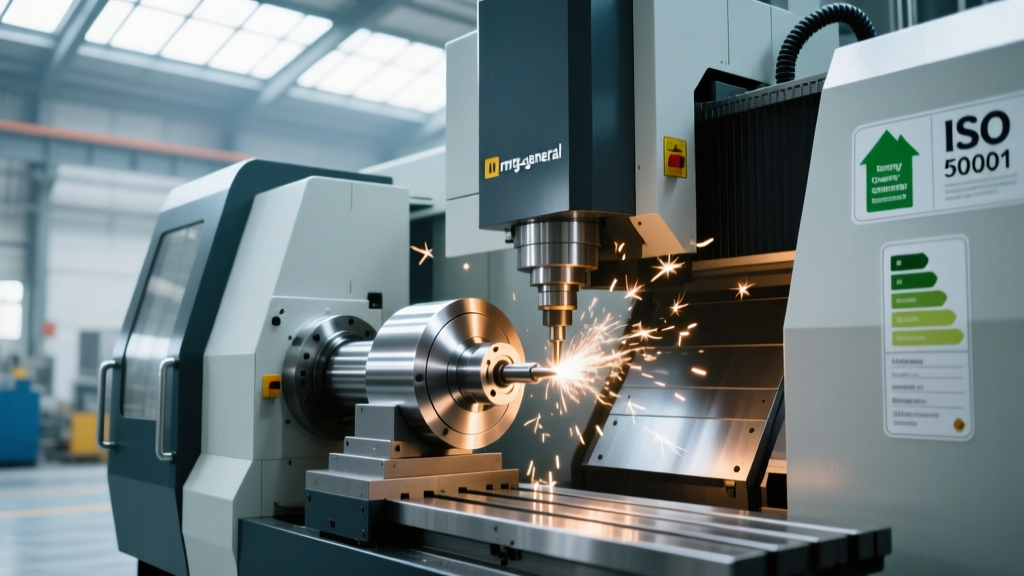
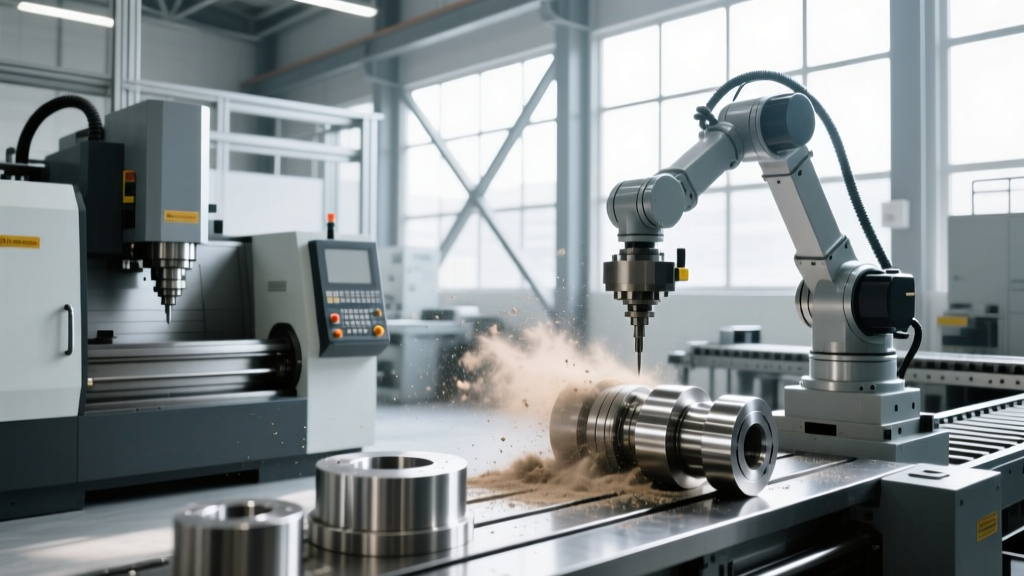
A modern batch fabrication cell for an air seeder frame relies on automated nesting and robotic welding. Facilities utilize CNC laser cutters, such as the Trumpf TruLaser 5030 fiber, to batch-cut plate steel. The cut parts are then moved to a robotic welding cell equipped with a Fanuc ArcMate 120iC and a dual-axis positioner.
- Batch Size: Typically 50 to 150 units per run.
- Changeover Time: 4 to 6 hours to swap welding fixtures and reprogram robot paths for a different frame width (e.g., switching from a 40-foot to a 60-foot model).
- CapEx Requirement: $850,000 to $1.4 million per fully tooled robotic welding cell.
- Work-in-Progress (WIP): High. Batch processing inherently creates queues of semi-finished weldments waiting for the next operation (e.g., powder coating or sub-assembly).
The primary advantage here is flexibility. If a sudden supply chain disruption delays the delivery of specific hydraulic cylinders, the plant can halt the batch, swap the welding fixture, and run a different implement frame without stopping the entire factory. According to data tracked by the USDA Economic Research Service, the volatility in raw material pricing and farm income directly impacts implement ordering patterns, making this batch flexibility a vital risk-mitigation tool for US manufacturers.
Case Study 2: Continuous Flow for High-Volume Tractor Assembly
In stark contrast, the final assembly of Class 8 row-crop tractors (150 HP to 300 HP) operates on a strict continuous flow model. Plants like those operating in the US Midwest utilize paced assembly lines where the chassis moves continuously or in precise, timed increments (indexing) from station to station.
Equipment Configuration and Metrics
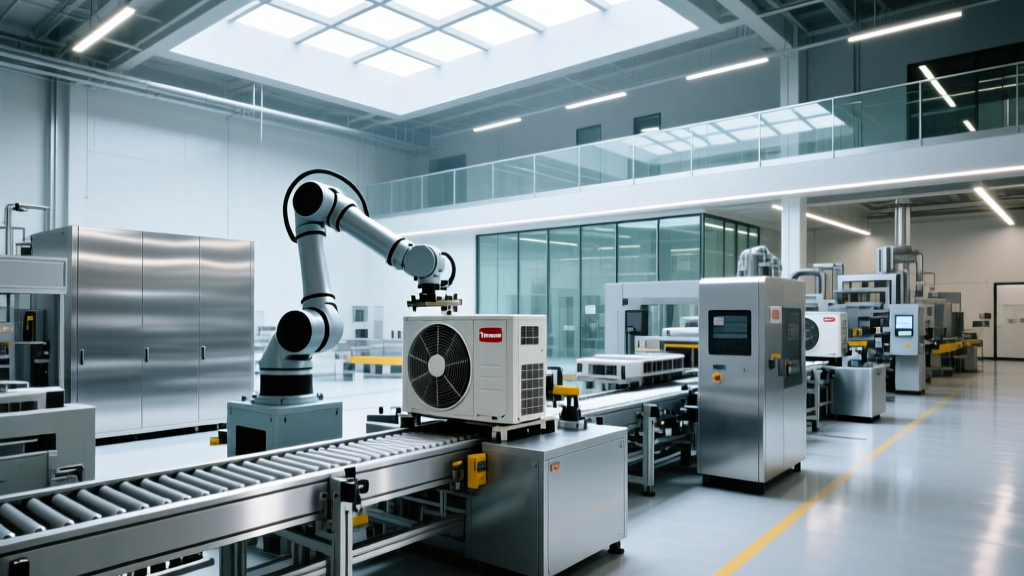
Modern continuous lines have largely abandoned traditional chain-and-skid conveyors in favor of heavy-payload Automated Guided Vehicles (AGVs). Systems like the KUKA KMP 1500P navigate via magnetic tape or LiDAR, carrying the 12,000-pound tractor chassis through 40 to 60 assembly stations.
- Takt Time: 42 to 48 minutes per unit. If a worker or robot cannot complete their task within this window, the entire line stops.
- Line Balancing: Requires rigorous time-study engineering. Engine drop, transmission mating, and cab installation must be perfectly timed to the 45-minute heartbeat.
- CapEx Requirement: $15 million to $25 million for a fully integrated AGV routing system, overhead torque tooling, and automated fluid-fill stations.
- Ergonomics: Continuous lines allow for height-adjustable AGVs, raising the chassis to waist level for undercarriage work and lowering it for cab installation, aligning with OSHA Ergonomics Guidelines to reduce musculoskeletal disorders.
The continuous model ruthlessly exposes bottlenecks. There is no buffer stock between stations. However, the OEE (Overall Equipment Effectiveness) of a well-tuned continuous tractor line frequently exceeds 85%, driving the per-unit assembly cost down to a fraction of what batch assembly would require.
Financial & Operational Comparison Matrix
To visualize the trade-offs, below is a direct comparison of how capital and operational resources are distributed across both methodologies in the context of US agricultural machinery production.
| Parameter | Batch Manufacturing (Implement Fabrication) | Continuous Flow (Tractor Assembly) |
|---|---|---|
| Primary Automation | 6-Axis Robotic Welders, CNC Plasma/Laser | Heavy-Payload AGVs, Automated Nutrunners |
| CapEx Intensity | Moderate ($1M - $3M per cell) | Extreme ($15M+ for full line integration) |
| SKU Flexibility | High (Easy to pivot to different frame sizes) | Low (Limited to modular options on one chassis) |
| WIP Inventory | High (Pallets of welded frames in queue) | Near Zero (Just-in-Sequence delivery) |
| Disruption Impact | Localized (Only the specific batch is delayed) | Catastrophic (Missing one $50 sensor halts the plant) |
The Hybrid Reality: Paced Assembly and Sub-Cells
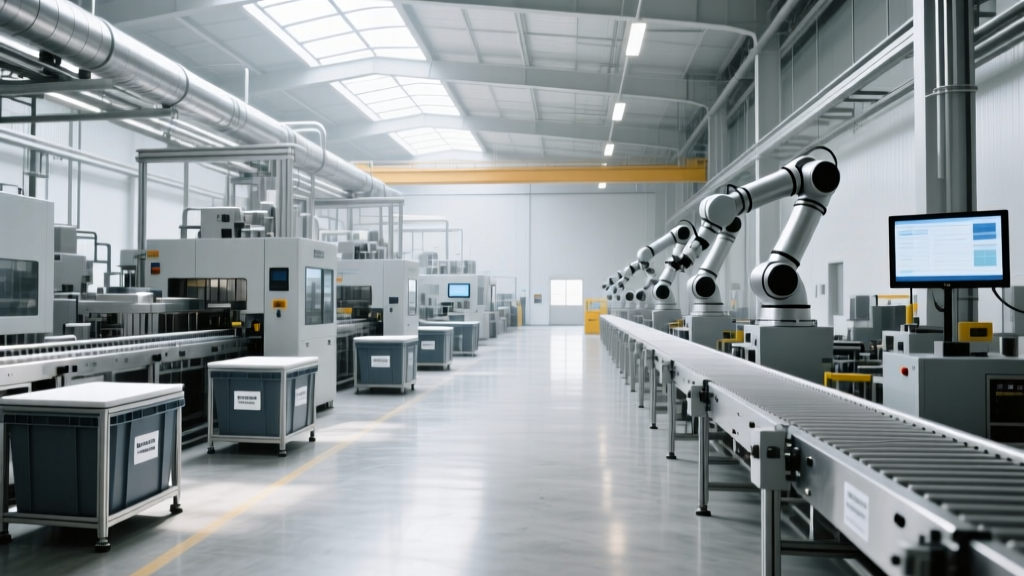
While the theoretical distinction between batch and continuous is clear, the reality on the floor of major US agricultural manufacturers is a hybrid approach known as paced assembly with batch sub-cells.
'The most resilient factories in 2026 do not choose one over the other. They build sub-assemblies—like powertrain modules, hydraulic valve banks, and cab interiors—in highly automated batch cells offline. These batches are then sequenced into a continuous final-assembly line exactly when the main chassis arrives at the marriage station.'
— Adapted from smart manufacturing integration principles outlined by NIST Advanced Manufacturing
This hybrid model solves the primary weakness of continuous lines: the inability to handle complex, time-consuming sub-assemblies without breaking the takt time. By building the tractor transmission in a batch cell of 50 units, testing them dynamically on a dynamometer, and then feeding them to the continuous line via Automated Storage and Retrieval Systems (ASRS), manufacturers maintain the high throughput of continuous flow without sacrificing the quality control inherent to batch processing.
Actionable Framework for Mid-Tier Implement Builders
For mid-sized farm equipment manufacturers in USA (producing 1,000 to 5,000 units annually) looking to upgrade their facility, transitioning blindly to a continuous line is a common and fatal error. Use this step-by-step framework to audit your production floor:
- Map the P-Q (Product-Quantity) Matrix: Plot every SKU you manufacture on a graph of Volume vs. Routing similarity. Items in the high-volume, high-similarity quadrant are your candidates for continuous flow.
- Isolate the 'Monuments': Identify equipment that cannot be moved or easily reconfigured (e.g., a massive 1,000-ton press brake or a continuous powder-coat oven). These are your 'monuments.' Batch processes must be scheduled around them; continuous lines should ideally avoid incorporating them directly into the main flow.
- Calculate the Cost of Changeover: If your current welding fixtures take more than 2 hours to swap, and you run more than 5 different SKUs a week, you are losing 10+ hours of weekly production to changeovers. Invest in quick-release, modular welding tables (like Bluco or Siegmund systems) to reduce batch changeover to under 15 minutes before attempting continuous flow.
- Implement Supermarket Pull Systems: Before linking your batch fabrication cells to your final assembly line, establish a physical 'supermarket' (a controlled buffer zone) containing exactly 2 days' worth of finished weldments. This decouples the batch cell from the assembly line, ensuring that a welding robot breakdown does not immediately starve the final assembly workers.
Ultimately, the most successful US agricultural equipment plants leverage batch manufacturing to manage the heavy, variable fabrication of steel structures, while reserving continuous flow for the highly repeatable, ergonomic-sensitive final assembly of the machine. Aligning your equipment investments with this natural divergence is the key to maintaining competitive unit costs in a volatile market.