How VTL Machines for Metalworking Function: Technical Specs
Explore the technical specifications, mechanics, and bearing architectures of VTL machines for metalworking large-diameter, heavy components.
The Kinematics and Core Mechanics of Vertical Turret Lathes
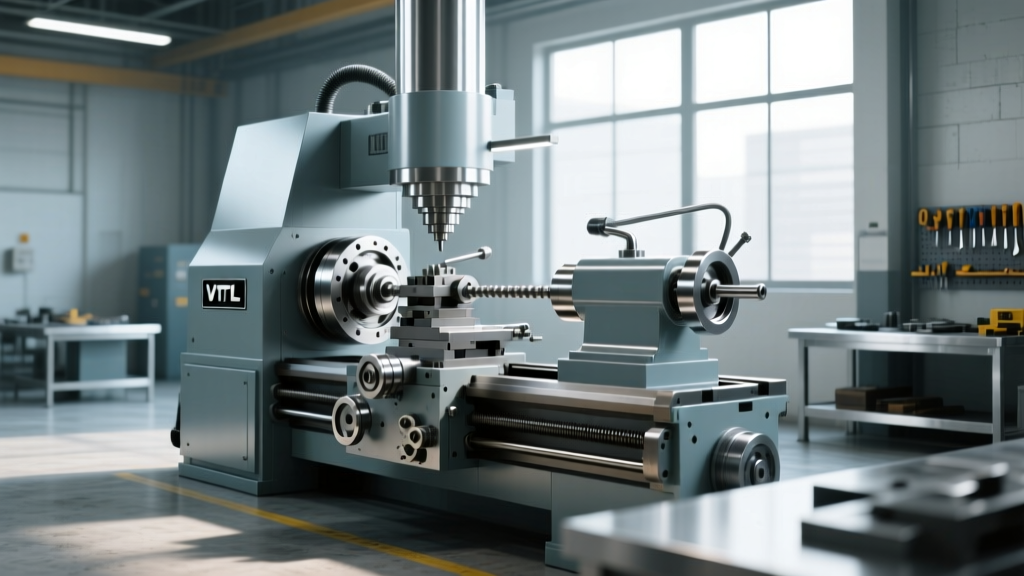
When manufacturing large-diameter, relatively short, and exceptionally heavy components—such as wind turbine main bearing rings, large valve bodies, and aerospace structural flanges—horizontal lathes suffer from severe chuck sag and gravity-induced workpiece deflection. VTL machines for metalworking solve this geometric vulnerability by inverting the traditional lathe axis. In a Vertical Turret Lathe (VTL), the workpiece rests horizontally on a rotary table while the cutting tool moves vertically and laterally.
This orientation leverages gravity to naturally seat the workpiece against the table, drastically reducing the clamping force required to hold the part. By minimizing clamping distortion, VTLs maintain tighter concentricity and flatness tolerances on thin-walled or easily deformed large rings. For a comprehensive look at how leading manufacturers implement these mechanics, reviewing Okuma's vertical turning lathe lineup reveals the integration of high-rigidity Meehanite castings with advanced thermal compensation algorithms.
Axis Configuration and Movement
The fundamental kinematics of a standard CNC VTL rely on two primary axes, with modern configurations expanding to four or five:
- X-Axis (Cross Rail): Controls the lateral movement of the tool turret across the diameter of the table. On heavy-duty models, the cross rail itself can move vertically (W-axis) to maintain optimal tool overhang and maximize rigidity.
- Z-Axis (RAM): Dictates the vertical plunge and retract of the cutting tool into the workpiece. High-end VTLs utilize a square or octagonal ram profile rather than a cylindrical quill to resist torsional twisting during heavy interrupted cuts.
- C-Axis (Spindle/Table): Allows the rotary table to act as a programmable spindle, stopping at precise angular increments for milling, drilling, and tapping operations without unfixturing the part.
- Y-Axis: Enables off-center milling and complex contouring on the face of the workpiece, transforming the VTL into a multifunctional turning-mill.
Technical Specifications: Standard vs. Heavy-Duty VTLs
The engineering parameters of VTL machines for metalworking scale dramatically based on the target payload. Below is a comparison matrix outlining the technical boundaries between standard production VTLs and heavy-duty infrastructure VTLs.
| Parameter | Standard CNC VTL (40" - 80" Swing) | Heavy-Duty VTL (100" - 160"+ Swing) |
|---|---|---|
| Max Table Load Capacity | 8,000 lbs – 25,000 lbs | 40,000 lbs – 220,000+ lbs |
| Table Speed (RPM) | 10 – 400 RPM | 1 – 60 RPM (High Torque) |
| Rotary Bearing Type | Precision Cross-Roller | Hydrostatic Guideways & Thrust Bearings |
| RAM Cross-Section | Cylindrical or Square (8" x 8") | Octagonal or Square (12" x 12" to 16" x 16") |
| Positioning Accuracy (X/Z) | ±0.0004" (0.01 mm) | ±0.0008" (0.02 mm) over full travel |
| Tool Interface | VDI 50/60 or Capto C6 | Capto C8/C10 or Custom HSK-T100 |
Critical Subsystems: Bearings, Drives, and Thermal Management
The true differentiator in VTL performance lies beneath the rotary table. The bearing architecture dictates the machine's load capacity, damping characteristics, and long-term geometric accuracy.
Cross-Roller vs. Hydrostatic Bearing Architecture
Standard VTLs utilize precision cross-roller bearings. These pre-loaded mechanical bearings offer excellent stiffness for light-to-medium interrupted cuts and require minimal maintenance. However, when table loads exceed 40,000 lbs, mechanical friction generates excessive heat, leading to thermal expansion and preload loss.
Heavy-duty VTLs bypass mechanical friction entirely by employing hydrostatic bearings. A network of precision-machined pockets beneath the table pumps high-pressure oil (typically 300 to 1,500 PSI), lifting the rotary table on a microscopic film of oil. This eliminates metal-on-metal contact, providing infinite stiffness and unparalleled vibration damping. The trade-off is complexity: hydrostatic systems require dedicated oil chillers to maintain the fluid at exactly 20°C (±0.1°C) to prevent thermal growth of the table itself.
Drive Systems: Direct Drive Torque Motors
Legacy VTLs relied on massive gearboxes to multiply motor torque for the rotary table, introducing backlash and limiting C-axis contouring accuracy. Modern VTL machines for metalworking increasingly utilize direct-drive torque motors. By wrapping the stator directly around the table's outer diameter, manufacturers eliminate mechanical transmission losses. This yields zero-backlash C-axis positioning, which is critical when using the VTL to mill complex bolt-hole patterns or keyways on large turbine flanges. Mazak's vertical turning technology frequently leverages advanced servo-driven tables to achieve seamless turn-mill transitions.
⚠️ Maintenance Alert: Hydrostatic Oil Contamination
In heavy-duty VTLs, the most common cause of catastrophic table failure is not mechanical overload, but hydrostatic oil contamination. Fine cast iron swarf or carbide dust bypassing the way covers can enter the oil return trenches. If the filtration system (typically rated to 10 microns) fails, particulate matter scores the bearing pockets, destroying the oil film and resulting in a seized table. Weekly verification of the hydrostatic chiller delta-T and monthly filter differential pressure checks are non-negotiable maintenance requirements.
Installation and Foundation Engineering
A VTL is only as accurate as the concrete it sits on. Unlike smaller machining centers, heavy-duty VTLs cannot simply be leveled on standard shop-floor concrete. The sheer mass of the machine (often exceeding 150,000 lbs bare) combined with dynamic cutting forces requires specialized foundation engineering.
- Independent Isolation Pad: The VTL must be mounted on an independent concrete pad, physically separated from the main shop floor by an expansion joint. This prevents ground-borne vibrations from nearby overhead cranes or stamping presses from transferring into the machine base.
- Depth and Mass Ratio: A standard rule of thumb for heavy VTL foundations is a concrete mass equal to 1.5 to 2 times the mass of the machine. For a 120-inch VTL weighing 100,000 lbs, the foundation should consist of approximately 150,000 to 200,000 lbs of reinforced concrete, often extending 4 to 6 feet below the shop floor.
- Epoxy Grouting: The machine leveling jacks must be encapsulated in high-compressive-strength, non-shrink epoxy grout (e.g., MasterFlow 648) to ensure 100% load transfer and prevent micro-movements during heavy roughing passes.
2026 Procurement Framework: Pricing and Sizing
When specifying VTL machines for metalworking, buyers must account for the total cost of ownership, which extends far beyond the base machine price. Below is a realistic pricing framework for new equipment in the current market.
- Standard 60" CNC VTL (Cross-Roller, 15k lb capacity): Base price ranges from $450,000 to $650,000. Adding a C-axis and Y-axis milling capabilities will push the configuration closer to $750,000.
- Heavy-Duty 120" VTL (Hydrostatic, 80k lb capacity): Base prices start at $1.4 million and easily exceed $2.2 million when equipped with automated pallet changers, high-pressure coolant through-spindle (1,000 PSI), and extended W-axis cross-rail travel.
- Hidden Costs: Allocate $35,000 to $60,000 for foundation engineering, excavation, and epoxy grouting. Additionally, heavy-duty VTLs require 3-phase, 480V power drops capable of sustaining 100+ Amp continuous draw, alongside dedicated compressed air lines for way-cover purging.
For shops exploring advanced manufacturing methodologies and turn-mill integration, consulting resources from the Association for Manufacturing Technology (AMT) provides vital benchmarks on cycle-time reduction and ROI calculations for large-format vertical turning investments.
Summary of Application Suitability
VTL machines for metalworking dominate the production of parts where the diameter-to-length ratio is high, and the weight exceeds the safe chucking limits of horizontal lathes. By prioritizing hydrostatic bearing technology for heavy payloads, utilizing direct-drive torque motors for C-axis precision, and investing heavily in isolated foundation engineering, manufacturers can achieve single-setup completions on massive components with tolerances held to within 0.001 inches.