Hoist Training for Dry Bulk Material Handling Equipment
Master operator training for hoists in dry bulk environments. Learn rigging FIBCs, dust-proof inspection protocols, and explosive atmosphere safety.
The Unique Demands of Vertical Dry Bulk Transport
Vertical transport of dry bulk materials—such as Portland cement, fly ash, silica sand, and grain—introduces severe environmental stressors to hoist and winch systems. Unlike clean-room or standard manufacturing lifts, dry bulk material handling equipment operates in environments where particulate matter acts as both an abrasive and a combustible hazard. Operator training must transcend basic load-chart memorization; it requires a deep understanding of dust ingress mechanics, dynamic shock loading from scooping operations, and specialized rigging for Flexible Intermediate Bulk Containers (FIBCs).
When a standard electric chain hoist is deployed in a cement silo facility without modification, microscopic particulates bypass standard seals, infiltrating the gearbox and motor windings. This results in premature thermal failure and catastrophic brake slippage. According to OSHA Standard 1910.179, overhead and gantry cranes must be maintained to handle specific environmental conditions, yet operators are frequently undertrained on identifying the early mechanical warnings of dust-induced degradation.
⚠️ COMBUSTIBLE DUST WARNING:Facilities handling grain, coal, sulfur, or aluminum powder operate in Class II, Division 1 or 2 hazardous locations per the NEC. Standard hoists can ignite suspended dust via mechanical sparking or electrical arcing. Operators must verify the hoist carries a valid NEMA 7/9 or ATEX explosion-proof rating before initiating any vertical lift in these zones. Consult the NIOSH Combustible Dust Guidelines for specific material hazard classifications.
Equipment Selection Matrix for Bulk Environments
Matching the hoist architecture to the specific bulk material is the first line of defense against downtime. The following matrix outlines 2026 market standards for vertical transport equipment in varying bulk environments.
| Environment / Material | Required Hoist Architecture | Example Model (2026) | Approx. CapEx (5-Ton) | Critical Spec |
|---|---|---|---|---|
| Standard Warehouse (Bagged/Palletized) | Standard Electric Chain | Kito ED Single Speed | $4,200 - $5,500 | IP54 Rating, Standard Brake |
| High-Dust Abrasive (Cement, Fly Ash, Silica) | Sealed / Washdown Chain | CM Lodestar D8 Contour | $6,800 - $8,500 | IP65/IP66, Sealed Gearcase |
| Combustible Dust (Grain, Coal, Aluminum) | Explosion-Proof (EX) | Harrington EX010 Series | $15,500 - $19,200 | NEMA 7/9, Bronze-Coated Hooks |
| Corrosive Bulk (Fertilizers, Phosphates) | Stainless / Epoxy-Coated | Acco Galvanized SS Chain | $11,000 - $14,000 | 316 SS Components, Marine Grade |
Operator Pre-Shift Inspection: The Dust Factor
Standard pre-shift checklists fail in dry bulk environments because they ignore particulate accumulation points. Operators must be trained to execute a bulk-specific inspection protocol focusing on the following critical nodes:
- Rotary Geared Limit Switches: Dust packs into the micro-switch housing of the upper limit. When compacted, the switch fails to trip, allowing the hook block to two-block against the upper sheave. Operators must blow out limit switch housings with dry compressed air (max 30 PSI) every shift.
- Load Chain Lubrication State: In abrasive environments, standard chain oil mixes with airborne silica or cement dust to form a highly abrasive lapping paste. This paste accelerates pocket wheel wear. Inspect the chain; if the lubricant feels gritty between the fingers, the chain must be degreased and re-lubricated with a dry-film PTFE spray that repels particulate adhesion.
- Hook Latch Torsion Springs: Bulk dust corrodes and binds the small torsion springs on safety latches. A bound latch will not close automatically, violating OSHA 1910.184 sling and rigging regulations regarding accidental load disengagement. Manually cycle the latch to ensure full rotational return.
- Brake Dust Shields: Verify that the mechanical load brake covers are intact. If dust infiltrates the friction discs, the brake will slip under load, causing uncontrolled lowering of bulk skips.
Chain vs. Wire Rope in Abrasive Settings
For vertical dry bulk transport, welded alloy steel chain (Grade 80 or 100) vastly outperforms wire rope. Wire rope consists of multiple stranded wires; when microscopic bulk particulates penetrate the core, they act as an internal grinding compound, severing the inner wires long before external broken wires are visible. Chain links, conversely, present a solid, easily inspectable wear surface. Operators must measure chain link elongation using calipers; any stretch exceeding 3% of the original pitch length mandates immediate chain replacement.
Rigging Flexible Intermediate Bulk Containers (FIBCs)
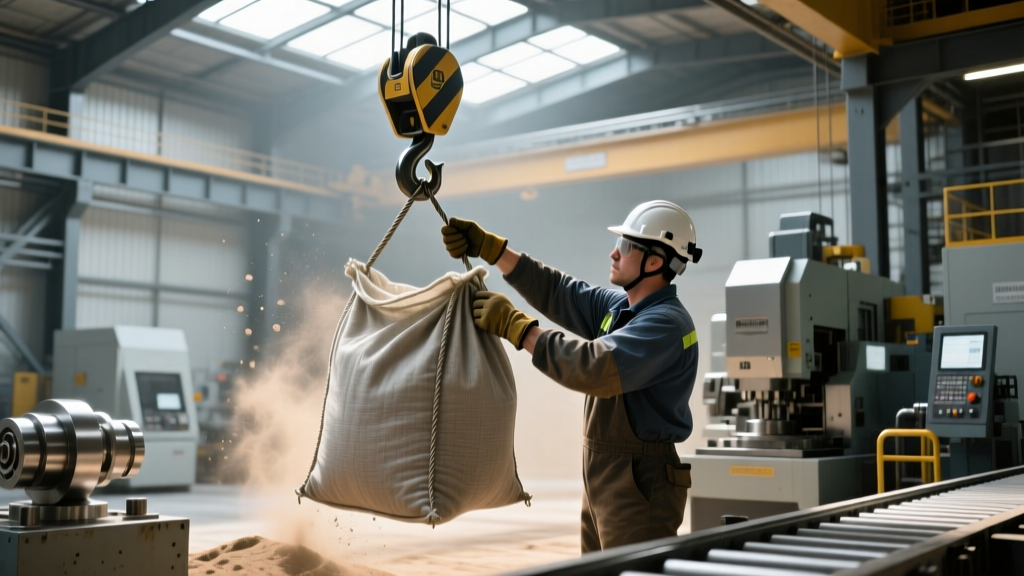
Dry bulk materials are frequently transported vertically in FIBCs (bulk bags) ranging from 1,000 to 4,000 lbs. Improper rigging of these containers is a leading cause of dropped loads and operator fatalities in bulk facilities.
The Spreader Bar Mandate
When lifting a standard 4-loop FIBC, operators must never gather all four loops onto a single crane hook. This creates an inward crushing force that compromises the sewn seams of the bag's lift loops. Training must enforce the use of a 4-leg spreader bar or a dedicated FIBC lifting frame. The lifting frame keeps the loops vertical, maintaining the bag's structural integrity and ensuring the Safe Working Load (SWL) is not compromised by angular stress.
"A bulk bag rated for a 5:1 safety factor is designed for single-trip use. If a facility attempts to reuse single-trip FIBCs for vertical hoisting, the dynamic shock load of the hoist brake engaging can easily snap degraded UV-exposed polypropylene loops. Always verify the manufacturer's tag for an 8:1 safety factor before authorizing multi-trip vertical lifts."
Managing Dynamic Shock Loading
Dry bulk materials shift during transport. When a hoist lifts a partially filled bulk skip or FIBC, the material settles, creating a dynamic shock load that can exceed the static weight by 20% to 40%. Operators must be trained to perform a "test lift"—raising the load exactly two inches off the deck, pausing for three seconds to allow the bulk material to settle and the hoist brake to prove its holding capacity, before proceeding with the full vertical travel.
Troubleshooting Common Bulk-Handling Hoist Failures
When equipment malfunctions in a dry bulk setting, the root cause is rarely a simple electrical fault. Use this diagnostic matrix to train maintenance and operator teams on bulk-specific failure modes.
| Symptom | Bulk-Specific Root Cause | Corrective Action |
|---|---|---|
| Hoist motor overheats and trips thermal overload prematurely. | Dust accumulation on motor cooling fins acts as thermal insulation; fan cowl packed with debris. | Vacuum motor housing; do not use compressed air which drives dust deeper into windings. Install finned motor covers. |
| Upper limit switch fails to stop hook block. | Particulate packing inside the rotary geared limit switch housing prevents internal cam rotation. | Disassemble limit switch, clean with electrical contact cleaner, and apply dielectric grease to seal out moisture and dust. |
| Load chain exhibits severe lateral wear and binding. | Silica/cement dust mixed with wet lubricant creates an abrasive paste, grinding the chain link bearing surfaces. | Replace chain if elongated >3%. Switch to dry-film PTFE lubricant. Install chain scrapers at the pocket wheel entry point. |
| Hook latch fails to close automatically. | Corrosive bulk dust (e.g., ammonium nitrate fertilizer) pits the torsion spring and latch pivot pin. | Replace latch assembly. Upgrade to stainless steel latch components if handling hygroscopic or corrosive bulk powders. |
Effective operator training for dry bulk material handling equipment requires shifting the focus from generic lifting mechanics to environmental hazard mitigation. By enforcing strict inspection protocols for dust ingress, mandating proper FIBC rigging hardware, and selecting correctly sealed hoist architectures, facilities can eliminate the primary failure modes associated with vertical bulk transport.