Storeroom Bulk Material Handling Equipment: AS/RS vs Pallet Racking
Compare AS/RS and high-density pallet racking for storeroom bulk material handling equipment. Get 2026 pricing, throughput data, and selection frameworks.
The Infrastructure Decision: Static Density vs. Automated Throughput
Designing a high-capacity bulk storeroom requires matching SKU velocity profiles with physical infrastructure constraints. When evaluating storeroom bulk material handling equipment, facility managers face a critical bifurcation: invest in high-density static pallet racking or deploy Automated Storage and Retrieval Systems (AS/RS). This decision dictates not only your capital expenditure but also your long-term cost-per-pallet, throughput ceiling, and facility footprint.
Surface-level comparisons often reduce this choice to 'manual versus automated.' In reality, the decision hinges on specific load weights, seismic zone requirements, fire suppression classifications, and SKU velocity distributions. Below is a technical breakdown of the leading storage architectures for bulk materials in 2026, complete with real-world pricing, engineering tolerances, and integration frameworks.
Decision Matrix: Racking vs. AS/RS
| System Type | Cost per Pallet Position | Max Throughput | Density / Footprint | Best Use Case |
|---|---|---|---|---|
| Selective Racking | $120 - $250 | Forklift dependent | Low (40-50%) | High SKU count, low volume per SKU |
| Push-Back Racking | $250 - $450 | Forklift dependent | Medium (60-75%) | LIFO bulk, 3-6 pallets deep |
| Pallet Shuttle AS/RS | $800 - $1,500 | Up to 300 cycles/hr | High (85-95%) | Deep-lane FIFO/LIFO, high density |
| Unit-Load Crane AS/RS | $2,000 - $4,500+ | 100-150 cycles/hr | Very High (90%+) | High-bay (>60ft), heavy bulk loads |
High-Density Pallet Racking: Engineering the Static Baseline
For facilities where capital constraints preclude full automation, high-density static racking remains the backbone of storeroom bulk material handling equipment. However, modern push-back and drive-in systems require precise engineering to prevent catastrophic deflection and product damage.
Push-Back Racking Specifications and Edge Cases
Push-back racking utilizes nested carts on inclined rails, allowing forklifts to store pallets 3 to 6 deep. The critical engineering metric here is the pitch angle. Standard systems require a pitch of 3/8 inch per foot of rail length to ensure gravity-fed retrieval. If the pitch is too shallow, pallets fail to index forward; if too steep, the impact force at the end stop can damage bulk packaging.
- Wheel Selection: Standard steel wheels are sufficient for ambient environments. However, for cold storage bulk materials (below 32°F), polyurethane wheels with sealed bearings are mandatory to prevent frost-jacking and cart seizure.
- Load Limits: While standard carts handle 2,500 lbs, heavy-duty bulk materials (e.g., industrial chemicals, dense metal parts) require reinforced C-channel carts rated for 4,000 lbs per pallet.
- Seismic Bracing: According to the Rack Manufacturers Institute (RMI), facilities in Seismic Design Categories D, E, and F must utilize specialized baseplates and heavier vertical bracing. Expect a 15-20% cost premium on structural steel for these zones.
Unit-Load AS/RS: The Automated Leap for Bulk Storerooms
When facility height exceeds 45 feet or throughput demands surpass human forklift capabilities, Unit-Load AS/RS becomes the optimal storeroom bulk material handling equipment. According to the Material Handling Industry (MHI), AS/RS implementations consistently yield a 25% to 40% reduction in operational footprint compared to conventional VNA (Very Narrow Aisle) racking.
Crane-Based vs. Shuttle-Based Architectures
The choice between a fixed-aisle crane and a pallet shuttle system depends on your depth-to-throughput ratio.
Fixed-Aisle Cranes (Single vs. Double Mast): Single-mast cranes are ideal for loads up to 3,000 lbs and heights up to 80 feet. For dense bulk materials exceeding 3,000 lbs, double-mast cranes are required to prevent mast deflection. The industry standard for mast deflection is H/400 to H/500 (where H is the mast height). Exceeding this deflection limit causes the extractor forks to misalign with the rack beam, leading to dropped loads or system fault loops.
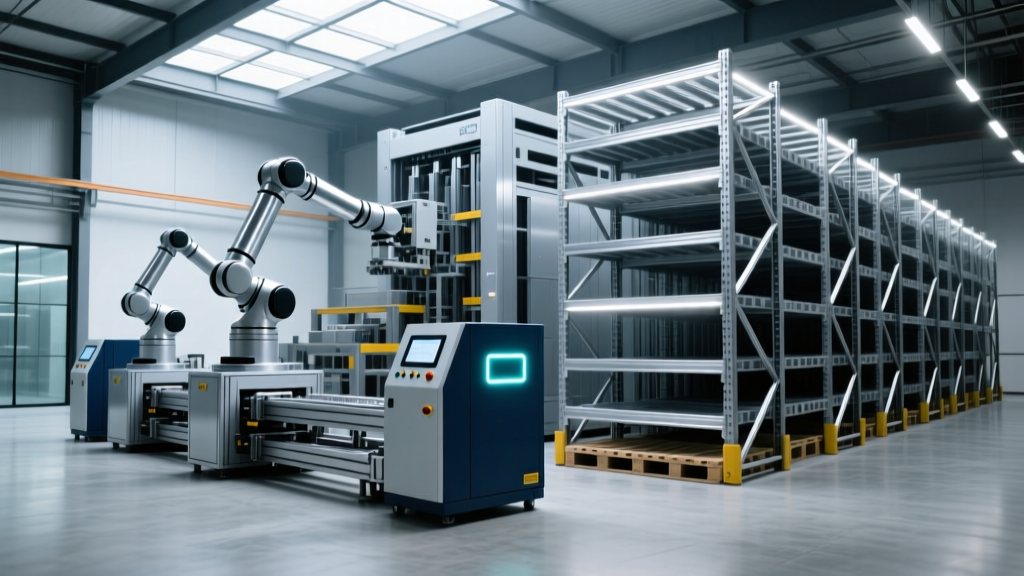
Pallet Shuttle Systems: Brands like SSI Schaefer and Dematic utilize battery-operated shuttles that travel inside the rack structure. This decouples horizontal travel from vertical lifting, allowing multiple shuttles to operate simultaneously in a single aisle. This architecture is superior for bulk storerooms with a low SKU count but massive volume per SKU (e.g., beverage distribution, paper rolls).
Warning: WCS/WMS Integration Latency
When procuring AS/RS, the mechanical hardware is only half the battle. The Warehouse Control System (WCS) must communicate with your host WMS via APIs. In 2026, look for WCS platforms that support sub-50-millisecond latency for task interleaving (combining putaway and retrieval in a single crane cycle). Poorly optimized WCS logic can reduce theoretical crane throughput by up to 30%.
Fire Suppression: The Hidden Cost in Bulk Storage
The most frequently underestimated cost in storeroom bulk material handling equipment selection is fire suppression compliance. High-density racking and AS/RS fundamentally alter airflow and water penetration dynamics.
The National Fire Protection Association (NFPA 13) sets the baseline for warehouse sprinkler systems. For bulk materials stored over 20 feet high:
- ESFR (Early Suppression, Fast Response) Ceiling Sprinklers: Effective for selective and push-back racking up to specific height limits, provided there are adequate flue spaces (typically 6 inches transverse, 12 inches longitudinal) to allow water cascade.
- In-Rack Sprinklers: Mandatory for most Unit-Load AS/RS and deep-lane shuttle systems. The dense, solid-block nature of AS/RS storage prevents ceiling water from reaching the base of the rack. In-rack sprinkler lines add $40 to $85 per pallet position to your total project cost and require specialized flexible drop hoses to accommodate rack deflection.
ROI Calculation Framework: When to Automate
To determine if the premium for AS/RS is justified over high-density racking, utilize the following 3-variable framework:
1. The Real Estate Multiplier
Calculate the fully loaded cost of warehouse space per square foot in your specific zip code (including property tax, HVAC, and lighting). If AS/RS reduces your required footprint by 30,000 square feet, and your localized space cost is $12/sq ft annually, the automated system yields $360,000 in annual real estate savings.
2. Labor and Equipment Depreciation
A single shift requires 3 forklifts and 4 operators to move 400 bulk pallets. Over a 10-year horizon, factor in operator wages (including benefits and turnover costs), forklift lease costs ($800-$1,200/month per unit), and battery maintenance. Compare this directly against the AS/RS maintenance contract (typically 2-4% of the initial capital cost annually) and the energy consumption of the cranes.
3. Product Damage and Shrinkage
Manual forklift handling of heavy bulk materials results in an industry-average damage rate of 1.5% to 3%. AS/RS reduces this to near zero. For high-value bulk materials (e.g., aerospace composites, pharmaceutical raw materials), the elimination of forklift-induced product damage alone can shorten the AS/RS payback period from 7 years to under 4 years.
Final Procurement Directives
Do not evaluate storeroom bulk material handling equipment in a vacuum. If your bulk materials are uniform, high-volume, and stored in a high-cost real estate market, unit-load AS/RS is the mathematically superior choice. If your SKU profile is highly fragmented, requiring constant physical access and visual inspection, invest in heavy-duty push-back racking with reinforced seismic bracing and polyurethane cart wheels. Always mandate a third-party fire protection engineer to review your rack layout against NFPA 13 before finalizing any purchase order.