Storeroom Integrated Material Handling Equipment Installations Oakland: Dock Leveler Specs
Technical specifications and integration protocols for dock levelers in storeroom integrated material handling equipment installations in Oakland.
The Transition Zone: Dock Pit to Storeroom AGV Routing
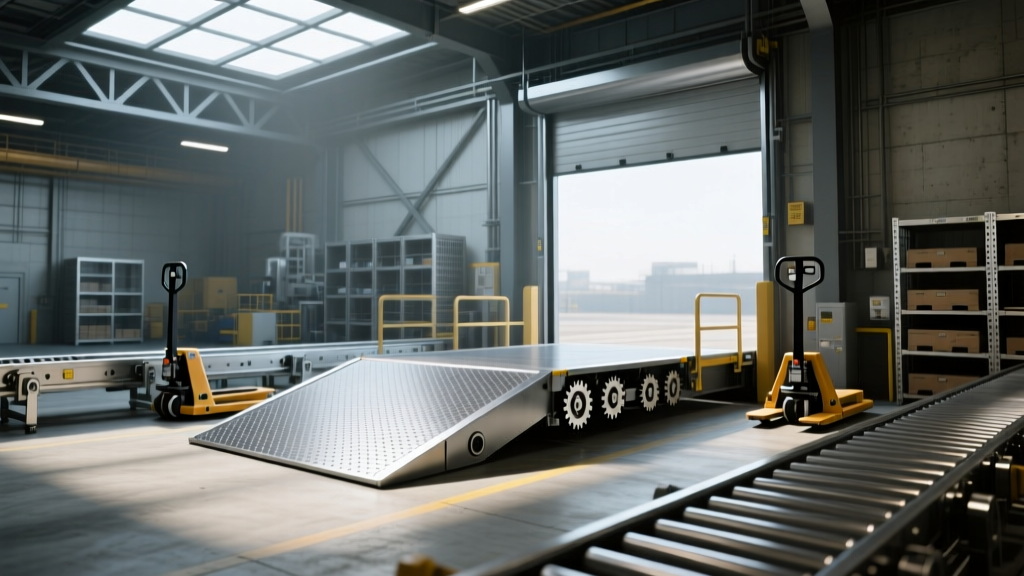
When engineering storeroom integrated material handling equipment installations in Oakland, facility planners must address the most volatile physical and digital handshake in the supply chain: the loading bay transition zone. This is the exact coordinate where 80,000-pound highway trailers meet internal Automated Guided Vehicles (AGVs) and automated conveyor networks. A standard dock leveler is no longer sufficient; the equipment must act as a smart, load-bearing bridge capable of communicating with the facility’s Warehouse Management System (WMS) while tolerating severe dynamic impacts.
The primary engineering challenge in these installations is maintaining a seamless kinetic flow. If a dock leveler lip deflects more than 0.25 inches under the point-load of a fully laden 6,000-pound forklift or an AGV tugger, the resulting jolt can derail automated routing sequences, damage polyurethane drive wheels, and trigger emergency stop (E-stop) protocols across the entire storeroom network.
⚠ Seismic Design Warning: Oakland Dock Pits
Oakland falls under Seismic Design Category D. Dock pits subjected to heavy dynamic loading must be poured with a minimum 4,000 PSI compressive strength concrete (cured for 28 days per ACI 318-19 standards). Furthermore, seismic isolation joints must be integrated between the dock pit foundation and the main warehouse slab. Failure to isolate the pit can result in lateral slab shifting during minor tremors, permanently misaligning the leveler frame and causing the hydraulic cylinder to bind or shear.
Core Technical Specifications for High-Cycle Levelers
Selecting the correct leveler for a high-throughput Oakland port-adjacent facility requires analyzing yield strength, hydraulic pressure tolerances, and lip geometry. Below is a comparison of three industrial-grade dock levelers optimized for continuous automated material handling integration.
| Model / Series | Rated Capacity | Lip Thickness & Material | Operating Pressure | Est. 2026 Unit Cost |
|---|---|---|---|---|
| Rite-Hite RHH Hydraulics | 80,000 lbs | 1.0" (AR400 Steel) | 5,000 PSI | $6,800 - $7,500 |
| McGuire 1000 Series | 80,000 lbs | 0.875" (ASTM A36) | Mechanical Spring | $4,200 - $4,800 |
| Pentalift Air-Hydraulic | 80,000 lbs | 1.0" (High-Tensile) | Air Bag / 3,500 PSI Lip | $5,500 - $6,200 |
Lip Deflection and Yield Strength Calculations
For storeroom integrated systems utilizing heavy-duty AGVs, the dock leveler lip must resist permanent deformation. Standard ASTM A36 steel (yield strength of 36,000 PSI) is prone to 'lip creep' after 50,000+ cycles. Upgrading to AR400 (Abrasion Resistant) steel with a yield strength exceeding 150,000 PSI reduces deflection to less than 0.15 inches under a 15,000-pound point load. This ensures the lip remains perfectly flush with the trailer bed, preventing the 'snag' effect that destroys automated tugger wheels.
PLC Handshakes and WMS Integration Protocols
A mechanical bridge is useless if the digital logic fails. In modern Oakland logistics hubs, the dock leveler's Programmable Logic Controller (PLC) must execute a strict interlock sequence with the storeroom's WMS before any material handling equipment is permitted to cross the threshold.
- Trailer Restraint Engagement: The automated vehicle restraint (e.g., a rotational hook dock lock) secures the trailer's ICC bar. A limit switch confirms engagement and sends a 24VDC signal to the main PLC.
- Leveler Deployment & Verification: The hydraulic leveler extends. A secondary proximity sensor verifies that the lip is resting securely on the trailer bed, not suspended in mid-air due to a false ICC bar reading.
- WMS Authorization (Modbus TCP/IP): The PLC transmits a 'Dock Ready' boolean tag via Modbus TCP/IP to the facility's WMS. The WMS then authorizes the specific AGV or automated forklift to approach the bay.
- Physical Barrier Retraction: Only after the WMS confirms the AGV is in the 'approach zone' does the leveler's physical safety barrier (if stored above dock level) retract, preventing accidental forklift drive-offs.
"Integrating dock levelers directly into the storeroom's automated dispatch logic reduces bay-to-storeroom transit delays by up to 18%, eliminating the manual visual checks that bottleneck high-volume cross-docking operations." — MHI Dock Loading Equipment Solutions
Troubleshooting AGV Transition Failures
Even with perfect installation, high-frequency bay operations in Oakland's humid, salt-air microclimate introduce specific failure modes. Below is a diagnostic framework for resolving transition errors between the dock leveler and internal automated equipment.
1. AGV Wheel Snag and E-Stop Triggers
Symptom: Low-profile AGVs trigger E-stops when crossing from the leveler lip to the trailer floor.
Root Cause: The trailer bed is lower than the dock, creating a negative incline. The standard 0.5-inch bevel on the leveler lip acts as a physical barrier to small-diameter (under 8-inch) polyurethane AGV wheels.
Engineering Fix: Retrofit the leveler with a 'no-gap' or crowned lip design featuring a tapered 12-inch approach ramp machined to a 3-degree slope. This reduces the impact vector and allows continuous kinetic flow without triggering the AGV's internal IMU (Inertial Measurement Unit) tilt alarms.
2. Hydraulic Lip Creep During Staging
Symptom: The leveler lip slowly drops below the trailer bed while an automated forklift is staging a pallet inside the trailer, causing a dangerous shear point.
Root Cause: Internal bypassing of hydraulic fluid within the main lift cylinder due to degraded polyurethane seals, exacerbated by temperature fluctuations in the Bay Area.
Engineering Fix: Specify levelers equipped with a solid-steel mechanical maintaining cylinder or an automatic hydraulic recirculation valve that actively monitors lip height and micro-adjusts pressure every 50 milliseconds to maintain a zero-tolerance flush surface.
3. Sensor Blinding from Particulate Accumulation
Symptom: The PLC fails to register 'Lip Stored' or 'Lip Deployed' states, locking out the WMS dispatch sequence.
Root Cause: Wood splinters, shrink-wrap debris, and tire rubber accumulate in the dock pit, physically blocking the optical or inductive proximity sensors.
Engineering Fix: Replace standard optical sensors with heavy-duty, flush-mounted inductive proximity sensors (e.g., Turck or Balluff models) rated for IP69K washdown environments. These ignore non-metallic debris and rely solely on detecting the steel underside of the leveler deck and lip.
Safety and Compliance Mandates
Facility managers overseeing storeroom integrated material handling equipment installations in Oakland must ensure all loading bay configurations comply with rigorous safety standards. The integration of automated equipment does not exempt the facility from manual safety overrides. According to OSHA Material Handling Guidelines, all dock levelers must feature physical toe-guards that automatically deploy when the leveler is raised above the dock floor, preventing pedestrian or manual pallet jack wheels from slipping into the pit. Furthermore, emergency manual pump-down valves must remain accessible and unobstructed by automated conveyor staging lanes, ensuring safe egress in the event of a total facility power failure.