Coil Material Handling Equipment: Battery vs Propane Safety Rules
Compare OSHA and NFPA safety compliance for battery vs propane coil material handling equipment. Learn ventilation, fire code, and load stability rules.
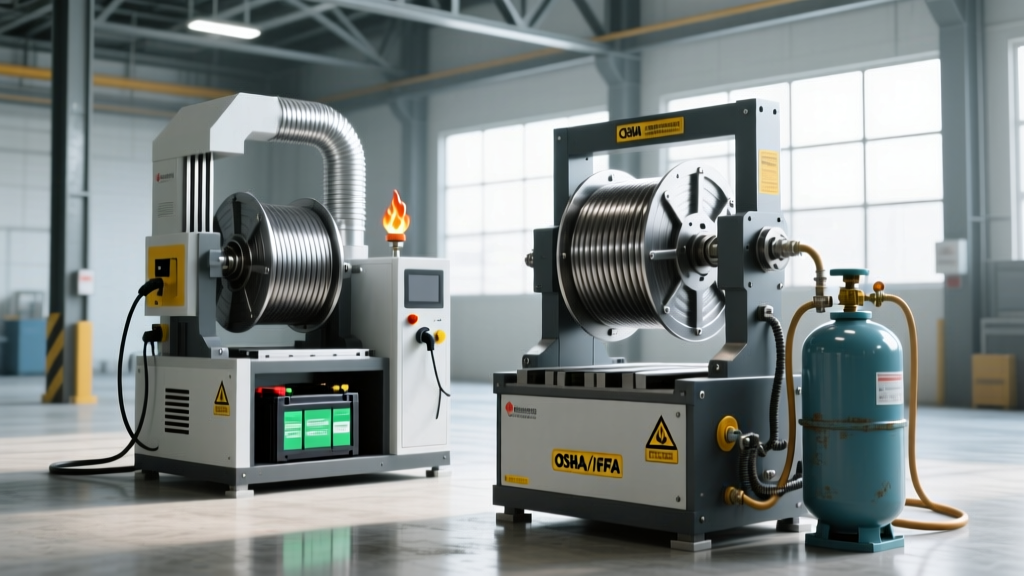
Moving 20-ton steel and aluminum coils requires specialized coil material handling equipment, such as heavy-duty forklifts equipped with coil rams, motorized C-hooks, or specialized grabbers. When specifying these 15,000 to 60,000-pound capacity machines, facility managers face a critical compliance fork: propane (LPG) versus battery power (Lead-Acid or Lithium-Ion). The power source dictates vastly different safety, ventilation, and fire code landscapes.
Choosing the wrong power architecture for your specific warehouse environment can result in severe OSHA violations, catastrophic thermal events, or fatal carbon monoxide exposure. This guide breaks down the exact regulatory requirements and physical safety dynamics governing battery and propane coil handlers.
The Regulatory Baseline: OSHA and ANSI/ITSDF Standards
All powered industrial trucks (PITs) operating in the United States must comply with OSHA Standard 1910.178. However, the standard bifurcates safety requirements based on the power source. Furthermore, the underlying design and stability testing for coil handlers are governed by the ANSI/ITSDF B56.1 standard. Because coil loads are cylindrical, dense, and prone to kinetic shifting, the base machine's power source directly impacts its center of gravity and compliance with B56.1 stability triangles.
Propane (LPG) Coil Handlers: Combustion & Air Quality Mandates
Internal combustion (IC) coil handlers powered by LPG are favored for outdoor lumber yards and open-air steel service centers due to their high torque and rapid refueling. However, deploying them indoors introduces strict air quality and fire safety compliance hurdles.
Ventilation and Carbon Monoxide (CO) Compliance
Under OSHA regulations, the permissible exposure limit (PEL) for carbon monoxide is 50 parts per million (ppm) over an 8-hour time-weighted average. A 30,000-lb capacity LPG coil forklift operating in a poorly ventilated bay can exceed this limit in minutes.
- Catalytic Converters: OSHA requires LPG forklifts operating indoors to be equipped with approved catalytic converters to reduce CO emissions.
- Continuous Monitoring: Facilities must install fixed, calibrated CO monitors with alarms set to trigger at 35 ppm (providing a buffer before the 50 ppm PEL is breached).
- Airflow Engineering: HVAC systems must be engineered to provide a minimum of 4 to 6 air changes per hour (ACH) in coil storage aisles where LPG equipment idles or operates.
LPG coil handlers emit the highest concentration of carbon monoxide during cold starts and rich-idle phases. Never allow operators to idle a 30,000-lb LPG coil truck inside the warehouse doors while waiting for crane operators to prep the next steel coil.
NFPA 58 and Cylinder Handling
Propane cylinder exchange for heavy-duty equipment falls under NFPA 58 (Liquefied Petroleum Gas Code). Operators must use proper PPE (neoprene gloves and face shields) during exchanges to prevent frostbite from liquid LPG expansion. Cylinders must be stored in NFPA-compliant outdoor cages, at least 10 feet from building openings, which increases the travel time for refueling high-capacity coil handlers.
Battery-Powered Coil Handlers: Electrical & Thermal Compliance
As of 2026, the shift toward high-voltage (80V to 120V+) lithium-ion architectures in heavy-duty coil handlers has accelerated, driven by zero-emission mandates and indoor air quality concerns. However, battery power shifts the compliance burden from air quality to electrical safety and thermal management.
Lead-Acid vs. Lithium-Ion Compliance Divergence
OSHA Standard 1910.178(g) strictly governs battery charging installations, but the physical risks differ wildly between chemistries.
Lead-Acid: Chemical and Crane Hazards
Traditional 80V, 1500Ah+ lead-acid batteries used in heavy coil forklifts weigh upwards of 4,500 pounds. Compliance mandates include:
- Eye Wash Stations: ANSI-compliant plumbed eye wash stations must be located within 10 seconds (approx. 55 feet) of the battery charging area due to sulfuric acid splash risks.
- Overhead Cranes: Dedicated overhead hoists with specialized battery lifting beams are required. Using the coil forklift's own mast to extract a lead-acid battery is a direct OSHA violation unless the manufacturer explicitly engineered an approved extraction mechanism.
- Ventilation: Hydrogen gas off-gassing during the equalization charge cycle requires dedicated exhaust ventilation to keep hydrogen concentrations below 1% of the lower explosive limit (LEL).
Lithium-Ion: Thermal Runaway and NFPA 1
Lithium-ion battery packs eliminate hydrogen off-gassing and acid spills but introduce thermal runaway risks. Under the NFPA 1 Fire Code and local AHJ (Authority Having Jurisdiction) requirements, Li-ion charging stations for heavy industrial equipment often require:
- Thermal Management Clearances: Minimum 3-foot clearances around the battery compartment to allow for heat dissipation during 150A+ fast charging.
- Specialized Suppression: Standard wet-pipe sprinkler systems are often insufficient to stop Li-ion thermal runaway. Many jurisdictions now mandate specialized water-mist or continuous-deluge sprinkler heads directly above high-capacity Li-ion charging bays.
The 'Coil Factor': Load Dynamics and Power Source Safety
The most overlooked compliance issue in coil material handling equipment is how the power source interacts with the physics of the load. Steel coils are incredibly dense; a 4-foot wide coil can weigh 25,000 pounds. This requires a massive counterweight to maintain the ANSI/ITSDF B56.1 forward stability triangle.
The Ballast Compliance Trap: In a lead-acid electric coil forklift, the 4,500-lb battery acts as the primary counterweight. If a facility retrofits or upgrades to a lithium-ion battery—which can weigh 40% to 60% less than its lead-acid equivalent—the machine loses its rearward mass. Operating a coil handler with an undersized Li-ion pack without a certified, manufacturer-stamped steel ballast box is a severe stability violation that will cause the rear axle to lift during a 20-ton coil pickup.
Compliance & Infrastructure Matrix
Use the following matrix to evaluate the infrastructural and compliance requirements for your facility's coil handling fleet.
| Compliance / Infrastructure Factor | Propane (LPG) | Lead-Acid Electric | Lithium-Ion Electric |
|---|---|---|---|
| Indoor Air Quality Monitoring | Mandatory (CO sensors at 35ppm) | Not Required (Zero emissions) | Not Required (Zero emissions) |
| Ventilation Requirements | High (4-6 ACH for exhaust) | High (Hydrogen exhaust in charge room) | Low (Standard HVAC sufficient) |
| Fire Suppression Upgrades | Standard (Outdoor storage cages) | Standard (Acid spill containment) | High (Deluge/Mist for thermal runaway) |
| Counterweight / Stability | Fixed cast-iron counterweight | Battery mass acts as counterweight | Requires certified steel ballast box |
| Refueling/Charging Time | 10-15 minutes (Cylinder swap) | 8 hours charge + 8 hours cool down | 1-2 hours (Opportunity fast charging) |
Actionable Decision Framework for Facility Managers
To select the compliant power source for your coil material handling equipment, run your operation through this decision filter:
1. Evaluate the Enclosure Rating
If your coil processing lines are fully enclosed and climate-controlled (common in aerospace aluminum or automotive steel blanking), eliminate LPG. The cost of engineering 6 ACH ventilation and maintaining continuous CO scrubbing systems outweighs the lower upfront cost of IC engines.
2. Audit Your Overhead Crane Capacity
If you lack a dedicated 5-ton+ overhead crane in your maintenance bay, you cannot safely or legally perform lead-acid battery exchanges on a heavy-duty coil handler. In this scenario, specify Lithium-Ion (which requires no physical removal for charging) or LPG.
3. Verify the Ballast Certification
If purchasing Li-ion electric coil handlers, demand the manufacturer's Ballast Weight Certification Sheet before delivery. Ensure the facility's charging infrastructure can support the high-voltage draw (often requiring 480V 3-phase drop) and that the local fire marshal has approved the specific Li-ion chemistry's suppression plan.
Compliance in coil handling is not just about the attachment; it is about the holistic integration of the power source, the facility environment, and the extreme physics of the load. Aligning your power choice with OSHA and NFPA mandates ensures operational continuity and protects personnel from the unique hazards of multi-ton cylindrical loads.