Best Lathe Machine Tools: 2026 Buying Guide for Precision Turning
Discover the best lathe machine tools for 2026. Compare indexable inserts, QCTP systems, and boring bars with expert buying advice and pricing data.
The 2026 Landscape for Lathe Machine Tools
Outfitting a manual or CNC turning center requires more than just picking generic cutting bits off a catalog page. In 2026, the market for lathe machine tools has bifurcated into high-volume production tooling and ultra-precision bespoke setups, driven by advancements in PVD coatings and vibration-dampening metallurgy. Selecting the correct lathe machine tools dictates your cycle times, surface finish capabilities, and overall cost per part. This guide bypasses generic advice to provide exact specifications, pricing benchmarks, and material-matching frameworks for machinists and shop owners.
Critical Buying Warning: Avoid 'piston-type' Quick Change Tool Posts (QCTP) often sold in bulk import kits for under $90. They suffer from severe Y-axis repeatability loss (often exceeding 0.002'') after a few weeks of use. Always invest in wedge-type systems for precision turning.Material-Specific Tool Selection Framework
Before purchasing toolholders and inserts, you must map your primary workpiece materials to the correct substrate and coating. Using a CVD-coated insert on gummy 304 stainless steel will result in immediate built-up edge (BUE) and insert failure. According to data from Sandvik Coromant's turning knowledge hub, matching the insert grade to the ISO material group is the single highest factor in extending tool life.
| Workpiece Material | ISO Group | Recommended Insert Grade / Coating | Optimal Geometry & Rake | Estimated Cost per Insert (2026) |
|---|---|---|---|---|
| Aluminum (6061 / 7075) | N (Non-ferrous) | Uncoated Carbide (e.g., Kennametal KC5010) or PCD | High positive rake, polished flute, sharp edge | $14 - $22 |
| Stainless Steel (304 / 316) | M (Stainless) | PVD-Coated (e.g., Sandvik GC215) | Sharp cutting edge, high feed geometry | $18 - $26 |
| Low Carbon Steel (1018 / A36) | P (Steel) | CVD-Coated (e.g., Iscar IC907) | Medium rake, chipbreaker for stringy chips | $10 - $15 |
| Hardened Steel (>45 HRC) | H (Hard) | CBN (Cubic Boron Nitride) or Ceramic | Negative rake, heavy edge prep (T-land) | $45 - $85 |
Indexable Turning Toolholders: Sizing and Shank Standards
When buying indexable toolholders for lathe machine tools, the shank size must perfectly match your machine's center height and turret clearance. For standard manual engine lathes (10'' to 14'' swing), the industry standard is a 1/2'' or 3/4'' shank. For CNC lathes, 1'' to 1.5'' shanks are required to handle the rigidity demands of high-speed cutting.
Decoding Insert Geometry for Turning
Do not buy 'general purpose' inserts. You need specific geometries for roughing, semi-finishing, and finishing. The ISO naming convention dictates the shape, clearance, tolerance, type, size, and thickness. For example, a CNMG 432 insert is a staple for roughing:
- C: 80-degree diamond shape (allows for both turning and facing).
- N: 0-degree clearance (requires a negative rake holder, providing maximum edge strength).
- M: Medium tolerance (standard for most production tooling).
- G: Top face has a chipbreaker groove.
- 432: Size 4 (1/2'' inscribed circle), thickness 3 (3/16''), nose radius 2 (1/32'').
For a comprehensive breakdown of advanced chipbreaker geometries and turning portfolios, refer to Kennametal's official turning catalog, which details how specific rake angles influence cutting forces in 2026's high-feed applications.
Quick Change Tool Posts (QCTP): Wedge vs. Piston
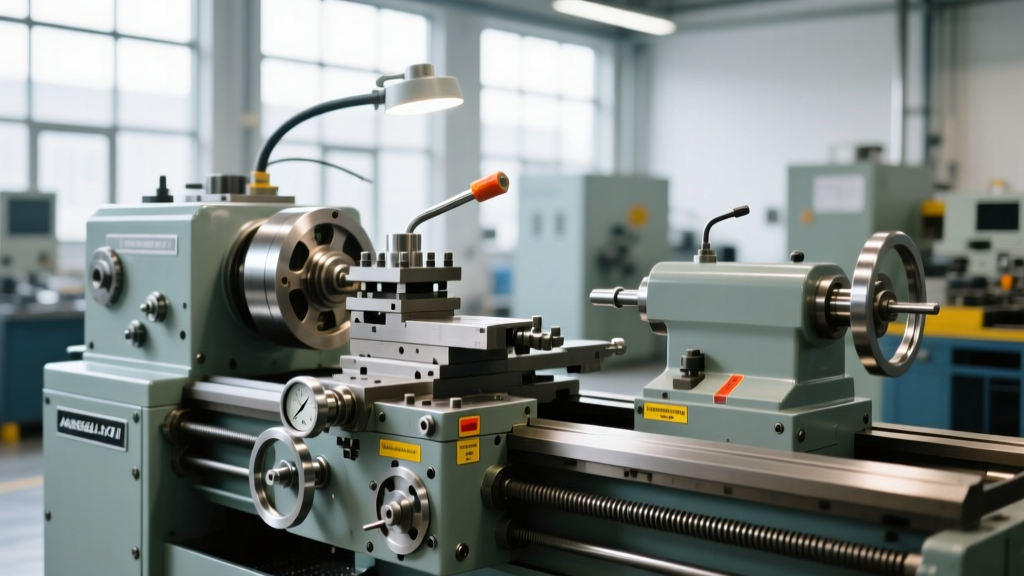
For manual lathe operators, a QCTP is the most significant upgrade you can make to your lathe machine tools setup. It reduces tool change times from 3 minutes to under 15 seconds while maintaining center height repeatability.
Sizing Guide for Manual Lathes
- AXA Series (100 / 120): Fits 9'' to 12'' swing lathes. Accepts 1/2'' and 3/4'' toolholders. Max tool height: 3/4''.
- BXA Series (200): Fits 13'' to 15'' swing lathes. Accepts 3/4'' and 1'' toolholders. Max tool height: 1''.
- CXA Series (300): Fits 16'' to 18'' swing lathes. Accepts 1'' and 1-1/4'' toolholders. Max tool height: 1-1/4''.
'The wedge-type mechanism uses a dovetail slide that pulls the toolholder down and inward simultaneously. This dual-axis clamping force eliminates the microscopic lift that occurs during heavy interrupted cuts, a common failure point in cheaper piston-style designs.' — Senior Tooling Engineer, Aerospace Manufacturing Division
Brand & Pricing Benchmarks (2026):
- Aloris (USA): The gold standard. An AXA wedge-type kit costs between $450 and $650. Guaranteed repeatability of 0.0005''.
- Dorian Tool (USA): Excellent mid-tier option. AXA kits range from $280 to $350. Repeatability of 0.001''.
- Import Brands (e.g., Shars, Accusize): Budget options ranging from $120 to $180. Acceptable for hobbyists, but expect to shim tools occasionally.
Boring Bars and Vibration Dampening
Internal turning operations are where most shops lose money due to scrap from chatter. The fundamental rule of boring bar overhang is dictated by the material's modulus of elasticity. When selecting boring bars as part of your lathe machine tools inventory, adhere strictly to these maximum overhang ratios to prevent harmonic vibration:
| Bar Material | Max Overhang Ratio (L:D) | Best Application | Price Range (1'' Diameter Bar) |
|---|---|---|---|
| Standard Steel | 4:1 | Shallow bores, high rigidity setups | $45 - $80 |
| Solid Carbide | 6:1 | Medium depth, high surface finish requirements | $250 - $400 |
| Heavy Metal (Tungsten Alloy) | 7:1 to 8:1 | Deep bores without anti-vibration tech | $350 - $600 |
| Anti-Vibration (Dampened) | 10:1 to 14:1 | Extreme depth, aerospace tubing, thin walls | $1,200 - $2,500+ |
Cost vs. Performance: Indexable vs. Solid Carbide vs. HSS
A common mistake in 2026 is defaulting to solid carbide tools for manual lathes, or using High-Speed Steel (HSS) on CNC production runs. Here is the decision matrix for optimizing your tooling budget:
1. High-Speed Steel (HSS) & Cobalt (M42)
Use Case: Manual lathes, one-off prototypes, custom form tools, and low-rigidity machines (e.g., 7x12 mini lathes).
Pros: Extremely cheap ($8-$15 per blank), can be ground to any custom geometry, forgiving on machines with backlash or worn bearings.
Cons: Loses hardness above 600°C. Cannot machine hardened steels or exotic alloys. Requires manual grinding skill.
2. Indexable Carbide
Use Case: CNC lathes, high-volume production, roughing operations.
Pros: Fast cutting speeds (300-800 SFPM), no grinding required, consistent part dimensions.
Cons: High initial cost for toolholders ($40-$120 each), inserts cannot be ground to custom profiles, requires rigid machine setup.
3. Solid Carbide & Brazed Carbide
Use Case: Micro-turning (Swiss-type lathes), finishing operations requiring sharp corners, small bore grooving.
Pros: Maximum rigidity, allows for smaller tool geometries than indexable holders.
Cons: Brittle (chips easily on interrupted cuts), expensive to replace entire tool.
Final Procurement Strategy
When building out your inventory of lathe machine tools, allocate 70% of your budget to indexable tooling for roughing and standard turning, 20% to a premium wedge-type QCTP system, and 10% to specialized solid carbide or HSS tools for threading, grooving, and custom form cuts. Always verify the center height of your compound rest before ordering toolholders, and prioritize PVD-coated inserts for any stainless or high-temperature alloy work to maximize your spindle uptime.