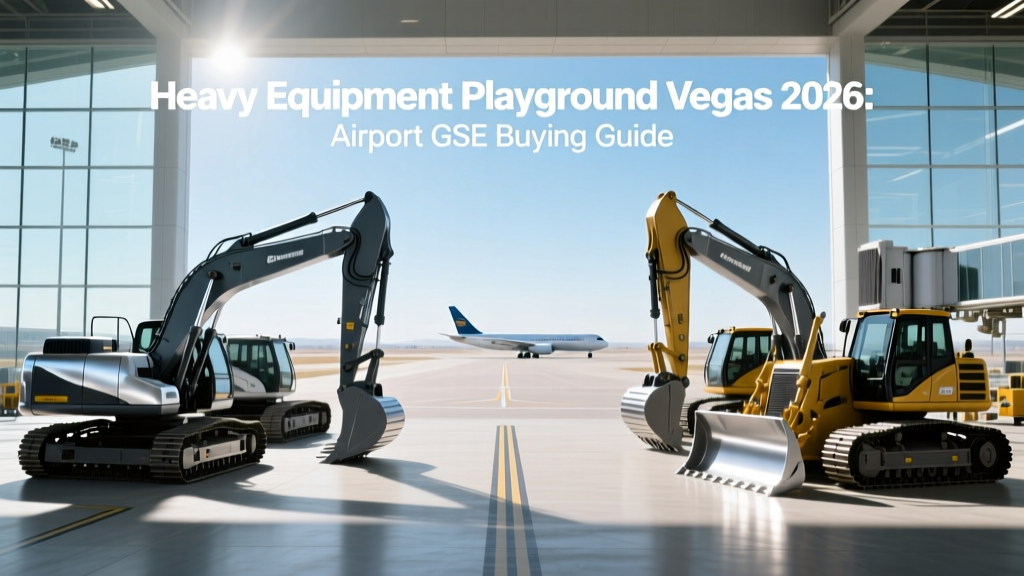
Heavy Equipment Playground Vegas 2026: Airport GSE Buying Guide
Source airport ground support equipment at the 2026 Vegas heavy equipment playground. Compare eGSE pricing, tow tractors, and GPUs for fleet procurement.
Navigating the 2026 GSE Procurement Landscape
Procuring airport ground support equipment (GSE) requires rigorous live-testing, precise specification matching, and a clear understanding of total cost of ownership. For aviation fleet managers and FBO (Fixed Base Operator) directors, the CONEXPO-CON/AGG exhibition—widely recognized as the ultimate heavy equipment playground Vegas has to offer—presents a critical 2026 opportunity to evaluate next-generation electric GSE (eGSE) and heavy-duty pushback tractors under load. Rather than relying on brochure specifications, buyers can test drawbar pull, ramp grade traction, and 400 Hz voltage stability in real-world conditions.
This guide provides a technical framework for sourcing, testing, and purchasing airport ground support machinery, leveraging the live-testing environments available at major 2026 equipment expos to finalize your fleet procurement strategy.
The Core Fleet: Ground Support Equipment Categories
Airport ramp operations rely on a synchronized matrix of specialized heavy machinery. When building or upgrading a fleet, procurement officers must categorize equipment by primary function and powertrain architecture. The IATA Ground Operations standards dictate strict safety and compatibility requirements for all ramp equipment.
1. Aircraft Tow Tractors (ATT) & Pushback Tractors
ATTs are categorized by drawbar pull (DBP), measured in pounds. Conventional tow tractors (using a towbar) typically range from 8,000 lbs to 15,000 lbs DBP, suitable for regional jets and narrow-body aircraft up to 150,000 lbs MTOW (Maximum Takeoff Weight). For wide-body aircraft, towbarless (TBL) pushback tractors like the Goldhofer AST-1X or Eagle Tugs SuperTug are mandatory, offering cradle mechanisms that lift the nose gear directly, reducing turnaround times by up to 18% and eliminating towbar maintenance.
2. Ground Power Units (GPU)
GPUs supply electrical power to aircraft while engines are off. Buyers must choose between 28V DC (for engine starts and older avionics) and 145 kVA 400 Hz AC (for modern commercial cabin power). Solid-state electric GPUs are rapidly replacing diesel motor-generator sets due to lower noise profiles and zero local emissions, a critical factor for enclosed terminal gates.
3. Belt Loaders & Cargo Conveyors
Self-propelled belt loaders (e.g., JBT AeroTech Commander 15i) require precise approach angles and variable belt speeds (typically 100 to 140 ft/min) to prevent cargo damage. The 2026 focus is on auto-leveling sensors and anti-collision radar systems that halt the unit inches from the aircraft fuselage.
Live-Testing at the Vegas Playground: What to Measure
Walking the floor of the heavy equipment playground Vegas hosts at CONEXPO is not just about visual inspections; it is an active proving ground. When testing GSE prototypes or production models, mandate the following field tests with the manufacturer's technicians:
⚠️ CRITICAL WARNING: Nose-Gear CompatibilityWhen testing Towbarless (TBL) pushback tractors, verify the cradle's hydraulic clamping range. The Boeing 737 MAX and Airbus A320neo feature distinctly different nose-gear geometries and tow-fitting tolerances. Ensure the TBL unit's proximity sensors and physical cradle limits accommodate both without requiring manual adapter swaps, which add 4-6 minutes to pushback operations.
Evaluating Drawbar Pull on Ramp Grades
Do not accept static drawbar pull ratings. Request a dynamic incline test. A fully loaded baggage tug or aircraft pushback tractor must maintain continuous traction on a 10% to 15% grade simulating wet apron conditions. Verify the torque curve of the electric drivetrain; electric motors deliver 100% peak torque at 0 RPM, which is superior for starting heavy loads on an incline compared to diesel torque converters.
Verifying 400 Hz GPU Voltage Drops
When testing electric GPUs, deploy the full 200-foot 400 Hz output cable. Under a simulated 90 kVA continuous load, measure the voltage drop at the aircraft receptacle end. Industry standards dictate the voltage must not drop below 110V (phase-to-phase) or 108V (phase-to-neutral). If the manufacturer's cable gauge is undersized to save weight, the voltage drop will trigger aircraft ground power monitoring faults, causing the aircraft to reject the external power.
CapEx vs. OpEx: 2026 GSE Procurement Matrix
The transition to eGSE fundamentally alters the financial modeling of GSE procurement. While electric units carry a higher initial capital expenditure (CapEx), the operational expenditure (OpEx) savings in fuel, maintenance, and brake replacement are substantial. Below is the 2026 pricing and lifecycle matrix for standard GSE fleet assets.
| Equipment Type | Powertrain | Avg CapEx (USD) | Est. Annual OpEx | Key Spec to Verify |
|---|---|---|---|---|
| Conventional ATT (12k DBP) | Diesel Tier 4 | $55,000 - $75,000 | $8,500 | DEF fluid system reliability |
| Electric ATT (12k DBP) | Li-Ion (LFP) | $85,000 - $110,000 | $2,100 | Battery thermal management |
| TBL Pushback Tractor | Diesel / Hybrid | $280,000 - $420,000 | $18,000 | Cradle hydraulic cycle time |
| Solid-State GPU (145 kVA) | Grid-Tied Electric | $95,000 - $135,000 | $1,500 | Cable voltage drop over 200ft |
| Self-Propelled Belt Loader | Electric | $65,000 - $85,000 | $2,500 | Auto-leveling sensor latency |
The eGSE Mandate: Battery Chemistry and Charging Infrastructure
The shift toward electric GSE is no longer optional; major global hubs and industry authorities are enforcing strict emission reduction targets for ramp operations. However, buying eGSE requires understanding battery chemistry and charging bottlenecks.
"Fleet managers transitioning to eGSE must prioritize Lithium Iron Phosphate (LFP) battery chemistry over Nickel Manganese Cobalt (NMC). LFP cells tolerate the high-frequency, shallow-cycle charging patterns typical of airport ramp operations and offer a 10-year lifecycle without the severe thermal runaway risks associated with NMC batteries in high-ambient-temperature tarmac environments."
Infrastructure Hidden Costs
Procuring electric belt loaders and GPUs is only half the equation. You must budget for the charging infrastructure. A standard 150kW DC fast-charging depot for GSE costs between $45,000 and $75,000 per stall, including trenching, high-voltage drop cabling, and smart-load balancing software to prevent peak-demand utility penalties. Ensure your purchase agreement with the GSE manufacturer includes a site audit and charging integration plan.
Step-by-Step Procurement Checklist for Fleet Managers
Before signing a fleet renewal contract at the expo or via direct dealer networks, execute this 5-point technical verification checklist:
- Demand Telematics API Access: Ensure the GSE units feature open-protocol telematics (e.g., CAN bus integration) that can feed directly into your airport's existing ramp management software (like SITA or Resource Manager). Proprietary, closed-loop telematics will trap your operational data.
- Verify IP Ratings for Tarmac Exposure: Electric GPUs and ATTs must carry a minimum IP65 rating for all high-voltage junction boxes and motor controllers to withstand high-pressure apron washing and blowing de-icing fluids.
- Audit the Anti-Collision Sensor Suite: For belt loaders and passenger stairs, verify the use of solid-state LiDAR or ultrasonic arrays rather than basic optical cameras, which fail in heavy rain, snow, or direct tarmac glare.
- Negotiate Lifecycle Component Swaps: For eGSE, write a guaranteed battery degradation clause into the contract. The manufacturer should guarantee that the LFP battery pack will retain 80% of its original kWh capacity at year 7, or provide a prorated replacement.
- Confirm FOD (Foreign Object Debris) Mitigation: Inspect the undercarriage and wheel wells of tow tractors. Open cavities that trap tarmac debris and subsequently drop it near jet engines are a massive liability. Require factory-installed FOD flaps and enclosed hydraulic lines.
Finalizing the Acquisition
Attending the CONEXPO-CON/AGG exhibition provides an unparalleled tactile advantage in GSE procurement. By forcing manufacturers to demonstrate dynamic drawbar pull, 400 Hz voltage stability, and automated safety halts on the show floor, buyers transition from passive consumers to technical auditors. Use the 2026 pricing matrices and battery chemistry guidelines above to structure your RFPs, ensuring your ground support fleet is optimized for the next decade of high-turnaround aviation operations.