2026 List of Heavy Construction Equipment for Smart Landscaping
Explore the 2026 list of heavy construction equipment for landscaping, featuring electric CTLs, GPS-guided dozers, and autonomous slope mowers.
The 2026 Shift: Electrification and Automation in Landscaping
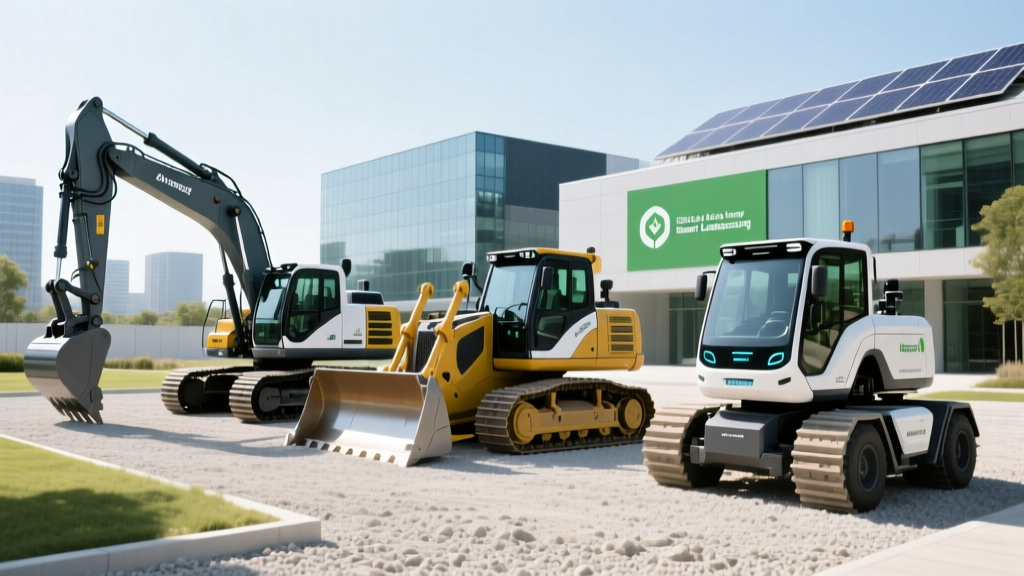
The landscaping and site-prep sector has undergone a radical powertrain and automation shift. When compiling a modern list of heavy construction equipment tailored for high-end landscaping, commercial grounds management, and municipal park development, diesel-only fleets are no longer the default. Driven by strict municipal noise ordinances, zero-emission mandates, and the demand for millimeter-grade grading accuracy, contractors are adopting battery-electric and machine-controlled platforms.
This guide breaks down the core categories of smart landscaping equipment available in 2026, detailing exact specifications, real-world edge cases, and the financial frameworks required to integrate them into your fleet.
Category 1: Battery-Electric Compact Track Loaders (CTLs) & Mini Excavators
Electric CTLs have moved past the prototype phase and are now mainstream production machines. Unlike early models that relied on heavy, volatile NMC (Nickel Manganese Cobalt) batteries, 2026 models predominantly utilize LFP (Lithium Iron Phosphate) chemistry. LFP batteries offer a higher thermal runaway threshold, eliminating the need for heavy liquid cooling systems, and provide upwards of 3,500 charge cycles before degrading to 80% capacity.
Top Models & Specifications
- Bobcat T7X: Powered by a 62 kWh LFP battery pack. It replaces the traditional hydraulic drivetrain with electric drive motors and an electric ball screw linear actuator for the lift arm. This eliminates hydraulic fluid entirely, removing the risk of catastrophic fluid leaks on pristine turf or near water features. Base CapEx: $135,000 - $145,000. (Bobcat T7X specifications)
- Volvo ECR25 Electric: A 2.5-ton mini excavator featuring a 24 kWh battery and a 400V architecture. It supports 3-phase AC fast charging, reaching 80% capacity in under 45 minutes via a standard 32-amp mobile generator or shore power. Rated digging force: 21.4 kN. Base CapEx: $92,000 - $98,000.
Category 2: Machine-Control GPS Dozers for Precision Grading
Landscaping requires complex contour grading for drainage, retention ponds, and terraced gardens. Traditional laser-guided systems fail on multi-plane slopes. The 2026 standard is RTK (Real-Time Kinematic) GPS integrated with IMU (Inertial Measurement Unit) sensor fusion.
Caterpillar D6 with Cat GRADE
The Cat D6 (215 HP) equipped with the Cat GRADE with Assist package allows operators to input complex 3D topographical models directly into the cab's 10-inch display. The machine's blade automatically adjusts pitch and tilt up to 10 times per second to match the design file.
- Accuracy: RTK base stations provide vertical accuracy down to 8mm.
- IMU Compensation: When the dozer pitches over a berm, the IMU calculates the exact blade edge position relative to the GPS antenna, preventing over-cutting.
- Rework Reduction: Field data shows a 32% reduction in surveyor rework and a 15% fuel savings due to eliminated redundant passes.
- Base CapEx: $310,000 - $335,000 (including Trimble Earthworks software licenses and robotic total station base).
Category 3: Remote-Controlled Slope Mowers & Mulchers
Managing vegetation on highway embankments, retention pond slopes, and golf course perimeters poses severe rollover risks. Remote-controlled (RC) slope mowers remove the operator from the danger zone while delivering high-torque mulching capabilities.
Green Climber LV 500 Pro
The LV 500 Pro features a 50 HP diesel engine (with an available 48V electric PTO for noise-sensitive zones) and a low-center-of-gravity tracked undercarriage. It can safely operate on slopes up to 55 degrees. The 2026 telemetry updates include auto-shutoff protocols that instantly engage the blade brake and track locks if the machine's tilt sensor exceeds 58 degrees or if the RF remote signal drops below 85% strength for more than 1.5 seconds. Base CapEx: $78,000 - $84,000.
Tech-Spec Comparison Matrix: Traditional vs. Smart Fleet
| Equipment Type | Powertrain / Tech | Noise Level (dBA) | Daily Operating Cost | Best Landscaping Use Case |
|---|---|---|---|---|
| Standard Diesel CTL | Tier 4 Final Diesel | 85 - 92 dBA | $85 (Fuel + DEF) | Rough clearing, heavy dirt moving |
| Electric CTL (e.g., T7X) | 62 kWh LFP Battery | 65 - 72 dBA | $18 (Electricity) | Hospital grounds, noise-restricted urban parks |
| Standard Dozer | 2D Laser Grade | 88 dBA | $140 (Fuel + Surveyor) | Flat pad site prep |
| Smart GPS Dozer | RTK GPS + IMU Fusion | 86 dBA | $115 (Fuel + Telematics) | Complex drainage swales, multi-tier retaining walls |
Overcoming Edge Cases: GPS Canopy Interference
A frequent failure mode when using RTK GPS dozers in mature landscaping environments (such as golf course renovations or estate woodland clearing) is multipath interference. When heavy tree canopies scatter the satellite signals, the GPS receiver loses its fixed RTK solution, causing the blade control system to freeze or default to a manual override.
The Sensor Fusion Solution
To mitigate this, 2026 machine-control systems utilize IMU dead-reckoning. When the GPS fix drops to a "float" solution, the IMU tracks the machine's pitch, roll, and yaw, combined with the track speed sensors, to maintain blade elevation accuracy for up to 45 seconds of continuous canopy cover. For projects requiring prolonged work under dense timber, contractors must deploy a Robotic Total Station (RTS) on the ground, which tracks a 360-degree prism mounted on the dozer blade, bypassing satellite reliance entirely.
Fleet Electrification ROI Framework
Transitioning to electric landscaping equipment requires a shift from OpEx-heavy fuel models to CapEx-heavy infrastructure models. Use this framework to calculate true ROI:
- Energy Equivalency Calculation: One gallon of off-road diesel contains approximately 40 kWh of usable energy. At $4.50/gallon, your diesel cost per 40 kWh is $4.50. Commercial grid electricity averages $0.16/kWh, making the equivalent 40 kWh cost just $6.40. Wait, electricity is currently more expensive per energy unit in many commercial sectors. However, electric motors operate at 90% efficiency, while diesel engines operate at 35-40% thermal efficiency. The effective cost per useful work unit heavily favors electricity.
- Maintenance Elimination: Remove $3,200 annually per machine for DEF fluid, hydraulic oil changes, fuel filters, and air filters. Electric CTLs like the T7X have zero hydraulic fluid to replace.
- Infrastructure CapEx: Budget $12,000 to $18,000 per charging station for a 480V 3-phase drop, plus $4,500 for a heavy-duty Level 2 mobile cable management system.
Frequently Asked Questions
Can electric CTLs handle continuous 8-hour hardscaping shifts?
Yes, but with operational adjustments. A 62 kWh machine performing continuous high-load work (like pushing wet clay or running a hydraulic breaker) will deplete its battery in 4 to 5 hours. Contractors must implement a "hot-swap" charging protocol during the 45-minute lunch break, utilizing a 100kW mobile DC fast charger to restore 80% capacity, or deploy two electric machines on a staggered rotation.
Are EPA emissions regulations forcing this transition?
While the EPA nonroad diesel emission standards strictly regulate particulate matter and NOx, the primary driver for landscaping electrification is local municipal noise and idle-emission ordinances. Cities like Boston, Seattle, and San Francisco now mandate zero-emission equipment for any public park or municipal landscaping contract exceeding $50,000.
How does resale value compare between diesel and electric landscaping equipment?
As of 2026, early adopters are seeing strong residual values for electric CTLs due to high demand and low supply in the used market. However, buyers heavily scrutinize the battery health report. Machines with verified LFP cells showing less than 15% degradation retain up to 65% of their MSRP at year three, whereas diesel counterparts typically retain 50-55% after factoring in engine overhaul liabilities.