Snow Removal Heavy Equipment Machines: Municipal Fleet Case Studies
Analyze municipal fleet case studies deploying snow removal heavy equipment machines. Compare Oshkosh, Mack, and Volvo models with ROI and deployment data.
Operational Demands of Modern Winter Maintenance Fleets
Municipalities and state departments of transportation face compounding pressure to maintain arterial clearances during extreme winter events. Deploying the right heavy equipment machines for snow removal is no longer just about attaching a steel blade to a standard dump truck; it requires highly engineered, purpose-built platforms capable of sustained hydraulic output, sub-zero powertrain reliability, and precise operator visibility. According to the Federal Highway Administration (FHWA), winter road maintenance accounts for over 20% of annual highway operations budgets in northern climates, making equipment uptime and operational efficiency critical metrics for fleet managers.
This analysis examines three distinct municipal fleet case studies, breaking down the exact chassis specifications, upfit costs, and operational ROI of modern winter maintenance equipment deployed in high-snowfall regions.
Case Study 1: Class 8 Heavy Equipment Machines for Arterial Plowing
For primary arterial routes and highway corridors, Class 8 chassis equipped with 14-foot reversible moldboard plows and liquid prewet systems remain the industry standard. The operational debate in 2026 centers on cab configuration: set-forward (cabover) versus conventional. The Oshkosh H-Series and the Mack Granite represent these two competing philosophies.
Set-Forward vs. Conventional: The Visibility and Turning Radius Trade-off
The Oshkosh H-Series utilizes a set-forward axle design, positioning the driver directly over the front axle. This configuration yields a significantly tighter turning radius (typically 28 to 32 feet curb-to-curb), which is critical for navigating tight municipal intersections, cul-de-sacs, and roundabouts. Furthermore, the H-Series features a sloped hood and an offset driver position, maximizing right-side visibility to monitor the plow blade's proximity to curbs and guardrails.
Conversely, the Mack Granite conventional chassis offers superior highway ride comfort for long rural routes and provides unobstructed, walk-in access to the engine bay. This easy access is a massive advantage for mechanics performing mid-storm maintenance, such as thawing frozen Diesel Exhaust Fluid (DEF) lines or replacing clogged fuel filters in -20°F conditions.
| Specification | Oshkosh H-Series (Set-Forward) | Mack Granite (Conventional) |
|---|---|---|
| Chassis Base Price (2026) | $245,000 - $265,000 | $215,000 - $235,000 |
| Curb-to-Curb Turning Radius | 28 - 32 ft | 38 - 44 ft |
| PTO Capacity (Continuous) | Up to 150 GPM / 400 HP | Up to 120 GPM / 300 HP |
| Fully Upfitted Fleet Cost | $380,000 - $410,000 | $340,000 - $370,000 |
| Primary Deployment Use Case | Dense urban grids, tight intersections | High-speed rural highways, long hauls |
Hydraulic PTO Requirements: Running a 14-foot steel plow, an underbody scraper, and a 1,500-gallon brine prewet system simultaneously requires immense hydraulic flow. Fleet managers must spec heavy-duty Chelsea or Hyva Power Take-Off (PTO) units paired with Parker or Danfoss piston pumps capable of delivering 100 to 120 Gallons Per Minute (GPM) at 3,000 PSI. Underspecifying the PTO results in sluggish blade reversal times, causing operators to miss curbs during high-speed plowing.
Case Study 2: Articulated Wheel Loaders for Snow Stacking and Pushing
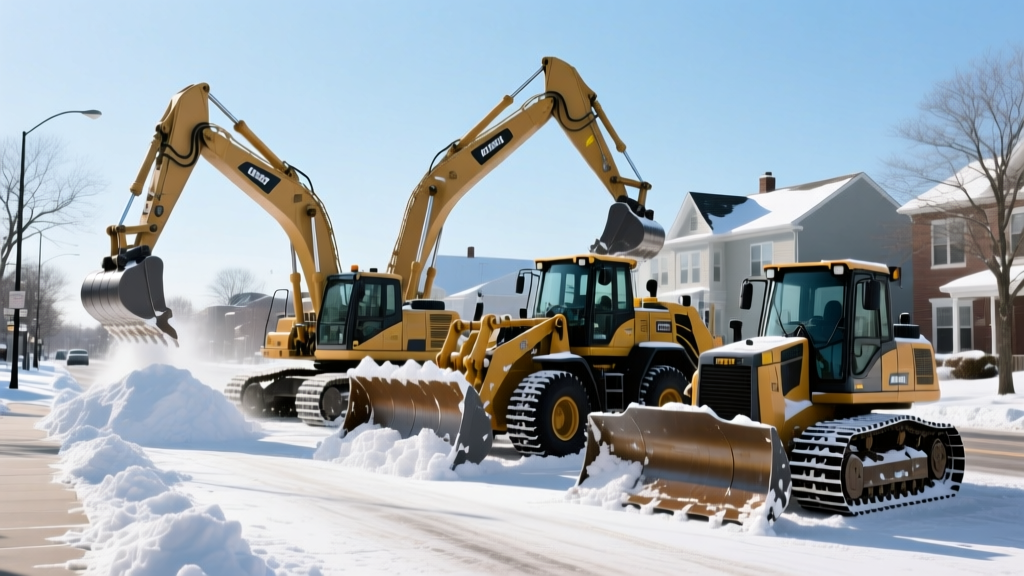
While dump trucks excel at moving snow laterally across the road, articulated wheel loaders are the undisputed heavy equipment machines for snow stacking, windrow removal, and loading out into tandem-axle dump trucks. The Volvo L90H and Caterpillar 926 are the dominant 30,000 to 35,000-pound class loaders in municipal fleets.
Attachment Engineering: Containment Boxes vs. Standard Buckets
A critical error made by underfunded municipalities is attempting to push snow with standard rock or dirt buckets. The curved profile of a standard bucket spills snow over the top edge, requiring multiple passes to clear a windrow. Instead, fleets must deploy 12-foot to 16-foot snow containment boxes (manufactured by brands like Pro-Tech or Sno-Way).
- Cutting Edge Material: Standard steel cutting edges destroy municipal infrastructure, gouging asphalt and snapping manhole covers. Loaders must be fitted with 2-inch thick polyurethane rubber cutting edges. These edges flex over obstacles, protecting both the loader's lift arms from shock-loading and the city's infrastructure from damage.
- Tire Configuration: Standard L3/L4 rock tires provide zero traction on packed ice. Fleets must invest in dedicated winter tires, such as the Michelin X-Ice Snow or Nokian Hakkapeliitta Loader series. At approximately $4,500 per tire, a full set of eight tires adds $36,000 to the machine's capital cost, but reduces slip-and-spin fuel waste by up to 22% and eliminates the need for steel tire chains, which tear up dry asphalt when temperatures briefly rise above freezing.
When ambient temperatures drop below -10°F, standard ISO 46 hydraulic fluid thickens drastically. If an operator attempts to lift a full containment box of snow (often exceeding 12,000 lbs) before the hydraulic system reaches optimal operating temperature, the pump will starve for fluid, causing cavitation. This creates microscopic air bubbles that implode under pressure, pitting and destroying the pump's internal bronze plates within hours.
The Fix: Drain standard fluid in October and replace it with full-synthetic ISO 15 or ISO 22 hydraulic fluid. Additionally, install 120V hydraulic tank immersion heaters on the loader's winterization package to maintain fluid viscosity during overnight staging.
Case Study 3: Dedicated Rotary Snowblowers for High-Altitude Passes
In mountainous regions like the Sierra Nevada or the Wasatch Range, standard plowing creates massive windrows that cannot be pushed further without burying adjacent lanes or avalanche fencing. Here, heavy-duty rotary snowblowers are mandatory. The Wausau Everest 2000 series and the Øveraasen RS 400 represent the pinnacle of this specialized heavy equipment category.
Impeller Dynamics and Throwing Distance
The Wausau Everest 2000 features a 10-foot cutting width with dual horizontal augers that feed snow into a high-speed centrifugal impeller. Driven by a dedicated 1,000 HP diesel engine (separate from the carrier vehicle's drivetrain), the impeller can throw up to 4,000 tons of snow per hour at a lateral distance of 150 feet. This throwing distance is critical for clearing snow completely off the highway shoulder and down the embankment, preventing meltwater from refreezing on the asphalt.
Wear and Maintenance Realities: The impeller fan blades and auger flighting endure extreme abrasion from embedded rocks and ice chunks. Fleet shops must apply chromium carbide overlay (CCO) wear plate to the impeller housing and auger edges. While CDO plating adds $18,000 to the initial build cost, it extends the lifespan of the auger flighting from 400 operational hours to over 1,200 hours, drastically reducing mid-season downtime.
2026 Fleet Procurement and Winterization Framework
Procuring snow removal heavy equipment machines requires navigating extended lead times and stringent emissions regulations. Fleet managers must integrate the following parameters into their 2026 and beyond capital expenditure plans:
- DEF System Winterization: Tier 4 Final and Stage V diesel engines rely on Diesel Exhaust Fluid, which crystallizes and freezes at 12°F. Ensure all new chassis purchases include factory-installed, engine-block-heated DEF tanks and heated supply lines. Retrofitting these systems post-delivery costs upwards of $6,500 per truck and voids standard powertrain warranties.
- Electrical System Upgrades: Modern plow lighting, GPS telemetry, and automated prewet controllers draw massive amperage. Spec dual 160-amp alternators and AGM (Absorbent Glass Mat) battery banks. Standard flooded lead-acid batteries lose up to 50% of their cranking amps at 0°F, leading to frequent no-start scenarios during critical storm deployments.
- Telemetry and Route Optimization: According to guidelines from the American Public Works Association (APWA), integrating GPS and automated spreader controls (ASC) reduces salt and brine usage by 15% to 20%. Specify chassis with open J1939 CAN-bus architecture, allowing seamless integration of third-party fleet tracking and material usage sensors without requiring expensive proprietary dealer programming.
By matching the specific chassis configuration, hydraulic capacity, and attachment engineering to the precise topographical and meteorological demands of their routes, municipalities can transform their snow removal heavy equipment machines from simple seasonal expenses into highly optimized, reliable assets that ensure public safety and minimize long-term lifecycle costs.