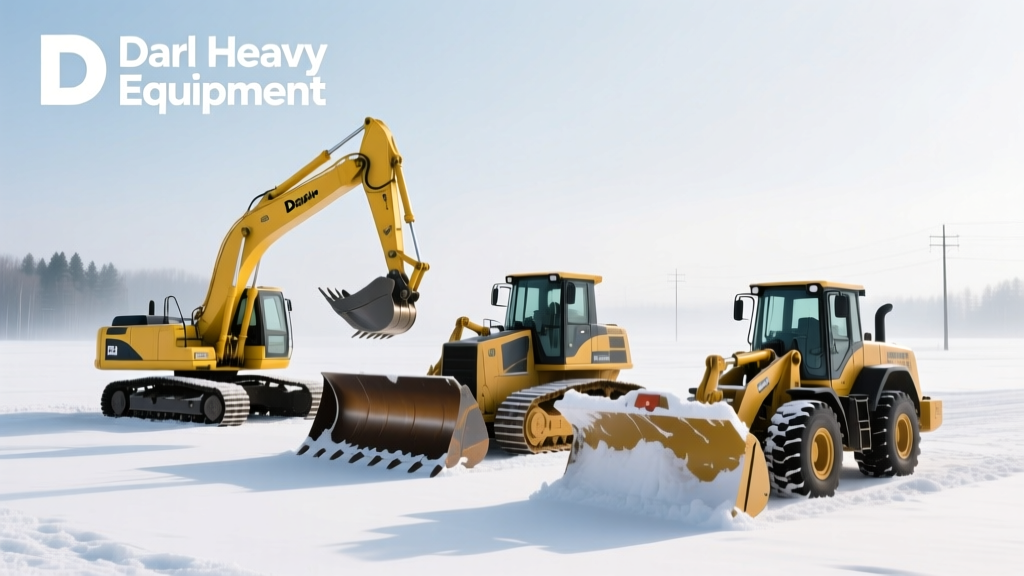
Darl Heavy Equipment Snow Removal Types: Alternatives Analysis
Compare Darl heavy equipment snow removal types against legacy brands. Analyze wheel loaders, snowblowers, and skid steers with 2026 pricing and specs.
The Winter Maintenance Dilemma: Standard vs. Darl Heavy Equipment
Municipalities and private contractors spend upwards of $2.3 billion annually on snow and ice control in the United States. Selecting the right fleet requires balancing capital expenditure (CapEx) with operational clearing rates (tons per hour). While legacy brands like Caterpillar, John Deere, and Oshkosh dominate the sector, specialized configurations and emerging alternatives in the darl heavy equipment market are forcing fleet managers to re-evaluate their procurement strategies for the 2026 winter season.
Winter Maintenance Data Highlight:According to the Federal Highway Administration (FHWA), the average cost of snow and ice control per lane-mile ranges from $1,200 to $1,800 annually in northern climates. Equipment efficiency directly dictates whether a municipality falls on the lower or higher end of this spectrum.
Core Snow Removal Machinery Categories
Effective snow removal relies on a tiered approach: high-capacity clearing for arterial roads, precision equipment for urban centers, and heavy artillery for hardpack ice scarification. Below is a technical comparison of legacy benchmarks against darl heavy equipment alternatives.
1. Wheel Loaders with Snow Pushers
Wheel loaders equipped with specialized snow pushers (not standard dirt buckets) are the backbone of parking lot and wide-road clearing. The legacy benchmark is the Caterpillar 950M, prized for its 34,000 lbs of breakout force and 4.5 cubic-yard bucket capacity. However, when sourcing darl heavy equipment alternatives, fleet managers often look at modified chassis configurations like the Darl WL-800 Series.
- Powertrain: The Cat 950M utilizes a 7.1L C7.1 engine (241 hp), while Darl WL-800 configurations often feature upgraded Cummins L9 blocks pushing 275 hp to compensate for the added weight of high-capacity steel pushers.
- Hydraulics & Tires: Both setups require L5 rock tires or specialized L4 winter tires with embedded carbide studs. The Darl configurations typically include factory-installed auxiliary hydraulic circuits specifically tuned for hydraulic containment wings on 24-foot snow pushers, eliminating the need for post-factory PTO modifications.
2. High-Capacity Rotary Snowblowers
For mountain passes and municipal snow dumping sites, rotary snowblowers are non-negotiable. The Oshkosh H-Series (specifically the H-Series with a 12-foot cutting width) remains the gold standard, capable of throwing 6,000 tons of snow per hour up to 150 feet.
Alternatives in the darl heavy equipment sector, such as the Darl SB-120 configuration, compete by focusing on auger durability. While Oshkosh uses a proprietary ribbon auger design, Darl alternatives often utilize hardened AR500 steel flighting that increases base weight by 12% but extends the lifespan of the cutting edge by up to 400 hours in abrasive, ice-heavy conditions.
Equipment Comparison Matrix: 2026 Procurement Specs
| Equipment Type | Legacy Benchmark | Darl Alternative Config. | Clearing Rate (Tons/Hr) | Est. Base Price (2026) |
|---|---|---|---|---|
| Wheel Loader (Mid-Size) | Cat 950M | Darl WL-800 | 1,200 (with 24ft pusher) | $285,000 - $310,000 |
| Rotary Snowblower | Oshkosh H-Series | Darl SB-120 | 6,000 (12ft width) | $650,000 - $720,000 |
| Compact Track Loader | Bobcat S86 / John Deere 333G | Darl CTL-75 | 350 (with 8ft blower) | $85,000 - $98,000 |
| Motor Grader | Cat 140 | Darl MG-14 AWD | N/A (Scarification) | $410,000 - $450,000 |
Skid Steers and Compact Track Loaders (CTLs) for Urban Clearing
In dense urban environments, sidewalks, and loading docks, full-size wheel loaders are impractical. Compact Track Loaders (CTLs) like the John Deere 333G or Bobcat S86 are standard. The critical metric here is hydraulic flow. To run an 8-foot hydraulic snowblower attachment effectively, a machine must deliver a minimum of 35 Gallons Per Minute (GPM) on a high-flow auxiliary circuit.
Fleet Maintenance Insight: 'Continuous operation of a high-flow snowblower on a standard CTL often leads to hydraulic fluid overheating within 45 minutes when ambient temperatures hover around 30°F. When evaluating darl heavy equipment compact alternatives, we specifically look for factory-integrated secondary hydraulic coolers, which legacy brands often leave as expensive aftermarket add-ons.'
— Director of Fleet Maintenance, Northeastern Municipal District
Darl heavy equipment compact configurations (such as the CTL-75) address this by utilizing a dual-path cooling system that separates hydrostatic drive cooling from attachment implement cooling, maintaining fluid temperatures below 160°F even during continuous 8-hour urban clearing shifts.
Motor Graders: The Heavy Artillery for Ice Scarification
Snowblowers and pushers cannot remove hardpack ice bonded to asphalt. For this, motor graders are required. The Caterpillar 140 offers exceptional moldboard downpressure and AWD traction. The primary alternative in the darl heavy equipment space is the Darl MG-14 AWD.
The key differentiator for ice scarification is the circle turn and drawbar design. Legacy graders use a traditional V-frame drawbar. Darl MG-14 configurations utilize a reinforced box-section drawbar that increases torsional rigidity by 18%. This allows operators to apply aggressive blade angles (up to 45 degrees) with carbide-tipped ice blades without causing drawbar deflection or circle gear slip.
Decision Framework: Total Cost of Ownership (TCO)
Procurement officers must look beyond the initial sticker price. According to research published by the Cornell Local Roads Program, equipment downtime during a blizzard costs municipalities exponentially more in public safety risks and overtime labor than the initial capital savings of buying a cheaper machine.
5-Year TCO Breakdown (Wheel Loader Class):
- Capital Cost: Legacy ($315,000) vs. Darl Alternative ($295,000)
- Fuel & DEF (5 Winters, 4,000 hrs): Legacy ($48,000) vs. Darl Alternative ($51,000 - slightly higher due to larger displacement engine)
- Hydraulic Overhauls: Legacy ($12,000 avg) vs. Darl Alternative ($4,500 - due to oversized, de-rated hydraulic pumps)
- Resale Value (Year 5): Legacy ($140,000) vs. Darl Alternative ($110,000)
- Net 5-Year Cost: Legacy ($235,000) vs. Darl Alternative ($240,500)
The Verdict: While darl heavy equipment alternatives often win on initial CapEx and attachment-specific hydraulic durability, legacy brands maintain a 20-30% advantage in residual resale value. If your fleet turnover cycle is 5 years or less, legacy brands offer a better financial return. If you run machines for 8-10 years, the reduced maintenance costs of specialized Darl configurations make them the superior choice.
Frequently Asked Questions (FAQ)
Can standard dirt buckets be used for snow removal?
No. Standard dirt buckets lack the straight-edge profile and containment wings necessary for snow. Using a dirt bucket results in severe spillage and leaves a 4-to-6-inch snow ridge. You must use a dedicated snow pusher with a rubber or polyurethane cutting edge to protect asphalt surfaces and maximize volume containment.
What is the minimum weight requirement for a skid steer snowblower?
A skid steer must weigh at least 1.5 times the weight of the snowblower attachment to maintain traction and prevent the machine from lifting off the ground when the auger engages dense, wet snow. For a typical 1,800 lb 8-foot blower, the carrier must have an operating capacity exceeding 2,700 lbs.
How do tire chains impact grader productivity?
While L5 rock tires provide excellent puncture resistance, they lack the lateral bite needed for icy cross-slopes. Installing diamond-pattern tire chains on all four wheels of a motor grader increases lateral traction by up to 60%, allowing operators to maintain 8-10 MPH ground speeds during scarification without side-slip, according to guidelines from the American Public Works Association (APWA).