Smart Heavy Equipment Types Transforming 2026 Forestry
Discover how smart heavy equipment types, including AI-driven harvesters and hybrid forwarders, are transforming forestry operations and boosting ROI.
The Cyber-Physical Shift in Timber Harvesting
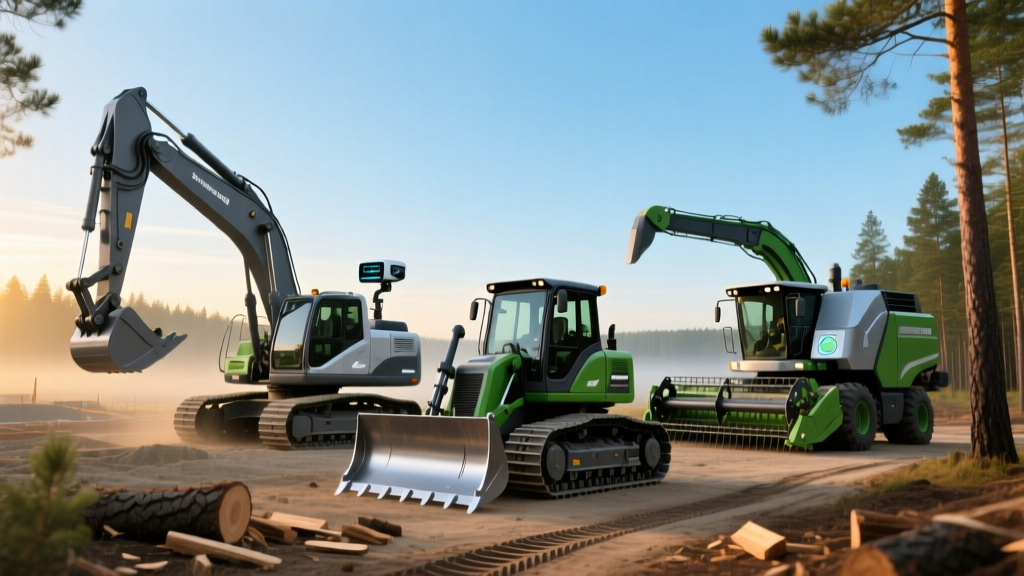
The forestry sector has historically relied on brute mechanical force to fell, delimb, and transport timber. However, the integration of edge computing, LiDAR, and hybrid drivetrains has redefined the capabilities of modern logging fleets. Today, advanced heavy equipment types in forestry are no longer just hydraulic machines; they are mobile data centers capable of processing real-time spatial data to optimize yield and minimize ecological disruption. According to the Food and Agriculture Organization (FAO), sustainable forest management increasingly depends on precision harvesting technologies that reduce soil compaction and residual stand damage.
2026 Forestry Tech Market Snapshot:- Automated Head Positioning: Now standard on 68% of new mid-to-large harvester models.
- Fuel Reduction: Hybrid-electric forwarders demonstrate a verified 14-18% reduction in diesel consumption per ton-mile.
- Sensor Suite Costs: Aftermarket LiDAR and SLAM (Simultaneous Localization and Mapping) packages have dropped to an average of $38,000, down from $55,000 in 2023.
Core Smart Heavy Equipment Types in Modern Logging
Understanding the specific technological upgrades across different machinery classes is critical for fleet managers evaluating capital expenditures. The following categories represent the most significant innovations in the logging sector.
AI-Guided Harvesters and SLAM Navigation
Modern harvesters, such as the John Deere 1270G equipped with TimberMatic Maps, utilize a combination of RTK GPS and LiDAR to map the forest floor. However, dense canopy cover frequently degrades GPS signals. To solve this, 2026 models integrate visual-inertial SLAM. The machine's onboard processors stitch together LiDAR point clouds and stereoscopic camera feeds to maintain sub-meter positioning accuracy even under complete canopy closure. This allows operators to pre-plan extraction routes that avoid sensitive root zones and waterways, directly aligning with John Deere Forestry precision ag initiatives adapted for timber.
Hybrid-Electric Forwarders
Forwarders are responsible for transporting felled timber from the stump to the landing, a process that requires massive torque and generates severe soil compaction. The latest generation of forwarders, including advanced configurations from manufacturers like Ponsse and Komatsu Forest, utilize series-hybrid drivetrains. A downsized diesel engine acts purely as a generator, feeding electricity to wheel-hub motors. This setup provides instantaneous peak torque for climbing steep gradients (up to 35% incline) while the engine runs at its most efficient RPM band, drastically cutting emissions and fuel costs.
Comparative Analysis: Diesel vs. Hybrid Forwarder Economics
| Metric | Conventional Diesel (e.g., 14-ton class) | Series-Hybrid Electric (14-ton class) |
|---|---|---|
| Base CapEx (USD) | $410,000 | $465,000 |
| Hourly Fuel Burn (Gallons) | 4.2 gal/hr | 3.1 gal/hr |
| Peak Torque Delivery | Ramp-up (1.5s lag) | Instantaneous (0.1s) |
| Estimated 5-Year Fuel Cost | $185,000 | $136,000 |
| Break-Even Point | N/A | 2.8 Years (at 2,000 hrs/yr) |
Overcoming Canopy Interference: Sensor Fusion
The most significant bottleneck in autonomous logging has been environmental interference. Dust, fog, and dense foliage scatter traditional LiDAR beams. The 2026 standard for sensor fusion pairs 1550nm wavelength LiDAR—which penetrates atmospheric moisture and dust far better than legacy 905nm sensors—with millimeter-wave radar. Radar detects the solid mass of tree trunks through thick underbrush, allowing feller bunchers equipped with selective thinning AI to identify crop trees versus brush without requiring a clear line of sight.
"The transition from reactive hydraulics to predictive electro-hydraulics means the machine now anticipates the load before the grapple even closes. We are seeing a 22% reduction in hydraulic hose blowouts simply because the system pre-pressurizes based on LiDAR volume estimates of the log being grabbed."
— Senior Fleet Engineer, Pacific Northwest Timber Operations
Real-World Failure Modes and Mitigation
Deploying highly sensitive technology in brutal, high-vibration environments introduces unique failure modes that traditional mechanical logging crews rarely face. Fleet managers must adapt their maintenance schedules to address these cyber-physical vulnerabilities.
- LiDAR Window Abrasion: Airborne sawdust and bark chips act as an abrasive blasting medium. Standard glass LiDAR covers scratch within 300 operating hours, causing point-cloud scattering. Mitigation: Install sacrificial, optically clear polycarbonate shields that can be swapped in under 5 minutes during daily greasing intervals.
- Thermal Throttling in Edge Computers: The onboard AI processing units generate immense heat. In high-ambient summer conditions, cabin AC failure will cause the SLAM processors to thermal-throttle, resulting in delayed boom movements. Mitigation: Ensure dedicated liquid-cooling loops for the tech rack are flushed bi-annually, independent of the cabin HVAC system.
- Vibration-Induced Connector Fretting: The constant shock loading of a harvester head striking a stump causes micro-movements in M12 sensor connectors, leading to oxidation and data dropouts. Mitigation: Mandate the use of dielectric grease and secondary locking wire-ties on all external sensor harnesses.
- Software Latency in Extreme Cold: At -30°C, standard LCD touchscreens and electro-hydraulic valve response times degrade. Mitigation: Specify Arctic-grade hydraulic fluids (e.g., ISO VG 15 synthetic) and ensure machine cabs are equipped with localized radiant heaters aimed directly at the HMI displays.
Fleet Upgrade Decision Framework
Upgrading a logging fleet requires balancing immediate capital outlay against long-term operational efficiency. Use this framework to determine the optimal integration path for smart heavy equipment types in your operation.
Step 1: Evaluate the Timber Profile
If your operation focuses on clear-cutting uniform plantation pine, the ROI on AI-driven selective thinning sensors is negligible. Invest instead in hybrid drivetrains for forwarders to maximize ton-mile efficiency. If you manage selective harvests in mixed-hardwood or steep-slope terrain, prioritize LiDAR mapping and automated boom control to minimize residual stand damage and avoid environmental fines.
Step 2: Assess Telemetry Infrastructure
Smart harvesters generate up to 40GB of spatial and operational data per shift. If your landing zones lack reliable 5G or satellite backhaul (like Starlink for Business), the data will bottleneck on the machine's local drives. Ensure your landing infrastructure can support automated Wi-Fi offloading when the forwarder returns to the staging area.
Step 3: Calculate the True Cost of Downtime
A $45,000 sensor suite is a total loss if a single severed CAN bus cable halts the entire machine. Before purchasing advanced models, verify the OEM's local diagnostic capabilities. As noted by Komatsu Forest technical bulletins, remote over-the-air (OTA) diagnostics are only effective if the local dealer possesses the proprietary software keys to reset safety-lockouts caused by sensor faults.
Step 4: Operator Training and Change Management
The most advanced feller buncher is useless if the operator overrides the AI to rely on "feel." Budget 15% of the technology upgrade cost toward simulator training and on-site OEM coaching. Operators must transition from manual joystick manipulation to supervising the machine's automated path-planning, requiring a fundamental shift in operational psychology.
By strategically selecting the right heavy equipment types and supporting their digital ecosystems, forestry contractors can secure a distinct competitive advantage, lowering per-ton costs while adhering to the stringent sustainability mandates of the modern timber market.