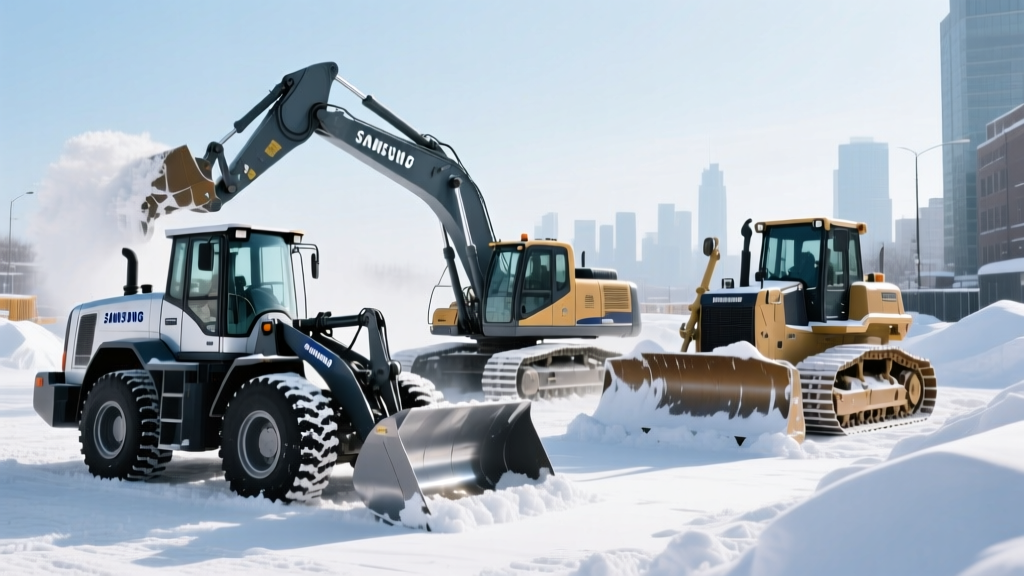
Troubleshooting Samsung Heavy Equipment Loaders in Snow Removal
Diagnose and repair Samsung and Doosan wheel loaders for snow removal. Fix hydraulic, transmission, and DEF issues in extreme cold.
Mechanical Realities of Samsung-Lineage Loaders in Winter Maintenance
When municipal fleets and private contractors deploy wheel loaders for snow removal, the equipment faces extreme mechanical stress. Operators running legacy Samsung heavy equipment wheel loaders (such as the SL-series) or their modern Doosan/Develon successors (like the DL280-5 and DL420-5) must manage high-resistance pushing, sub-zero ambient temperatures, and continuous auxiliary hydraulic demands. Snow removal is not simply about attaching a plow; it requires precise calibration of the machine's drivetrain and hydraulic circuits to prevent catastrophic mid-storm failures.
This troubleshooting guide addresses the specific failure modes encountered when configuring and operating Samsung-lineage wheel loaders for heavy snow removal, providing exact diagnostic steps, pressure specifications, and repair protocols for 2026 winter maintenance seasons.
Lineage Note: Samsung Construction Machinery's wheel loader division transitioned through Volvo and eventually Doosan Infracore (now Develon). The hydraulic and transmission architectures in legacy Samsung SL-series loaders share foundational DNA with early Doosan DL-series machines. The troubleshooting parameters below apply across this mechanical lineage.Auxiliary Hydraulic Circuit Failures with Snow Pushers
Snow pushers and containment plows require continuous, high-volume auxiliary hydraulic flow to angle and tilt the moldboard. A common failure mode on Samsung/Doosan loaders is the auxiliary relief valve popping prematurely, resulting in sluggish plow response or complete loss of angling capability when the blade encounters packed ice.
Symptom: Plow Angles Slowly Under Load and Relief Valve Chatters
This indicates that the auxiliary hydraulic pressure is bypassing at the main control valve before the cylinder reaches its mechanical stop. Wet, heavy snow can exert over 15,000 lbs of resistance against a 12-foot pusher, spiking system pressure.
- Diagnostic Step 1: Connect a 5,000 PSI inline hydraulic flow meter to the auxiliary quick-disconnects. Deadhead the circuit and record the pressure spike.
- Diagnostic Step 2: Compare against the machine's specification. The DL280-5 and legacy Samsung equivalents typically require a main relief setting of 3,200 to 3,500 PSI for auxiliary circuits.
- Diagnostic Step 3: If pressure peaks at 2,400 PSI, the relief valve spring has fatigued or the spool is contaminated with cold-thickened particulates.
The Viscosity Trap: ISO 32 vs. ISO 46
Running standard ISO VG 46 hydraulic fluid in sub-zero snow removal operations causes severe cavitation in the main hydraulic pump. As fluid temperatures drop below 10°F (-12°C), ISO 46 viscosity exceeds 2,000 cSt, starving the pump inlet. Switch to ISO VG 32 or a synthetic arctic-grade hydraulic fluid (like Mobil DTE 10 Excel 32) before the first freeze. This maintains optimal flow rates (typically 22 to 28 GPM depending on the loader model) and prevents the $4,500 cost of a prematurely scored main gear pump.
Transmission Slippage and Torque Converter Overheating
Pushing snow requires high tractive effort at low ground speeds. This forces the torque converter to operate in a high-slip state for extended periods, generating massive internal heat. If the transmission oil temperature gauge on your Samsung/Doosan loader consistently exceeds 220°F (104°C) during snow pushing, the lock-up clutch is failing to engage, or the cooler circuit is restricted.
Performing a torque converter stall test on ice or packed snow yields inaccurate data due to wheel spin. Always perform stall tests on dry, bare asphalt with the bucket curled back and pinned to the frame to accurately diagnose internal transmission slippage.
Executing the ZF Transmission Stall Test
Most mid-sized Samsung/Doosan loaders utilize ZF automatic powershift transmissions. To verify the health of the torque converter and transmission clutches:
- Ensure the transmission oil is at operating temperature (minimum 140°F).
- Apply the service brakes fully and engage the parking brake.
- Shift into second gear forward (F2).
- Apply full throttle for a maximum of 5 seconds while monitoring the tachometer.
- Pass Criteria: Engine RPM should stall between 1,800 and 2,100 RPM (verify exact spec for your specific engine tier).
- Fail Criteria: If RPM exceeds 2,300, the torque converter stator freewheel clutch is failing, or internal clutch packs are slipping. If RPM stalls below 1,600, the engine is derated or the torque converter is binding.
Tier 4 Final DEF System Gelling and Derates
Modern snow removal equipment must operate reliably in temperatures well below freezing. Diesel Exhaust Fluid (DEF) begins to crystallize and freeze at 12°F (-11°C). While the EPA guidelines note that frozen DEF does not damage the fluid itself, a failure in the machine's DEF thawing system will trigger an immediate engine derate, limiting loader travel speed to 5 mph—disastrous during a blizzard response.
Troubleshooting the DEF Heater Circuit
If your loader's monitor displays a 'DEF Tank Heater' fault code (often SPN 3361 or similar SAE J1939 codes) in cold weather, follow this multimeter diagnostic path:
Safety First: When troubleshooting electrical components in freezing environments, ensure you are following OSHA cold stress protocols. Wear insulated dielectric gloves, as metal chassis grounds become highly conductive and dangerously cold, increasing the risk of contact burns and frostbite during prolonged testing.- Check the Heater Element: Disconnect the DEF tank heater harness. Measure resistance across the heater pins. A functional 50W, 12V/24V heater should read between 5 and 15 ohms. An open circuit (OL) means the internal heating element has burned out and the tank must be replaced.
- Verify the Supply Harness: With the key ON, engine OFF, probe the harness side. You should read battery voltage (24V on most heavy loaders). If voltage is absent, trace back to the DEF heater relay and the 15A inline fuse, which frequently blows due to the high inrush current required to thaw solid ice.
- Inspect the Heated DEF Lines: The supply line from the tank to the dosing module contains a resistive heating wire. Look for physical abrasions where the line rubs against the loader's articulation joint. A short to ground here will blow the fuse and trigger a dosing fault.
Snow Removal Attachment Compatibility Matrix
Overloading a wheel loader with an oversized snow pusher damages the front axle pivots and overstresses the lift arm cylinders. Use the matrix below to match Samsung/Doosan loader models with appropriate snow removal attachments.
| Loader Model Lineage | Operating Weight | Max Pusher Width | Max Attachment Weight | Required Aux Flow (GPM) |
|---|---|---|---|---|
| Samsung SL200 / Doosan DL200-5 | 26,000 lbs | 10 ft | 2,100 lbs | 18 - 22 GPM |
| Samsung SL280 / Doosan DL280-5 | 34,000 lbs | 12 ft | 2,800 lbs | 22 - 26 GPM |
| Samsung SL300 / Doosan DL420-5 | 50,000 lbs | 14 ft | 4,200 lbs | 28 - 32 GPM |
| Doosan DL580-5 (Successor) | 72,000 lbs | 16 ft + | 6,500 lbs | 35 - 42 GPM |
Pre-Storm Winterization Checklist
Preventative maintenance is the only way to guarantee uptime during a multi-day snow event. Execute this checklist 30 days before the first projected freeze:
- Axle Breather Caps: Clean and verify front and rear axle breather caps. Moisture ingress in cold weather leads to emulsified lube oil and destroyed planetary hubs.
- Articulation Pins: Purge and re-grease the center articulation pins using a synthetic, moly-fortified grease (NLGI #1 or #0) that remains pumpable through the auto-lube system at -20°F.
- Battery CCA Verification: Load-test both 12V batteries. Cold cranking amps (CCA) must be within 90% of the factory rating (typically 1,000 CCA per battery). Weak batteries will fail to spin the starter fast enough to achieve the 180 RPM minimum required for the ECU to initiate fuel injection in freezing air.
- Coolant Concentration:Test the ethylene glycol mixture with a refractometer. Maintain a 50/50 ratio for protection down to -34°F. Avoid exceeding 60% coolant, as higher concentrations reduce the fluid's heat-transfer efficiency, ironically increasing the risk of localized engine overheating during heavy snow pushing.
Frequently Asked Questions
Can I use a standard pallet fork quick-attach for a snow pusher?
No. Standard pallet fork carriages lack the structural reinforcement to handle the torsional twisting forces generated when a snow pusher catches a frozen curb or manhole cover. Always use a heavy-duty, reinforced snow pusher quick-attach (often featuring dual tilt cylinders or a trip-edge mechanism) to prevent cracking the loader's Z-bar linkage.
Why does my loader's DEF warning light stay on even after the fluid thaws?
If the DEF froze and expanded, it may have cracked the internal pickup tube or damaged the pump diaphragm. Even after thawing, the dosing module will detect low pressure in the line and keep the warning light illuminated. You must clear the fault code via the diagnostic port and verify a minimum of 4.5 bar (65 PSI) at the dosing injector before the ECU will lift the engine derate.