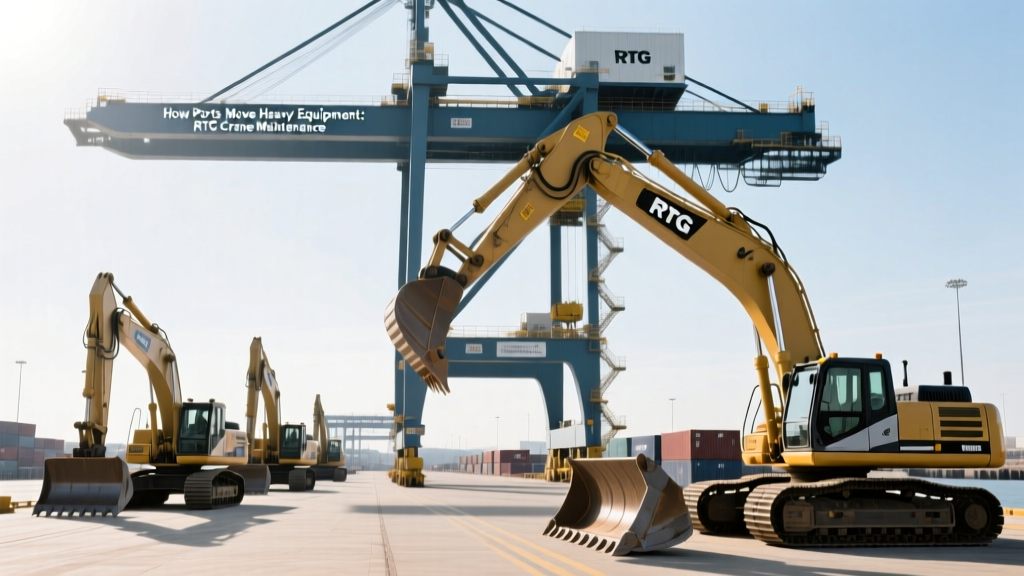
How Ports Move Heavy Equipment: RTG Crane Maintenance
Learn the exact maintenance schedules for port RTG cranes. Discover how terminals safely move heavy equipment with precise service intervals and cost data.
The Corrosion Reality: ISO 12944-9 and C5-M Environments
Marine terminals operate in some of the most aggressive corrosive environments on earth. When ports move heavy equipment and high-density container loads, Rubber-Tired Gantry (RTG) cranes and Ship-to-Shore (STS) cranes endure constant exposure to salt spray, high humidity, and UV degradation. Standard industrial coatings fail rapidly in these conditions. Modern port equipment must comply with ISO 12944-9 (specifically the CX/C5-M marine corrosivity categories) to survive a 15-to-20-year operational lifespan.
For fleet managers overseeing Konecranes SMV RTGs or Liebherr LRM series cranes, structural maintenance begins with coating integrity. Epoxy-zinc primers paired with polyurethane topcoats must be maintained at a minimum dry film thickness (DFT) of 320 microns. Any micro-fractures in the paint down to the steel substrate will initiate galvanic corrosion within 72 hours in a C5-M zone. Terminal maintenance teams must conduct quarterly ultrasonic thickness (UT) testing on the main gantry girders and leg connections, focusing on the splash zones and lower cross-members where saltwater accumulation is highest.
RTG Crane Service Interval Matrix
Routine servicing for marine gantry cranes cannot rely on generic construction equipment schedules. The high-cycle, repetitive nature of container lifting requires strict adherence to OEM hour-based intervals. Below is the standardized maintenance matrix for a typical diesel-electric RTG crane operating 4,000 hours annually.
| Interval | Primary Systems Targeted | Specific Action & Fluid/Component | Estimated Cost (USD) |
|---|---|---|---|
| Daily (10 hrs) | Spreader, Hoist, Tires | Visual twist-lock inspection, check 16.00 R25 tire pressures (120 psi), verify anti-sway laser sensors. | $0 (Operator) |
| 250 Hours | Gantry Drives, Hydraulics | Grease gantry travel wheel bearings (Mobilgrease XHP 322), check hydraulic tank ISO 4406 cleanliness code. | $450 |
| 500 Hours | Hoist Gearboxes, Genset | Sample hoist gearbox oil for spectrometric analysis, replace genset fuel filters (Cummins QSK19 or MTU 8V4000). | $1,200 |
| 2,000 Hours | Wire Ropes, Sheaves | Magnetic flux leakage (MFL) testing on 32mm 6x36WS IWRC hoist ropes, re-groove or replace sheave linings. | $8,500 |
| 5,000 Hours | Structural, Electrical | Megger test main hoist motors, NDT (Non-Destructive Testing) on spreader lift lugs, recalibrate load cells. | $22,000 |
Hoist Wire Rope and Spreader Twist-Lock Fatigue
The hoist mechanism is the critical failure point when operators move heavy equipment vertically. RTG cranes typically utilize 32mm or 36mm diameter, 6x36 Warrington-Seale (WS) Independent Wire Rope Core (IWRC) cables. In marine environments, salt crystals infiltrate the rope core, accelerating internal friction and corrosion. Maintenance teams must apply a penetrating, environmentally acceptable lubricant (EAL) like Kluberplex BE 41-1501 every 500 operating hours to displace moisture and reduce internal wire fretting.
Replacing a full set of main hoist wire ropes on a standard 1-over-6 RTG crane costs between $18,000 and $26,000, including labor and crane downtime. To maximize rope life, ensure the sheave-to-rope diameter ratio (D/d) strictly adheres to the minimum 18:1 ratio mandated by ASME B30 standards. Using undersized sheaves to save weight will induce premature crown wire breakage and void the rope manufacturer's warranty.
Diesel-Electric Genset and Hybrid Drive Maintenance
Traditional RTGs rely on onboard diesel generators, typically the Cummins QSK19 or MTU Series 4000, to power the electric hoist and gantry motors. In a marine setting, the genset air intake is highly susceptible to salt ingestion, which destroys turbocharger compressor wheels and cylinder liners. Maintenance schedules must mandate the replacement of heavy-duty marine-grade air filters every 500 hours, rather than the standard 1,000-hour on-highway interval.
For terminals that have transitioned to hybrid RTGs or fully electric e-RTGs with lithium-titanate battery banks, the maintenance focus shifts from engine oil to thermal management systems. The battery cooling loops must be flushed annually with a 50/50 propylene glycol mixture. Terminal engineers must monitor the battery management system (BMS) logs for cell voltage imbalances exceeding 0.05V during peak regenerative braking events, which indicate degraded cooling efficiency in the marine heat.
"The biggest mistake port maintenance managers make is treating an RTG like a standard mobile crane. An RTG operates in a fixed, high-salinity corridor with relentless stop-start cycles. If you aren't pulling oil samples from the travel gearboxes every 500 hours and checking for water ingress, you will be replacing a $40,000 gearbox by year five."
— Marine Terminal Reliability Engineer
Operator Pre-Shift Protocol Before You Move Heavy Equipment
Maintenance schedules dictate long-term reliability, but daily operator protocols prevent immediate catastrophic failures. Before operators move heavy equipment or begin a container loading shift, they must execute a strict 5-point verification process. NIOSH maritime safety guidelines emphasize that operator-level defect recognition is the primary defense against load-drop incidents.
- Load Cell Calibration Check: Lift a known empty 20-foot container (tare weight ~2,200 kg). Verify the cabin display reads within a 2% margin of the known weight. If the load cell reads high or low, the crane must be locked out until recalibrated to prevent overload trips mid-cycle.
- Anti-Sway System Verification: Engage the electronic anti-sway system and perform a low-speed trolley traverse. The system should automatically dampen the spreader pendulum effect. A malfunctioning anti-sway system increases structural fatigue on the main girder by up to 40% due to lateral shock loading.
- Brake Slip Test: With the spreader grounded, apply the hoist brake and command a 5% upward motor torque. The motor should stall without the drum rotating. Hoist brake linings in marine environments absorb moisture and lose friction coefficient rapidly; daily slip tests catch glazed brakes before they fail under a 35-ton load.
- Tire and Bogie Inspection: Check the 16.00 R25 pneumatic tires for sidewall cutting from terminal debris. Unequal tire pressures across the 8-wheel bogie will cause severe structural twisting of the gantry legs when traveling over rail crossings or uneven quay surfaces.
- Limit Switch Actuation: Slowly raise the empty spreader to manually trigger the upper hoist limit switch and the anti-two-block switch. Verify that the main contactor drops out immediately, preventing the spreader from being pulled into the sheave block.
Adhering to these rigorous, environment-specific maintenance schedules ensures that marine port equipment maintains peak availability. By combining ISO-compliant corrosion management, strict hour-based component replacements, and uncompromising daily operator checks, terminal operators can safely and efficiently move heavy equipment while minimizing unplanned downtime and extending asset lifecycles well past the 20-year mark.