Heavy Equipment Valuation: Renewable Energy Fleet Tech Trends
Discover how IoT, electric drivetrains, and specialized wind/solar rigs are redefining heavy equipment valuation in renewable energy construction.
The Telematics Paradigm Shift in Appraisals
Renewable energy construction has evolved from standard earthmoving into a highly specialized discipline requiring precision logistics, extreme-lift capabilities, and increasingly, zero-emission site operations. As wind turbine hub heights exceed 160 meters and solar farms span tens of thousands of acres, the machinery deployed on these sites experiences unique stress profiles. Consequently, heavy equipment valuation can no longer rely on rudimentary metrics like age and hour-meter readings. In 2026, the secondary market is driven by IoT telematics, predictive maintenance algorithms, and component-specific depreciation models.
Historically, appraisers evaluated a 2021 Cat 14M motor grader based on its manufacturing year and total operating hours. Today, valuation firms integrate directly with OEM telematics APIs—such as Cat Connect, Komatsu KOMTRAX, and John Deere JDLink—to extract granular operational data. A motor grader used for precision pad grading on a solar farm experiences vastly different powertrain stress than one used in highway construction. Telematics reveal engine load factors, hydraulic pressure anomalies, idle-time percentages, and ground-speed consistency. Machines with documented low-load, high-idle profiles common in solar array leveling often command a 6% to 9% premium on the secondary market due to reduced internal transmission wear.
Data Highlight: The IoT Valuation Premium
Fleet managers who maintain continuous, unbroken telematics data logs from day one of deployment are seeing an average 12.4% higher residual value at auction compared to identical models with data gaps. Buyers in the renewable sector use this data to underwrite predictive lifecycle costs, effectively transferring the risk premium back to the seller.
Wind Energy: The Mega-Crane Scarcity Premium
The onshore wind sector presents the most extreme valuation anomalies in the heavy machinery market. According to the U.S. Department of Energy's Land-Based Wind Market Report, the average capacity of newly installed onshore turbines has steadily climbed, necessitating cranes with unprecedented lift capacities and boom lengths.
Standard 500-ton crawler cranes suffer from steep depreciation curves once they age past the five-year mark. However, ultra-class crawlers specifically configured for renewable energy—such as the Liebherr LR 1700-8.0 or the Demag CC 3800-1—defy traditional depreciation. These machines are engineered to lift 100-ton nacelles at hub heights exceeding 170 meters. Their valuation is heavily tied to the scarcity of their specialized boom sections, luffing jibs, and multi-axle counterweight transport trailers.
- Boom Configuration Scarcity: A Liebherr LR 1700-8.0 equipped with the specialized wind turbine luffing jib (WT) retains up to 78% of its original CapEx after five years, compared to 55% for standard heavy-lift configurations.
- Transport Logistics Factor: Valuation algorithms now account for the availability of matching transport trailers. A crane sold without its proprietary counterweight transport system can see its resale value penalized by up to $450,000 due to the lead times required to fabricate replacement transport rigs.
- Ground Bearing Pressure Mods: Cranes fitted with specialized wide-track shoes for soft-soil wind farm terrain retain a 4% valuation premium in the secondary market.
Solar and BESS: Electric Earthmovers and Battery Degradation
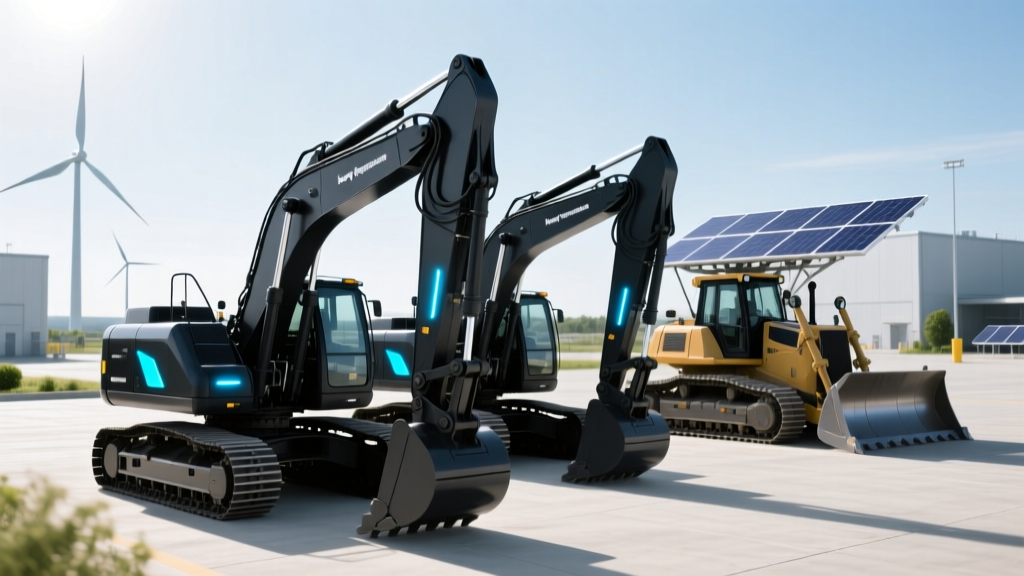
Solar farm developers and Battery Energy Storage System (BESS) integrators are increasingly bound by strict ESG (Environmental, Social, and Governance) mandates. This has forced general contractors to deploy battery-electric heavy equipment to reduce Scope 1 emissions on site. The integration of machines like the Volvo ECR25 Electric compact excavator and larger 25-ton class electric prototypes has introduced a complex new variable into heavy equipment valuation: lithium-ion degradation curves.
According to market data tracked by the Solar Energy Industries Association (SEIA), the footprint of solar installations continues to expand into remote, ecologically sensitive areas where zero-emission machinery is often a permitting prerequisite. However, valuing a four-year-old electric excavator requires a bifurcated approach.
| Equipment Class | Standard 5-Yr Residual | Renewable-Spec 5-Yr Residual | Primary Valuation Driver |
|---|---|---|---|
| 700-Ton Crawler Crane | 55% | 78% | Hub-height boom configuration scarcity |
| Motor Grader (14ft blade) | 48% | 42% | Undercarriage wear from abrasive silica sand |
| 25-Ton Electric Excavator | N/A | 51% (Chassis) / 30% (Battery) | Lithium-ion cycle degradation & ESG premiums |
| Pile-Driving Rig (Solar) | 60% | 68% | Hydraulic hammer attachment compatibility |
Appraisers must now separate the mechanical chassis valuation from the energy storage system (ESS). The Alternative Fuels Data Center (AFDC) notes that industrial battery packs experience accelerated degradation when subjected to the high-draw, continuous-cycle demands of trenching and pile driving compared to standard automotive use. A battery pack that has dropped below 75% State of Health (SoH) requires a replacement deduction of $35,000 to $60,000 from the machine's fair market value, fundamentally altering the negotiation dynamics at auction.
Warning: Software-Locked Attachments
Many modern solar pile-driving rigs rely on proprietary GPS machine control and automated depth-stop software. When selling these assets, fleet managers frequently discover that the OEM software licenses are tied to the original corporate account, not the machine's VIN. Failing to transfer or purchase a perpetual attachment-control license prior to auction can result in a 15% valuation penalty, as the buyer must repurchase the software suite from the dealer.
Actionable Framework: Adjusting Your Valuation Strategy
To maximize residual value and accurately forecast CapEx recovery for renewable energy fleets, equipment managers must adopt a modernized valuation framework. Relying on legacy blue-book estimates will result in severe miscalculations of asset equity.
- Implement API-Ready Telematics from Day One: Ensure all newly acquired assets are spec'd with factory-installed telematics hardware. Third-party retrofitted GPS trackers do not capture the deep-engine CAN bus data (e.g., hydraulic pump pressures, DEF fluid consumption rates) required by modern appraisal algorithms.
- Segregate Attachment Wear Metrics: In solar construction, vibratory hammers and specialized augers endure immense shock loading. Track attachment hours separately from the carrier machine hours. An excavator with 4,000 carrier hours but 2,500 hammer hours requires a distinct valuation adjustment for the hydraulic pump and boom cylinders.
- Document ESG Compliance History: Maintain a digital ledger proving that specific machines were deployed exclusively on LEED-certified or ESG-mandated renewable sites. Buyers targeting green infrastructure contracts will pay a premium for equipment with a verified low-emission operational history.
- Audit Battery SoH Annually: For electric earthmovers, mandate annual third-party battery health diagnostics. Presenting a certified SoH report at the time of sale eliminates buyer uncertainty and prevents aggressive lowball bidding based on assumed battery failure.
'The secondary market for renewable construction equipment is no longer a commodity exchange. It is a highly technical asset class where data continuity, specialized geometry, and powertrain chemistry dictate the final hammer price. Those who treat equipment data as a tangible asset will capture the highest residual values.' — Industrial Fleet Appraisal Guidelines, 2026 Edition
The Future of Asset Recovery
As the global transition to renewable energy accelerates, the machinery required to build the grid of the future will only become more complex. Heavy equipment valuation has permanently shifted from a backward-looking exercise in depreciation to a forward-looking analysis of technological viability, data integrity, and component-level lifecycle health. Fleet managers who align their acquisition, maintenance, and data-capture strategies with these realities will secure a distinct financial advantage in the secondary market.