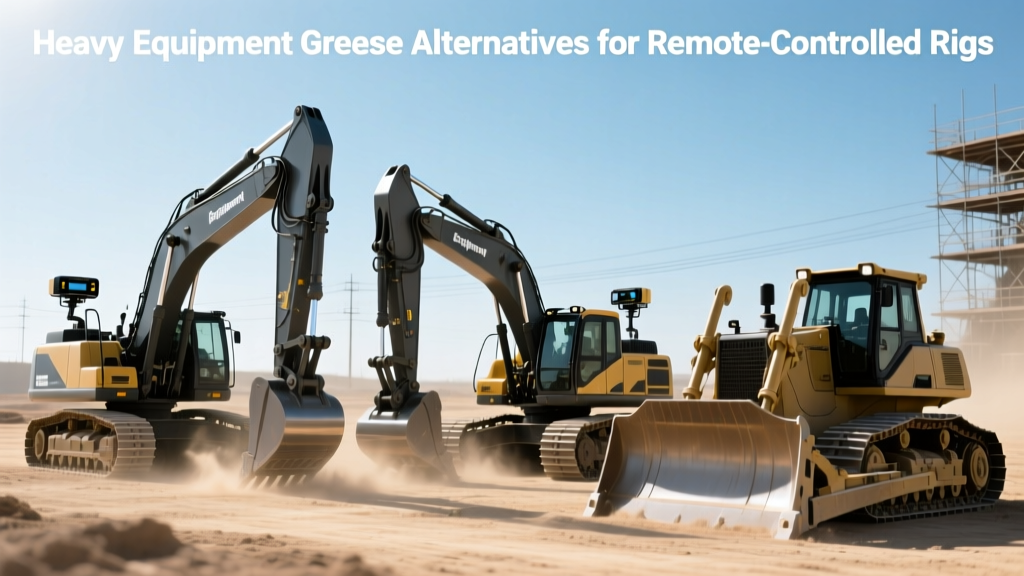
Heavy Equipment Grease Alternatives for Remote-Controlled Rigs
Compare heavy equipment grease alternatives for remote-controlled modular rigs. Discover calcium sulfonate and polyurea options for auto-lube systems.
The Hidden Cost of Lubricating Remote-Controlled Modular Rigs
Remote-controlled heavy equipment, such as the Brokk 500 demolition robot or tele-operated modular loaders like the Caterpillar R1700 XE, removes the operator from the hazard zone. However, this physical distance creates a critical blind spot: auditory and tactile feedback for lubrication failure. When an operator sits in a cab, they hear a squeaking boom pivot or feel the jerk of a dry slew ring. A remote operator watching through a camera feed or standing 50 feet away in a high-noise environment will not notice these warnings until catastrophic galling occurs.
Consequently, modular and remote-controlled machines rely entirely on automatic lubrication systems (auto-lube) and the precise formulation of the heavy equipment grease pumped through them. Selecting the wrong grease alternative for these automated systems does not just mean more frequent maintenance; it means silent, undetected joint failure that can result in $20,000+ in structural repairs and weeks of downtime.
⚠️ Critical Auto-Lube Warning: Never mix calcium sulfonate and lithium-complex greases in a remote rig's auto-lube reservoir. The incompatible thickeners will cross-link, forming a hard, soap-like sludge that will permanently destroy progressive metering valves (such as those in SKF Lincoln or Groeneveld systems), resulting in immediate system failure and starved pivot points.Baseline vs. Alternatives: Why Standard Lithium Fails
The default heavy equipment grease for 80% of manual applications is an NLGI #2 lithium-complex formulation. While cost-effective (typically $12 to $18 per 14oz cartridge) and sufficient for daily manual greasing, lithium-complex greases fail in remote-controlled modular setups for three primary reasons:
- Water Washout: Remote demolition robots (e.g., Husqvarna DXR 330) frequently operate hydraulic breakers in wet, flooded concrete environments. Lithium thickeners emulsify and wash out rapidly under high-pressure water ingress.
- Shear Thinning: Modular conveyor attachments and continuous-rotation slew rings subject the grease to high-RPM mechanical shearing. Lithium complex structures break down, losing their ability to stay in the raceway.
- Poor Pumpability: In single-line progressive auto-lube systems operating in cold-weather mining shifts, standard NLGI #2 lithium grease becomes too stiff, causing pump cavitation and starving distant distribution blocks.
To address these failure modes, fleet managers must evaluate specialized alternatives. Below is a comparison matrix of the most viable heavy equipment grease alternatives for automated remote rigs.
| Thickener Type | Water Washout (ASTM D1264) | Dropping Point (ASTM D2265) | Auto-Lube Pumpability (32°F) | Avg. Cost (14oz Tube) |
|---|---|---|---|---|
| Lithium Complex (Baseline) | 5% - 10% | 500°F+ | Poor (Requires NLGI #1) | $12 - $18 |
| Calcium Sulfonate Complex | < 2% | 550°F+ | Moderate | $35 - $45 |
| Polyurea | 3% - 5% | 500°F+ | Excellent | $28 - $38 |
| Aluminum Complex | 2% - 4% | 450°F+ | Good | $25 - $32 |
Alternative 1: Calcium Sulfonate Complex (The Demolition Standard)
For remote-controlled demolition robots operating in wet, highly corrosive environments, calcium sulfonate complex grease is the undisputed upgrade. The overbased calcium sulfonate thickener provides inherent Extreme Pressure (EP) properties without relying on solid additives like molybdenum disulfide (moly). This is a critical distinction for auto-lube systems: solid moly particles can accumulate and clog the fine 40-to-100-micron filters found in automated metering valves.
Products like Mobilgrease XHP 461 or Shell Gadus S2 V460 exhibit water washout scores of less than 2% under the ASTM D1264 standard. When a Brokk 70 is submerged in ankle-deep slurry while tearing down a foundation, the calcium sulfonate grease remains in the boom pivot pins, maintaining a hydrodynamic film that prevents the ingress of silica dust and moisture. According to tribology research published by Machinery Lubrication, the unique crystalline structure of calcium sulfonate thickeners also provides superior resistance to mechanical shear, ensuring the grease does not turn to liquid and leak out of the seals during high-impact breaker operations.
Alternative 2: Polyurea-Based Synthetics (For High-Heat Modular Conveyors)
Modular heavy equipment often utilizes interchangeable attachments. When a remote-controlled carrier is fitted with a continuous-rotation modular conveyor or a high-speed radial sweeper, the slew rings and bearings generate immense friction heat, frequently exceeding 250°F. Lithium and calcium thickeners begin to oxidize and form hard carbon deposits at these sustained temperatures.
Polyurea-based synthetic greases (such as Chevron Rykon Premium) are the optimal alternative here. Polyurea thickeners contain no metallic soaps, which drastically reduces ash formation and oxidation at high temperatures. Furthermore, polyurea greases possess excellent channeling characteristics and high base oil separation resistance, making them highly compatible with the continuous, low-volume dosing cycles of centralized auto-lube systems.
Auto-Lube System Compatibility: Viscosity and Pumpability
The most common mistake fleet managers make when switching heavy equipment grease alternatives for remote rigs is focusing solely on the thickener type while ignoring the base oil viscosity and NLGI grade. An auto-lube pump, such as the SKF Lincoln P203 or the Groeneveld-BEKA Twin XL, is essentially a positive displacement pump designed to move a specific fluid dynamics profile.
If you specify a calcium sulfonate grease with an ISO 460 base oil to handle heavy shock loads, you must consider the ambient operating temperature. At 32°F (0°C), an ISO 460 NLGI #2 grease will exceed the volumetric pull-capacity of the auto-lube pump's internal gears. The pump will cavitate, pulling air into the lines, and the system's pressure switch will either fault out or, worse, bypass the air pocket, leaving the furthest distribution block completely dry.
💡 The Viscosity Workaround: For remote rigs operating in sub-zero or highly variable temperatures, specify an NLGI #1 or #0 grade grease with a synthetic ISO 150 or ISO 220 base oil. The lower NLGI grade ensures the auto-lube pump can physically move the grease through 100+ feet of distribution hose, while the synthetic base oil maintains its film strength at the point of friction. Consult your Groeneveld-BEKA construction guidelines for specific pump clearances.Decision Framework: Matching Grease to Remote Rig Duty Cycles
Do not default to a single grease for all modular attachments. Remote-controlled equipment demands a segmented lubrication strategy based on the specific kinematics of the joint being lubricated.
- High-Shock, Wet Environments (Hydraulic Breakers, Shears): Use Calcium Sulfonate Complex (NLGI #1, ISO 220 synthetic base). Prioritize water washout resistance over extreme temperature stability.
- High-Speed, High-Heat Rotation (Slew Rings, Conveyor Modules): Use Polyurea Synthetic (NLGI #2, ISO 100/150 base). Prioritize oxidation resistance and mechanical shear stability.
- High-Load, Low-Speed Articulation (Boom Cylinders, Outriggers): Use Aluminum Complex or a specialized Calcium Sulfonate with EP additives. Ensure the grease contains a tackifier additive to prevent squeeze-out under static loads when the remote rig is parked on an incline.
'The transition to remote-controlled heavy equipment shifts the burden of machine health entirely onto automated systems. The grease is no longer just a lubricant; it is a hydraulic fluid within the auto-lube distribution network. If it cannot be pumped reliably at 5 AM in January, the best tribological properties in the world are useless.'
— Senior Fleet Reliability Engineer, Modular Mining Systems
By aligning the thickener chemistry and base oil viscosity with the specific operational realities of remote-controlled modular rigs, operators can eliminate silent joint failures, extend the lifecycle of expensive slew rings by up to 40%, and ensure that the machine's automated maintenance systems function exactly as engineered.