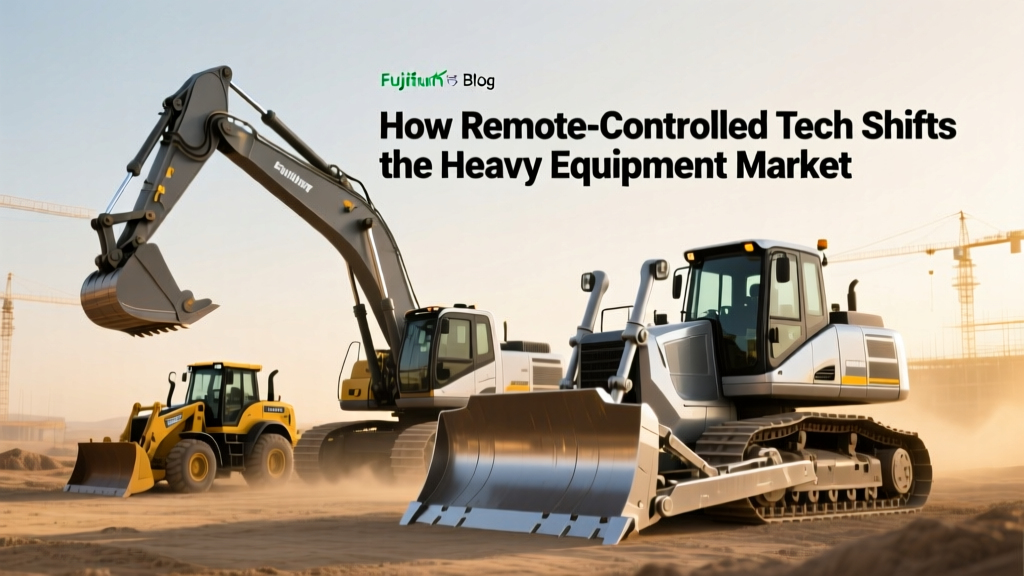
How Remote-Controlled Tech Shifts the Heavy Equipment Market
Explore how remote-controlled and modular machinery transforms the heavy equipment market through real-world mining and demolition case studies.
The transition from cab-operated machinery to remote-controlled and modular platforms represents the most significant capital expenditure shift in the heavy equipment market over the last decade. Driven by stringent safety regulations in hazardous environments and the demand for continuous operational uptime, fleet managers are increasingly decoupling the operator from the machine. This architectural shift relies on modular base carriers, swappable hydraulic tooling, and ultra-low latency telemetry networks. By examining specific deployments in nuclear decommissioning and deep-vein mining, we can quantify the operational realities, hidden infrastructure costs, and ROI timelines of remote-controlled heavy machinery.
The Architecture of Modular Remote Systems
Modern remote-controlled heavy equipment is not merely a traditional machine with a wireless joystick. It is a modular system comprising three distinct layers: the base power carrier, the quick-attach tooling interface, and the edge-computed telemetry station. The base carrier houses the powertrain (typically a 400V/1000V electric motor or a Tier 4 Final diesel engine), hydraulic pumps, and the PLC (Programmable Logic Controller) that processes operator inputs.
Critical Telemetry Thresholds for Remote Operation- Video Feedback Latency: Must remain below 100ms to prevent operator motion sickness and spatial disorientation.
- Hydraulic Control Latency: Must remain below 20ms for precision tasks like concrete crunching or delicate mucking.
- Signal Redundancy: Systems require dual-band Wi-Fi 6 or private 5G with automatic failover to halt the machine safely if packet loss exceeds 2%.
Case Study 1: Nuclear Decommissioning via the Brokk 700
In high-radiation and structurally compromised environments, human presence is a liability. The Brokk 700 remote-controlled demolition robot has become the standard for heavy indoor dismantling and nuclear decommissioning. Weighing in at 1,800 kg with a 20 kW power output, the Brokk 700 utilizes a modular SmartPower electrical system that adapts to fluctuating grid voltages, preventing motor burnouts in aging industrial facilities.
During a recent decommissioning project at a mid-century European reprocessing plant, a fleet of three Brokk 700 units was deployed. The modular quick-attach system allowed operators to swap between a 1,200 kg hydraulic crusher, a rotary drum cutter, and a specialized radiation-shielded grapple in under four minutes. The remote control station, operating on a secure 2.4 GHz digital link with a 300-meter line-of-sight range, allowed operators to work from a lead-lined control bunker.
'The modular tooling on the Brokk 700 reduced our specialized equipment footprint by 60%. Instead of bringing in three distinct machines that require separate decontamination protocols, we decontaminate one base carrier and swap the tooling inside the hot zone via remote quick-couplers.' — Site Decommissioning Director
Economic Impact: The base CapEx for a Brokk 700 hovers between $380,000 and $420,000, with specialized modular attachments adding $45,000 to $85,000 each. However, the elimination of human entry into the hot zone reduced ALARA (As Low As Reasonably Achievable) radiation exposure costs by an estimated $1.4 million annually, yielding a payback period of just 7.5 months.
Case Study 2: Deep-Vein Extraction with Sandvik LH518B
Underground mining presents severe ventilation and ground-fall risks. The Sandvik AutoMine system paired with the LH518B underground loader (LHD) demonstrates how remote-controlled modular systems scale to heavy tonnage. The LH518B is an 18-tonne payload LHD designed specifically for automated and remote-operated mucking in narrow veins.
In a Canadian hard-rock mine operating at depths exceeding 2,500 meters, the transition to remote-operated LH518B units fundamentally altered the mine's ventilation economics. Because the operator is relocated to a surface control room, the mine eliminated the need to pump massive volumes of fresh air, cooling, and exhaust scrubbing into the active mucking headings. The LHDs operate via a private LTE network integrated with mine-wide Wi-Fi mesh access points.
The modular nature of the Sandvik system lies in its software and sensor payloads. The same base LH518B chassis can be configured with modular LiDAR arrays for autonomous tramming, or stripped down to basic tele-remote cameras for manual mucking via surface joysticks. This modularity allows the mine to deploy autonomous tramming on main haulage drifts, while switching to manual tele-remote control for the highly variable, unstructured environment of the active stope drawpoints.
Deployment Decision Matrix
Fleet managers evaluating the heavy equipment market for remote-controlled assets must align the technology with specific operational constraints. The following matrix provides a framework for CapEx and deployment planning.
| Application Scenario | Recommended Architecture | Est. CapEx Premium (vs. Manned) | Primary ROI Driver |
|---|---|---|---|
| Hazardous Indoor Demolition | Electric compact carrier (e.g., Brokk 700) + RF remote | +45% to +60% | Elimination of hazard pay, insurance reduction, continuous uptime |
| Deep Underground LHD Mucking | Heavy LHD (e.g., Sandvik LH518B) + Private LTE/5G | +80% to +120% | Ventilation energy savings, removal of personnel from ground-fall zones |
| Surface Highwall Drilling | Tele-remote drill rig + Line-of-sight Wi-Fi mesh | +30% to +50% | Shift-change elimination, precision GPS hole placement |
Modular Tooling Economics
The true financial advantage of modular remote equipment is the utilization rate of the base power unit. In traditional heavy equipment markets, a dedicated hydraulic breaker carrier sits idle when breaking is not required. With modular remote carriers, the base unit operates at 85-90% utilization by swapping from a breaker to an auger, then to a grapple. This reduces the total number of base power units a fleet must purchase, offsetting the higher initial cost of the quick-attach hydraulic couplers and the remote telemetry suites.
Network Infrastructure and Latency Prerequisites
Deploying remote-controlled heavy machinery requires treating network infrastructure as critically as the hydraulic systems. According to data on Ericsson private 5G mining networks, a standard mid-size surface or underground operation requires a dedicated private network buildout costing between $850,000 and $1.2 million. This includes ruggedized edge servers, base stations, and CPE (Customer Premises Equipment) mounted on the machinery.
Warning: Hidden Infrastructure CapExDo not rely on public cellular networks for remote heavy equipment. Public networks prioritize voice and standard data traffic and cannot guarantee the deterministic latency required for heavy hydraulic control. Furthermore, standard IT-grade Wi-Fi routers will fail under the heavy electromagnetic interference generated by high-voltage electric motors and VFDs (Variable Frequency Drives) on modern heavy carriers. Always budget for industrial-grade, shielded mesh nodes.
Strategic Outlook for the Heavy Equipment Market
The integration of modular attachments and remote telemetry is permanently altering procurement strategies within the heavy equipment market. OEMs are increasingly selling 'base carriers' at near-cost, capturing long-term margins through proprietary quick-attach tooling and software licensing for autonomous features. For end-users, the mandate is clear: the viability of remote-controlled heavy equipment hinges not just on the machine's mechanical capabilities, but on the site's willingness to invest in deterministic, low-latency private network infrastructure. Operations that master this integration will see a definitive advantage in both safety metrics and cost-per-ton economics.