Heavy Equipment Wash Station Costs for Remote-Controlled Fleets
Budgeting a heavy equipment wash station for modular and remote-controlled fleets? Analyze 2026 costs, sensor-safe wash tech, and ROI metrics.
The Hidden Liability in Tele-Operated and Autonomous Fleets
The rapid adoption of modular and remote-controlled heavy equipment—ranging from Brokk demolition robots and Husqvarna DXR series to Caterpillar Command autonomous haulers—has fundamentally changed job site productivity. However, it has also introduced a critical blind spot in fleet maintenance budgets: equipment cleaning. Standard high-pressure wash racks are actively destroying the sensitive telemetry, LiDAR arrays, and modular CAN bus connectors that make these machines operational. When budgeting for a heavy equipment wash station in 2026, fleet managers must pivot from traditional dirt-removal metrics to sensor-preservation economics.
WARNING: High-Pressure Sensor DamageApplying standard 3,000+ PSI pressure wands to IP67 or IP69K rated telemetry enclosures causes micro-fractures in gasket seals. The resulting water ingress typically destroys the main Electronic Control Unit (ECU), leading to replacement costs averaging $28,500 per incident, plus 48-72 hours of machine downtime.
CapEx Breakdown: Standard vs. Sensor-Safe Wash Stations
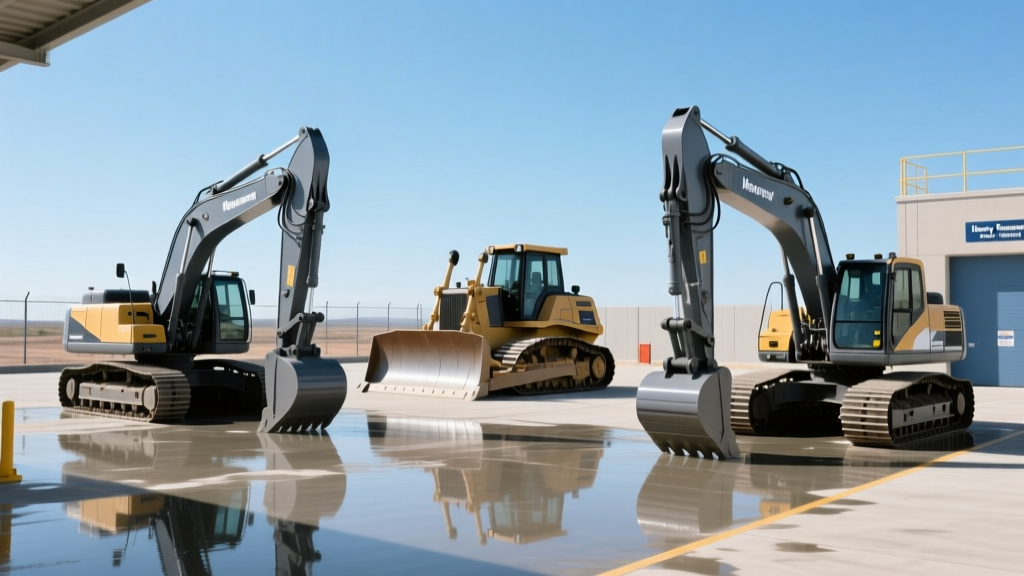
Upgrading your infrastructure requires understanding the capital expenditure tiers available for modern fleets. A traditional open-air rack is no longer viable for remote-controlled assets due to the risk of thermal shock to optical sensors and the lack of containment for hazardous dust.
| Station Tier | Estimated CapEx (2026) | Key Features | Risk to Remote Fleet |
|---|---|---|---|
| Tier 1: Open-Air Rack | $45,000 - $75,000 | High-PSI wands, grated floor, basic sump | High (Seal failure, sensor cracking) |
| Tier 2: Enclosed Closed-Loop | $120,000 - $180,000 | Water reclamation, variable pressure, enclosed bay | Medium (Chemical corrosion on modular pins) |
| Tier 3: Sensor-Safe Modular Bay | $220,000 - $350,000 | RO water, LVHV touchless wands, ultrasonic attachment baths | Low (Optimized for IP69K and optics) |
Critical Design Requirements for Modular Chassis
Remote-controlled machines rely heavily on modular attachments. A Brokk 700 demolition robot might swap between a breaker, crusher, and grapple multiple times a day. These quick-attach mechanisms utilize high-flow hydraulic couplers paired with multi-pin electrical connectors to transmit data from the attachment to the operator's remote control pendant.
1. Ultrasonic Connector Cleaning
Mud and silica dust baked onto a 24-pin CAN bus connector will cause data packet loss, resulting in latency between the operator's joystick inputs and the machine's hydraulic response. Tier 3 wash stations integrate flush-mounted ultrasonic cleaning baths. Operators detach the modular electrical pigtails and submerge them in a 40kHz ultrasonic bath filled with a dielectric, non-corrosive solvent. This removes microscopic debris without bending the delicate gold-plated pins.
2. Low-Volume, High-Velocity (LVHV) Touchless Systems
To protect LiDAR domes (such as Ouster or Velodyne units costing $15,000 to $40,000 each) and FLIR thermal cameras, the heavy equipment wash station must utilize LVHV nozzles. These systems deliver water at 1,200 PSI but at a high volume (40+ GPM), relying on kinetic energy rather than cutting pressure to sheet mud off the chassis. Furthermore, the water must be temperature-regulated to 85°F to prevent thermal shock to optical glass when washing machines that have been operating in freezing environments.
OpEx and Closed-Loop Water Reclamation
Operating a wash bay for autonomous and remote fleets involves strict environmental compliance. Because these machines often operate in contaminated zones (e.g., demolition sites with lead paint or mining sites with heavy metal runoff), wash water cannot be discharged into municipal storm drains.
According to the EPA's guidelines on stormwater discharges from construction activities, failing to contain and properly treat wash water runoff can result in fines exceeding $60,000 per violation. Closed-loop reclamation systems are no longer optional; they are a baseline requirement for heavy equipment maintenance budgets.
A modern closed-loop Reverse Osmosis (RO) system adds approximately $0.14 to $0.18 per gallon in operational treatment costs (filter replacements, UV sterilization, and ozone injection). However, this eliminates municipal water discharge fees and ensures that the water sprayed onto sensitive electronic modules is entirely free of dissolved minerals, preventing calcification on sensor lenses and electrical contacts.
ROI Framework: Calculating the Payback Period
How do you justify a $280,000 Tier 3 heavy equipment wash station to the CFO? The return on investment is calculated not by time saved, but by catastrophic failure avoidance and uptime preservation. Use this step-by-step framework to model your payback period:
- Calculate Annual Sensor/ECU Replacement Costs: Audit your maintenance logs. If your fleet averages three ECU water-ingress failures ($28,500 each) and two LiDAR thermal-shock replacements ($22,000 each) annually, your baseline loss is $129,500.
- Factor in Modular Downtime: Every hour a remote-controlled machine is offline waiting for a replacement telemetry module costs the project approximately $450 in delayed critical-path scheduling. If 130 hours are lost annually to wash-related electrical faults, add $58,500 to the loss column.
- Subtract OpEx Savings: A closed-loop system reclaims 85% of wash water. For a fleet washing 15 machines a week, this saves roughly $14,000 annually in municipal water and sewer surcharges.
- Determine Net Payback: Total avoided losses ($188,000) + OpEx savings ($14,000) = $202,000 annual value. A $280,000 Tier 3 system pays for itself in roughly 16.6 months.
Regulatory Compliance: Silica Dust and Operator Safety
Remote-controlled equipment is frequently deployed in high-hazard environments, such as concrete demolition and underground mining, where respirable crystalline silica is prevalent. When these machines are transported on lowboy trailers or brought into maintenance bays, dried silica dust becomes airborne, posing a severe health risk to mechanics and transport drivers.
The OSHA respirable crystalline silica standard for construction (1926.1153) mandates strict controls on dust exposure. A properly engineered heavy equipment wash station acts as the primary engineering control. By utilizing enclosed bays with negative air pressure and HEPA-filtered exhaust systems, the wash station captures silica-laden runoff and airborne particulates before they can migrate to general maintenance areas. Budgeting for the negative-air HVAC integration typically adds $35,000 to $50,000 to the initial CapEx, but it is non-negotiable for OSHA compliance when processing demolition robots and tunneling shields.
Final Budgeting Recommendations
When provisioning capital for a modular and remote-controlled fleet, do not treat the wash rack as a generic facility expense. Specify the heavy equipment wash station as a critical piece of diagnostic and preservation equipment. Mandate LVHV touchless wands, ultrasonic connector baths, and RO water treatment in your RFPs. The upfront premium of a Tier 3 sensor-safe bay is rapidly offset by the elimination of five-figure telemetry replacements and the preservation of your autonomous fleet's operational uptime.