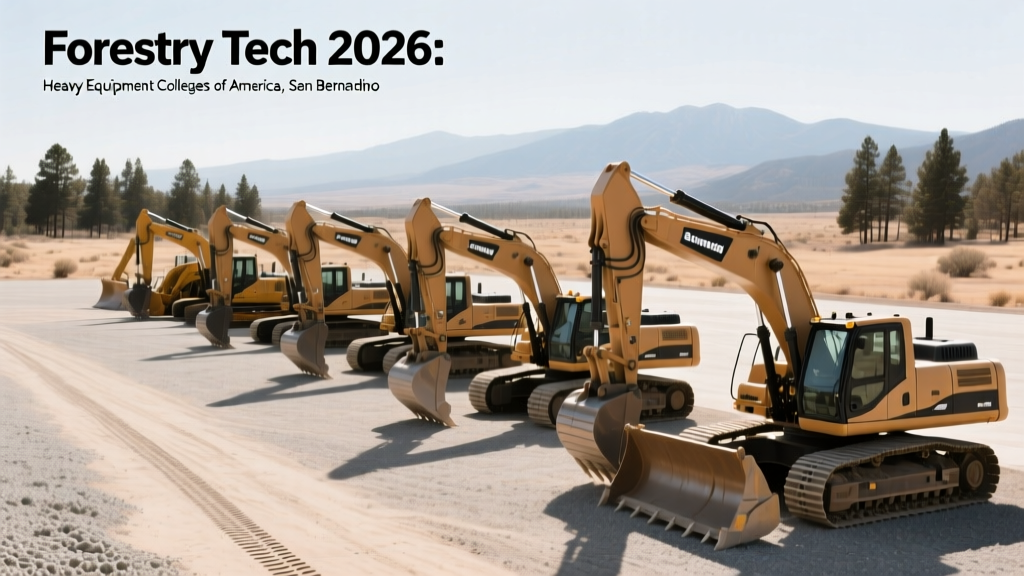
Forestry Tech 2026: Heavy Equipment Colleges of America San Bernardino
Explore 2026 forestry machinery innovations and how Heavy Equipment Colleges of America San Bernardino trains operators on advanced logging tech.
The transition from mechanical joysticks to AI-assisted, sensor-fused logging cabins has fundamentally altered the forestry and logging heavy machinery sector. In 2026, operating a modern harvester or forwarder requires an understanding of LiDAR canopy mapping, telematics-driven predictive maintenance, and automated boom control. This technological leap has created a severe skills gap in the Pacific Northwest and California logging markets. To bridge this divide, specialized training institutions, notably the Heavy Equipment Colleges of America San Bernardino campus, have adapted their heavy machinery curricula to produce operators capable of managing million-dollar, software-defined forestry fleets.
The 2026 Forestry Machinery Landscape: AI and Telematics
Modern logging equipment is no longer just about hydraulic brute force; it is about precision data extraction. The latest generation of forestry machines utilizes sensor fusion to optimize timber yield while minimizing soil disruption. For example, the Tigercat H7250D Harvester integrates advanced leveling winch-assist technology and a 330 kW engine managed by real-time telematics that adjust hydraulic flow based on wood density and terrain gradient.
Tech Spec Highlight: John Deere 1510E Forwarder
- Base Price (2026): $680,000 - $740,000 USD
- Automation: Active Frame Control (AFC) with TimberMatic Maps integration
- Sensor Suite: Roof-mounted LiDAR for canopy clearance and GPS-linked route optimization
- Downtime Cost: Estimated at $285 per hour in lost yield and idle crew wages
Because a single hour of unplanned downtime on a $700,000 forwarder can cost a logging company nearly $300 in lost productivity and cascading supply chain delays, firms are no longer willing to rely on 'on-the-job' trial and error. They require operators who understand the digital interfaces of these machines before they ever step into the cab.
Bridging the Skills Gap: Heavy Equipment Colleges of America San Bernardino
While historically recognized for earthmoving and crane operations, the Heavy Equipment Colleges of America San Bernardino facility has become a critical incubator for West Coast forestry talent. The campus provides the foundational heavy equipment hydraulics, grade control, and simulator training that logging companies use as a prerequisite before deploying operators to specialized OEM forestry schools.
The San Bernardino campus utilizes NCCER-certified training modules that focus heavily on the intersection of hydraulic systems and digital feedback loops. Trainees spend up to 40 hours in advanced simulator labs that replicate the exact joystick resistance, cab vibration, and visual telemetry of modern forestry cabs. This muscle-memory training is vital for mastering crane tip control, reducing hydraulic shock, and extending the lifespan of boom cylinders and rotary actuators.
'We are seeing a direct correlation between simulator-trained operators and a 22% reduction in hydraulic hose failures during the first year of a machine's life. The Heavy Equipment Colleges of America San Bernardino program ensures operators understand the digital limits of the machine's pressure relief valves before they test them in the mud.'
— Regional Fleet Manager, Pacific Northwest Timber Cooperative
Training Matrix: Traditional Logging vs. Tech-Integrated Curriculum
| Training Element | Traditional In-House (Pre-2020) | HECA San Bernardino Tech Curriculum |
|---|---|---|
| Hydraulic Systems | Visual leak checks, basic greasing | Telematics analysis, pressure sensor diagnostics, load-sensing pump theory |
| Boom Operation | Live-machine trial and error | Simulator-based crane tip control, anti-shock valve management |
| Spatial Awareness | Line-of-sight reliance | LiDAR integration, TimberMatic Maps navigation, blind-spot camera fusion |
| Maintenance | Reactive (run-to-failure) | Predictive (IoT oil analysis, thermal imaging of swing drives) |
Key Forestry Innovations Taught in Modern Certification Programs
To remain competitive in 2026, operators graduating from advanced heavy equipment programs must be proficient in several cutting-edge forestry technologies:
- Drone Canopy Integration: Operators now receive pre-loaded 3D topographical and canopy density maps generated by forestry drones. Training focuses on interpreting this data on in-cab displays to plan felling directions and extraction routes that minimize soil compaction.
- Automated Winch-Assist Traction: Steep-slope logging relies on tethered winch-assist systems (like the Falcon TG). Operators are trained to monitor tether tension telemetry, understanding the exact load limits of the synthetic ropes and the automated braking algorithms that prevent catastrophic rollback.
- Predictive IoT Maintenance: Modern harvesters transmit over 400 data points per second to cloud-based fleet management systems. Operators are taught to read early-warning telematics for issues like swing-drive gear wear or hydraulic fluid degradation, allowing maintenance crews to order parts before a failure occurs.
Decision Framework: In-House Training vs. Institutional Certification
Logging contractors often debate whether to train operators internally or send them to institutions like the Heavy Equipment Colleges of America San Bernardino. The decision should be based on the complexity of the fleet and the cost of capital equipment.
Fleet Investment Decision Guide
- If your fleet consists of older, mechanically controlled skidders and feller bunchers (Pre-2018): In-house mentorship remains cost-effective. The learning curve is primarily mechanical and spatial.
- If you are financing new, software-defined harvesters (e.g., Ponsse ScorpionKing, JD 1410E): Institutional training is mandatory. The $20,000 - $25,000 tuition cost for a comprehensive 12-week heavy equipment program is recouped within the first three months through a 15-20% increase in timber yield optimization and a drastic reduction in hydraulic component warranty claims.
Enrollment and Career Trajectory for Forestry Tech Operators
The comprehensive heavy equipment programs at the San Bernardino campus typically run for 10 to 12 weeks. Graduates earn NCCER credentials that are highly sought after by major timber firms operating in the Cascades and the Sierra Nevada. While the campus is located in Southern California, the telemetry and simulator skills acquired are universally applicable to the dense forests of the Pacific Northwest and the Southeastern pine plantations.
Starting salaries for tech-certified forestry equipment operators in 2026 range from $75,000 to $95,000 annually, with senior harvester operators commanding upwards of $110,000 when factoring in yield-based production bonuses. The integration of John Deere Forestry Technology and Tigercat's remote-monitoring suites means that the modern operator is as much a data analyst as a heavy machinery driver.
Frequently Asked Questions
Do I need prior logging experience to enroll in heavy equipment training for forestry?
No. Programs like those at the Heavy Equipment Colleges of America San Bernardino focus on the universal principles of heavy machinery hydraulics, telematics, and simulator-based spatial awareness. Logging companies prefer to teach the specific silviculture and felling techniques in-house, provided the operator already possesses a certified foundation in machine control and digital interface management.
How accurate are the forestry simulators used in training?
Modern 2026 simulators utilize physics engines that accurately replicate the center-of-gravity shifts of a fully loaded forwarder on a 30-degree incline. They also simulate hydraulic latency and boom swing momentum, providing a 95% correlation to real-world machine behavior, which is critical for preventing rollovers in steep-slope logging.
What is the most common failure mode for new operators on modern harvesters?
The most common and expensive error is 'shock-loading' the hydraulic system by making abrupt directional changes with the crane while processing high-density timber. This spikes system pressure, blowing O-rings and damaging load-sensing valves. Simulator training specifically targets and corrects this habit through repetitive, gamified boom-control exercises.
For further insights into heavy machinery operator standards and certification requirements, refer to the Heavy Equipment Colleges of America official curriculum guidelines and NCCER accreditation standards.