Port Crane Repair: When to Use Reconditioned Heavy Equipment Services
Expert troubleshooting for port cranes and when to use reconditioned heavy equipment services for RTGs, reach stackers, and ship-to-shore gantry repairs.
The Saltwater Toll: Unique Failure Modes in Marine Heavy Equipment
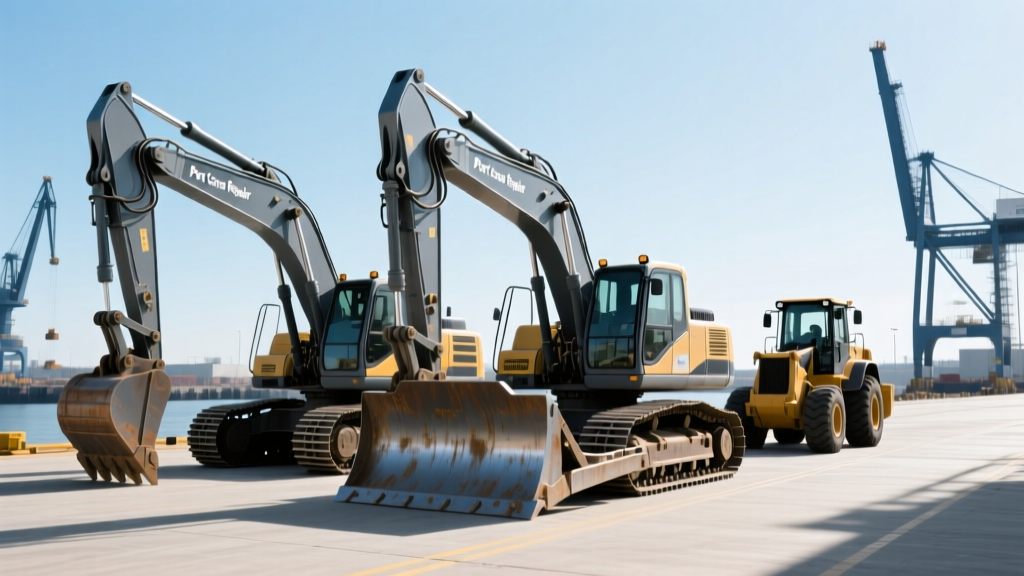
Marine and port environments subject heavy machinery to some of the most aggressive operating conditions on earth. Ship-to-shore (STS) cranes, rubber-tired gantries (RTGs), and heavy-duty reach stackers operate in high-salinity, high-humidity zones where micro-abrasive salt crystals infiltrate every mechanical tolerance. Unlike standard earthmoving equipment, port machinery suffers from accelerated galvanic corrosion, particularly at the interface of dissimilar metals in slewing bearings and trolley wheel assemblies.
For maintenance directors at busy terminals, the decision between executing a field repair and pulling a component for off-site rebuild is critical. As of 2026, global supply chain bottlenecks for specialized OEM marine drivetrain components mean that waiting for a new ZPMC hoist gearbox or a Konecranes RTG spreader hydraulic block can result in weeks of vessel demurrage. This is where leveraging specialized reconditioned heavy equipment services transitions from a cost-saving measure to an operational necessity.
CRITICAL ALERT: Slewing Bearing Micro-PittingSaltwater ingress past degraded labyrinth seals on STS crane slewing bearings causes micro-pitting on the raceway. If grease analysis shows iron particle counts exceeding 150 ppm (ISO 4406 code 22/19/16), immediate teardown is required. Operating with pitted raceways will cause catastrophic gear tooth shearing within 400 operating hours.
Symptom-to-Solution Decision Tree for Port Machinery
Accurate troubleshooting dictates whether a fault can be resolved on the tarmac or requires a complete component swap. Below is a diagnostic matrix for common marine equipment failures, mapping symptoms to precise mechanical interventions.
| Symptom | Equipment Model | Root Cause | Reconditioning Trigger |
|---|---|---|---|
| Telescopic boom drift under load | Kalmar DRG450 Reach Stacker | Internal spool valve leakage or failed load-holding check valve | If main lift cylinder shows >0.5mm scoring on chrome rod, requires full teardown and re-chroming off-site. |
| Hoist motor overheating (>95°C) | ZPMC STS Gantry Crane | Degraded cooling fins clogged with salt/cottonwood, or failing rotor bearings | Stator winding insulation resistance drops below 5 Megohms; requires complete rewind and VPI (Vacuum Pressure Impregnation) treatment. |
| Transmission slipping in 3rd/4th gear | Terberg YT Terminal Tractor | Clutch pack wear due to high-cycle shuttle operations | Magnetic particle inspection reveals >2mm wear on clutch plates; core unit sent for transmission rebuild. |
| Gantry steering lag >2 seconds | Konecranes RTG | Hydraulic pump volumetric efficiency loss, internal bypassing | Pump flow drops below 78% of rated GPM at 3000 PSI; swap with remanufactured Rexroth unit. |
Evaluating the ROI of Reconditioned Heavy Equipment Services
Port operators must balance the immediate capital expenditure of new OEM parts against the lifecycle value of rebuilt components. When managing a fleet of material handlers, utilizing reconditioned heavy equipment services for major sub-assemblies—such as diesel powerplants, planetary drive axles, and hydraulic pumps—yields a 40% to 60% cost reduction while maintaining OEM tolerances.
The 2026 Cost-Benefit Matrix: Marine Drivetrain Components
The following data reflects Q1 2026 pricing and lead times for critical port equipment components. Note that lead times for new OEM marine-spec gearboxes remain highly volatile, making the core-exchange model the preferred strategy for high-utilization terminals.
| Component | New OEM Cost | Reconditioned Cost | Downtime Delta | Warranty |
|---|---|---|---|---|
| Cummins QSM11 Marine Engine | $42,000 - $48,000 | $18,500 - $24,000 | Saves 4-6 weeks | 12 mo / 2,000 hrs |
| ZF 9 WG 211 Transmission | $28,500 | $11,200 - $13,500 | Saves 2-3 weeks | 12 mo / Unlimited hrs |
| Bosch Rexroth A4VSO Pump | $14,800 | $6,500 - $8,200 | Saves 1-2 weeks | 12 mo / 2,000 hrs |
| Spreader Twistlock Actuator Block | $9,400 | $3,800 - $4,500 | Saves 5-8 days | 6 mo / 1,000 hrs |
The Reconditioning Protocol: Marine-Grade Teardown and Rebuild
Reconditioning marine port equipment is not simply a matter of replacing seals. The corrosive environment demands a rigorous metallurgical and dimensional protocol. When a component like a Dana/Spicer heavy-duty drive axle is pulled from a reach stacker operating in a coastal salt-spray zone, it must undergo the following standardized rebuild process:
- High-Pressure Thermal Wash: The unit is submerged and agitated in a 180°F alkaline solution to dissolve crystallized salt deposits and carbonized grease from internal galleries that standard power washing misses.
- Magnetic Particle Inspection (MPI): All high-stress nodes, particularly the ring gear mounting flanges and axle shaft splines, undergo MPI to detect sub-surface micro-fractures caused by the high-torque shock loads of lifting 45-ton laden containers.
- Dimensional Metrology: Bearing journals are measured with laser micrometers. If a journal is out of round by more than 0.0015 inches, it is built up via thermal spray coating and precision ground back to OEM specifications.
- Dynamic Balancing: Rotating assemblies (driveshafts, pinions) are spin-balanced to ISO 1940-1 G2.5 standards to prevent harmonic vibrations that destroy wheel bearings at 25 km/h terminal travel speeds.
- Marine-Grade Coating: Exterior housings are grit-blasted to SA 2.5 and coated with a two-part epoxy zinc-rich primer followed by a polyurethane topcoat, specifically formulated to resist UV degradation and salt spray.
Compliance and Load Testing Post-Reconditioning
Reinstalling a reconditioned component on port machinery triggers strict regulatory compliance requirements. According to the OSHA 1917.71 standard for cargo handling gear, any repair or replacement of a critical load-bearing component requires thorough testing before returning to service.
Furthermore, the ASME B30.2 safety standard for overhead and gantry cranes mandates specific load testing protocols following major structural or hoisting mechanism repairs. Port engineers must execute the following validation steps post-rebuild:
- Static Load Test: The equipment must lift 125% of its rated capacity (e.g., 56.25 tons for a 45-ton reach stacker) and hold the load suspended for 10 minutes to verify structural integrity and brake holding torque.
- Dynamic Load Test: The equipment must perform full operational cycles (hoisting, traversing, traveling) with 110% of the rated load to validate hydraulic cooling, transmission shifting under load, and dynamic braking.
- Wire Rope Inspection: If the hoist mechanism was reconditioned, the wire rope (typically 6x36 WS IWRC construction) must be re-evaluated. ASME dictates replacement if more than 6 broken wires are found in one rope lay, or if there is a >15% loss of original rope diameter due to core failure.
When utilizing reconditioned heavy equipment services, always establish a 'core exchange' agreement upfront. Marine components are heavy and expensive to ship. Ensure the reconditioning facility provides a certified shipping crate and covers the freight for the defective core return, provided the core is not physically cracked or welded by prior unauthorized field repairs.
FAQ: Marine Equipment Reconditioning Specifics
How do we handle electronic control modules (ECMs) during a marine engine reconditioning?
When sending a Cummins or MTU marine engine for reconditioning, the ECM and wiring harness are typically stripped and retained by the port's electrical shop. Marine wiring harnesses suffer from severe capillary corrosion (where saltwater wicks inside the wire insulation). It is highly recommended to discard the old engine harness and install a new, marine-sealed harness when dropping in the reconditioned long-block to prevent CAN-bus communication faults.
Can we recondition RTG spreader hydraulic cylinders on-site?
Seal replacements can be done on-site, but true reconditioning cannot. If a spreader cylinder rod is pitted from salt exposure, field-applied epoxy fillers will fail within weeks under the high-pressure wiping action of the rod seals. The cylinder must be sent to a facility equipped to strip the old chrome, perform submerged arc welding to build up deep pits, grind to exact tolerances, and apply a new layer of hard industrial chrome plating.
What is the expected lifecycle of a reconditioned STS crane hoist gearbox compared to new?
A properly reconditioned hoist gearbox, where all bearings are replaced with SKF/NSK marine-grade equivalents and gears are lapped to optimal contact patterns, will achieve 90% to 95% of the lifecycle of a brand-new OEM unit. The critical variable is the terminal's preventative maintenance program; reconditioned gearboxes require strict adherence to synthetic oil change intervals (typically every 4,000 hours) and quarterly ferrography (oil debris analysis) to catch early wear signs.