Railroad Maintenance Equipment Types: How Heavy Equipment Can Be Fastened to Wood Framing Using a Trestle Anchor
Explore railroad maintenance equipment types for timber trestle routes. Learn load limits, MOW machine specs, and wood-framing anchor engineering.
The Intersection of MOW Equipment and Timber Infrastructure
Procuring Maintenance of Way (MOW) machinery in 2026 requires more than just evaluating horsepower and track gauge compatibility. For shortline railroads, logging routes, and historic transit corridors, a significant portion of the infrastructure relies on timber trestle bridges and wood-framed crossing platforms. Selecting the correct railroad maintenance equipment types for these routes demands a rigorous understanding of dynamic load distribution, axle weight restrictions, and structural fastening engineering.
Unlike steel or concrete viaducts, timber structures are highly susceptible to shear stress and moisture-induced degradation. According to the Federal Railroad Administration's Bridge Safety Standards, railroads must maintain strict Gross Rail Load (GRL) limits on aging timber structures, often capping them at 263,000 lbs or even 220,000 lbs. This necessitates the use of specialized, lightweight, or multi-axle MOW equipment to prevent catastrophic point-loading failures.
Critical Load Warning: Never deploy standard 4-axle production tampers on unreinforced timber trestles without calculating the Dynamic Impact Factor (DIF). AREMA Chapter 7 guidelines mandate a 20% to 30% impact allowance for timber structures, meaning a static 100-ton machine exerts up to 130 tons of dynamic force during vibration and transit.Top Railroad Maintenance Equipment Types for Wood-Supported Routes
When operating on wood-framed bridges and timber tie networks, equipment selection must prioritize low axle loads and wide load distribution footprints.
1. Multi-Axle Continuous-Action Tampers
Standard tampers concentrate immense down-force on the track structure during the tamping cycle. For timber routes, continuous-action machines with 8-axle or specialized 4-axle distributed-weight configurations are mandatory. The Plasser & Theurer 08-275 UNIMAT series remains an industry benchmark, offering a continuous tamping cycle that reduces the localized shock loads associated with stop-and-go tamping. Expect to invest between $1.8 million and $2.4 million for a modern, low-axle-load configured production tamper.
2. Hi-Rail Excavators for Timber Replacement
Replacing decaying timber bridge ties and trestle caps requires precision lifting. Hi-Rail excavators, such as the Caterpillar M323F RR (priced around $550,000 to $650,000), are equipped with specialized rail wheels and outrigger systems. When operating on a wood-framed trestle, the machine's outriggers must be fitted with engineered composite dunnage pads to spread the 22-ton operating weight across multiple timber caps, preventing localized crushing of Southern Yellow Pine or Douglas Fir structural members.
3. Pneumatic Spike Pullers and Tie Cranes
For localized timber bridge maintenance, self-propelled tie cranes (like those manufactured by Loram or Brandt) are utilized. These machines feature extended wheelbases to distribute the heavy counterweight and boom loads across a minimum of four bridge bents simultaneously. Modern 2026 models integrate load-moment indicators (LMI) that automatically restrict boom swing radii if the machine detects it is centered over a weak timber span.
Engineering the Connection: Securing Machinery on Wood Structures
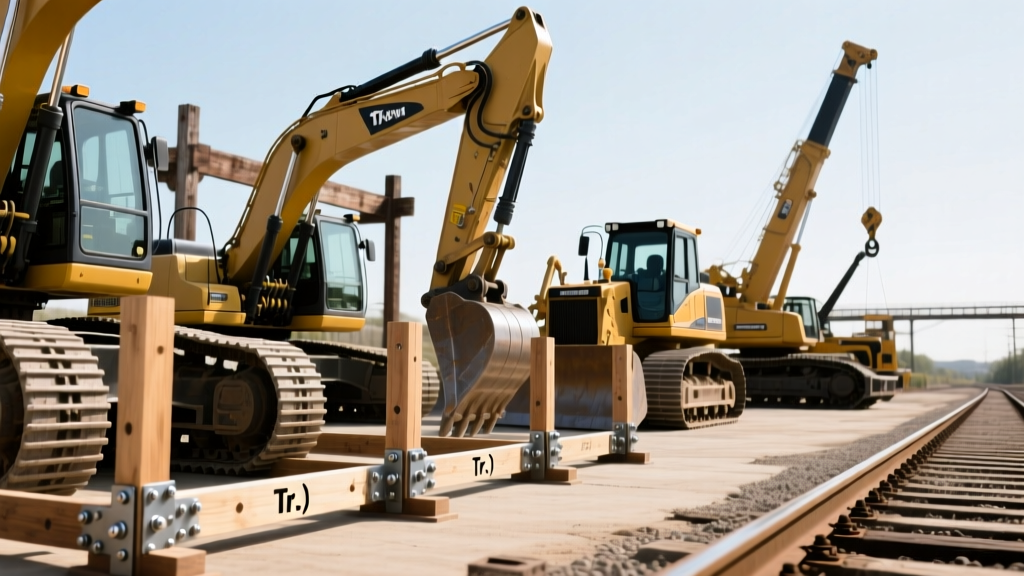
Beyond transit, MOW operations frequently require the staging of heavy machinery, temporary track panels, or winching systems directly on timber structures during bridge rehabilitation. In these highly specialized staging scenarios, heavy equipment can be fastened to wood framing using a structural timber anchor system paired with engineered steel bearing plates.
According to the U.S. Forest Products Laboratory Wood Handbook, standard lag screws are insufficient for the dynamic shear forces generated by rail-bound equipment. Instead, engineers utilize:
- ASTM F1852 Twist-Off Tension-Control Bolts: Used with heavy steel shear plates to anchor temporary winches or stabilizing outriggers directly into timber trestle caps.
- Structural Epoxy Anchors: Threaded rods epoxied into pre-drilled timber piles to secure heavy rail clamps and temporary guide rails without splitting the wood grain.
- Simpson Strong-Tie SDS Heavy-Duty Screws: Utilized for fastening temporary wooden dunnage tracks to the primary framing, providing high withdrawal resistance without the need for pre-drilling.
Equipment Selection Matrix for Timber Trestle Routes
| Equipment Type | Target Axle Load Limit | Dynamic Impact Risk | Est. 2026 Cost |
|---|---|---|---|
| 8-Axle Production Tamper | 36,000 lbs / axle | Moderate (Continuous) | $2.1M - $3.0M |
| Hi-Rail Excavator (20t) | 22,000 lbs / axle | High (During Swing) | $550K - $700K |
| Ballast Regulator | 30,000 lbs / axle | Low (Steady Transit) | $800K - $1.2M |
| Self-Propelled Tie Crane | 40,000 lbs / axle | Severe (Lifting) | $1.5M - $1.9M |
Procurement Framework: Buying MOW Equipment for Wood-Framed Networks
Purchasing heavy railroad maintenance equipment for timber-heavy networks requires a strict decision framework to avoid acquiring machinery that your infrastructure physically cannot support.
Step 1: Audit the Route's Weakest Timber Bent
Do not base procurement on the line's average bridge capacity. Identify the single weakest timber bent or trestle cap on the route. If your lowest-capacity bridge bent maxes out at 220,000 lbs GRL, you must eliminate any MOW equipment from your bidding list that exceeds a 27,500 lb per-axle static limit (accounting for the 20% dynamic impact multiplier).
Step 2: Mandate Composite Outrigger Pads
When specifying Hi-Rail excavators or tie cranes, include composite or engineered elastomer outrigger pads in the RFP. Steel pads will crush the surface fibers of timber bridge caps, accelerating moisture ingress and rot. High-density polyethylene (HDPE) pads distribute the point load safely across the wood grain.
Step 3: Evaluate Vibration Dampening Systems
For tampers and regulators, prioritize machines equipped with advanced vibration-dampening suspension and smooth-acceleration hydrostatic drives. The abrupt starting and stopping of older, mechanically driven MOW equipment creates longitudinal shear forces that can literally push timber trestle bents out of plumb over time.
Expert Insight: Always cross-reference the equipment manufacturer's stated 'axle load' with the 'dynamic axle load' generated during the machine's primary work cycle. A tie crane may have a low static transit weight, but the dynamic load on the lead axle when lifting a 2,000 lb wet oak tie at maximum boom extension can exceed timber shear limits instantly. Require load-moment limiter software in all 2026 procurement contracts.