How Quarry Applications Drive the Heavy Construction Equipment Market
Explore how quarry and aggregate processing applications shape the heavy construction equipment market through real-world fleet case studies and cost data.
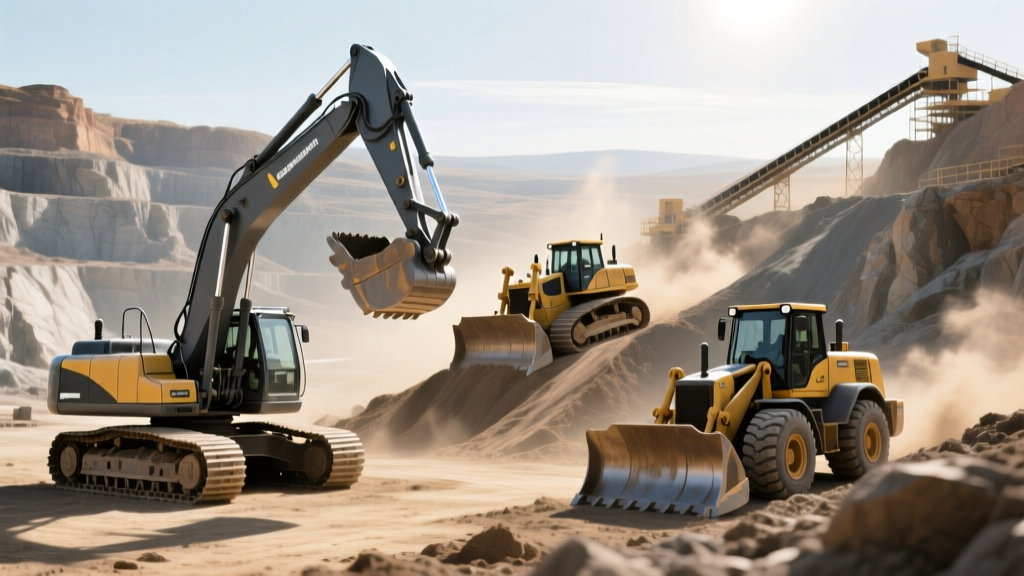
The heavy construction equipment market is undergoing a structural shift, heavily influenced by the operational realities of quarry and aggregate processing. Unlike general earthmoving or commercial building, aggregate extraction demands continuous, high-impact material handling that accelerates component wear and dictates fleet replacement cycles. In 2026, producers are aggressively moving away from static, fixed-plant installations toward track-mounted mobile crushing and screening circuits. This transition reduces internal haulage costs, minimizes silica dust exposure, and allows operations to follow the blast face directly.
Market Data Highlight: Mobile Processing Adoption
According to industry analyses tracked by Pit & Quarry, mobile aggregate processing equipment now accounts for over 40% of new crusher deployments in North America. The primary driver is the reduction of cost-per-ton by eliminating the need for 40-ton articulated dump trucks to ferry raw shot-rock to stationary primary crushers.
Case Study 1: High-Volume Limestone Extraction in the Midwest
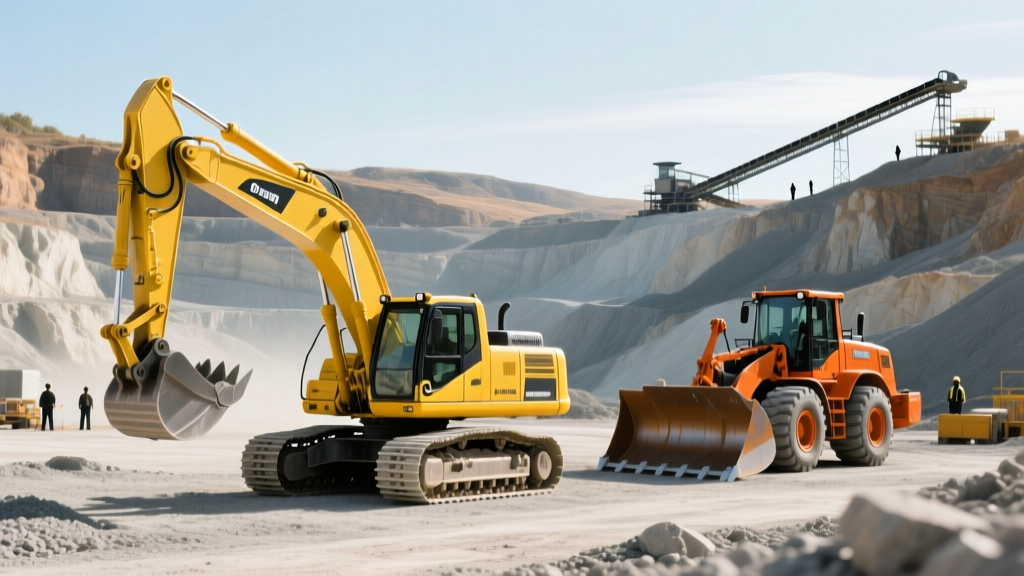
To understand how these applications dictate purchasing trends within the heavy construction equipment market, we examined a 4.5-million-ton-per-year limestone operation in Indiana. The site transitioned from a stationary primary jaw and overland conveyor system to a fully mobile track-mounted fleet to exploit multiple, non-contiguous limestone reserves on their 800-acre property.
Fleet Economics and Throughput Metrics
The operation deployed three Caterpillar 777G Off-Highway Trucks (100-ton payload class) to feed two Metso Lokotrack LT120 mobile jaw crushers. The LT120 features a Nordberg C120 jaw crusher with a 1200 x 870 mm feed opening, specifically engineered for high-capacity primary crushing in quarry applications.
| Equipment Model | Capital Cost (Est. 2026) | Hourly Fuel Burn | Target Throughput | Primary Wear Component |
|---|---|---|---|---|
| Cat 777G Haul Truck | $1.85M - $2.1M | 14.5 gal/hr | 100 tons/pass | Hoist cylinder seals |
| Metso LT120 Jaw Crusher | $850K - $1.05M | 13.0 gal/hr | 450 - 600 tph | Manganese jaw dies |
| Cat 980M Wheel Loader | $720K - $850K | 8.2 gal/hr | Feed rate control | Bucket cutting edges |
By utilizing the LT120, the operation achieved a sustained throughput of 520 tons per hour (tph) of 1.5-inch minus limestone. The critical economic metric here is the cost-per-ton of wear parts. By standardizing on 18% manganese (Mn) jaw dies rather than the OEM-standard 14% Mn, the quarry extended die life by 34%, dropping wear costs from $0.11/ton to $0.07/ton despite the higher initial procurement cost of the alloy.
Case Study 2: Abrasive Granite Processing and Mobile Screening
While limestone tests impact resistance, hard rock granite tests abrasion resistance and thermal management. A southeastern US granite producer processing high-silica gneiss and granite relies on the Sandvik QJ341 mobile jaw crusher paired with a QA451 triple-deck mobile screener. This specific material features a Mohs hardness of 6.5 to 7, causing catastrophic wear on standard carbon-steel conveyor components and rapid degradation of screen media.
Failure Modes and Maintenance Edge Cases
When analyzing the heavy construction equipment market from an aggregate producer's perspective, understanding non-obvious failure modes is critical for calculating total cost of ownership (TCO). In high-silica environments, standard maintenance schedules fail. The Indiana and Georgia case studies highlighted three specific edge cases:
- Vibrating Screen Bearing Thermal Seizure: The QA451 utilizes a triple-deck screen box driven by a heavy-duty exciter mechanism. In wet-screening applications common in granite washing, standard grease purging fails to prevent water ingress. The operation switched to synthetic polyurea-based grease with a higher dropping point (500°F) and installed automated single-point lubricators that inject 2cc of grease every 4 hours while the machine is running, reducing bearing failures by 80%.
- Eccentric Bushing Spin in Jaw Crushers: In the Sandvik QJ341, uneven feed distribution from the loader can cause localized overloading on the pitman. This leads to the main shaft eccentric bushing 'spinning' in its housing, scoring the cast steel frame. The mitigation requires strict adherence to center-feeding the hopper and utilizing a grizzly feeder to scalp out fines before they enter the crushing chamber, which reduces chamber packing and lowers peak amperage draw on the main drive motor.
- Conveyor Belt Mistracking via Fines Buildup: Granite dust is highly abrasive and hygroscopic. When it mixes with ambient humidity, it cakes on the conveyor return idlers, creating a crowned effect that forces the belt to mistrack and shred its edges. Installing tungsten-carbide-tipped V-plows and ceramic disc return idlers prevents material adhesion, extending belt life from 14 months to over 36 months.
Warning: Silica Dust Mitigation Compliance
As highlighted by the National Stone, Sand & Gravel Association (NSSGA), OSHA's permissible exposure limit (PEL) for respirable crystalline silica remains strictly enforced at 50 micrograms per cubic meter of air. Modern mobile crushers must be spec'd with factory-integrated, high-pressure water suppression systems (operating at 1000+ PSI) and fully enclosed conveyor transfer points to maintain compliance without blinding the vibrating screen decks.
Telematics and Predictive Maintenance in Abrasive Environments
The integration of IoT telematics is the fastest-growing segment within the quarry equipment sector. Modern fleets are no longer relying on 500-hour oil sample intervals to detect failing components. Instead, producers are retrofitting screen boxes with tri-axial accelerometers to monitor the orbit of the screen shaft in real-time. If the orbit shifts from a perfect ellipse to a figure-eight pattern, the control system flags a potential shear spring failure or structural crack in the side plate before catastrophic解体 occurs.
'In 2026, the most profitable quarries are not necessarily those with the highest-grade rock, but those that utilize hydrostatic pressure transducers on crusher main bearings to predict failures 40 hours before they halt production.' — Fleet Maintenance Director, Vulcan Materials regional division.
Strategic Sourcing Framework for Aggregate Producers
Navigating the heavy construction equipment market requires a rigorous CapEx vs. OpEx decision matrix, particularly when choosing between stationary modular plants and track-mounted mobile units. Below is a practical framework for fleet buyers evaluating their next capital expenditure.
CapEx vs. OpEx Decision Matrix
| Evaluation Criteria | Stationary Modular Plant | Track-Mounted Mobile Fleet |
|---|---|---|
| Initial Capital Outlay | High ($3M - $8M+) | Moderate ($1.5M - $3M) |
| Internal Haulage Costs | High (Requires dedicated truck fleet) | Low (Crusher moves to the material) |
| Setup / Teardown Time | Weeks to Months | Hours (Hydraulic folding conveyors) |
| Wear Part Cost per Ton | Lower (Larger, heavier castings) | Higher (Smaller, compact chambers) |
| Ideal Application | Single-site, 20+ year reserve, high tph | Multi-site, contract crushing, <5 year reserves |
For contract crushers operating across multiple municipal recycling yards and short-term quarry leases, the track-mounted mobile fleet is the undisputed choice. The ability to fold hydraulic conveyors and tram the unit onto a lowboy trailer without requiring a crane or cutting torches saves an average of $12,000 per site mobilization. However, for a primary quarry with a 50-year limestone reserve, the heavy construction equipment market still favors stationary modular plants due to the superior longevity of large-diameter gyratory crushers and lower cost-per-ton on electrical power versus diesel generation.
Final Procurement Directives
When issuing RFQs for aggregate processing equipment in 2026, mandate the inclusion of remote-control tramming capabilities, auto-lube system schematics, and specific metallurgical certifications for all wear liners. The heavy construction equipment market rewards buyers who specify exact material science requirements—such as demanding ASTM A128 Grade B4 manganese for cone crusher mantles—rather than accepting generic OEM baseline specifications. This level of technical procurement is what separates high-margin aggregate producers from those trapped in continuous maintenance loops.