Troubleshooting Heavy Equipment Rigging on Port Ship-to-Shore Cranes
Diagnose and repair heavy equipment rigging failures on STS and mobile harbor cranes. Expert troubleshooting for wire rope, sheaves, and spreaders.
The High Cost of Marine Rigging Failures
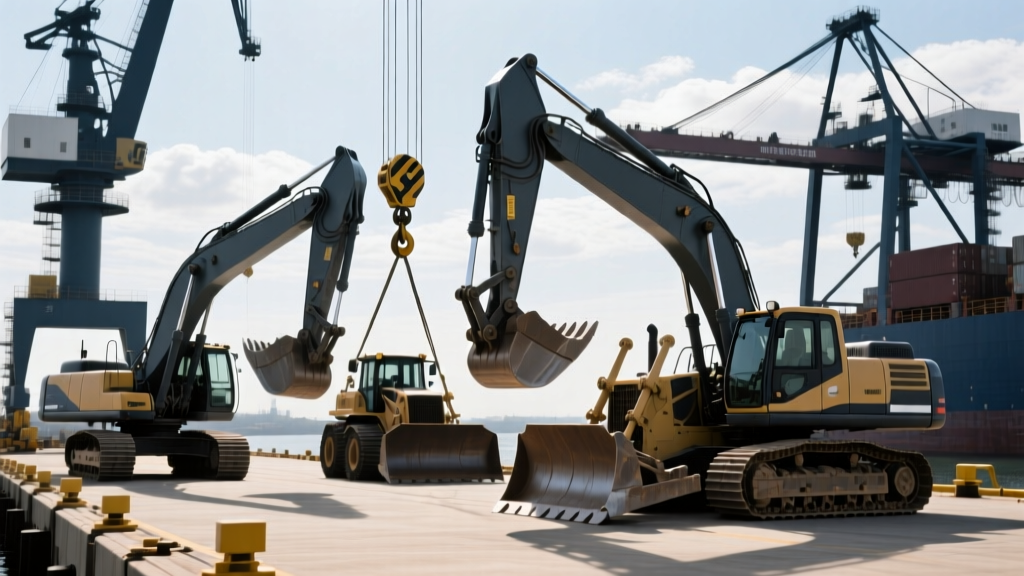
Port terminals operate on razor-thin margins where equipment uptime dictates profitability. When a Ship-to-Shore (STS) gantry crane or a Liebherr LHM 550 Mobile Harbor Crane experiences a rigging failure, the financial bleed is immediate. Demurrage charges, vessel delays, and lost throughput can exceed $22,000 per hour for a single out-of-service Post-Panamax crane. Troubleshooting heavy equipment rigging in marine environments requires moving beyond basic visual checks to address the insidious effects of saltwater corrosion, dynamic shock loading from container impacts, and sheave misalignment.
Unlike standard construction hoisting, port crane rigging endures high-cycle fatigue. A typical STS crane hoist rope (often a 40mm to 48mm 6x36 Warrington-Seale IWRC) may experience over 150,000 bending cycles annually. This guide provides terminal maintenance engineers with actionable diagnostic frameworks to identify, troubleshoot, and resolve complex rigging degradation specific to marine cargo handling.
⚠️ CRITICAL SAFETY THRESHOLD: Under OSHA 1917.45 (Marine Terminals - Cranes and Derricks), hoist wire ropes must be immediately removed from service if there are more than 10 randomly distributed broken wires in one rope lay, or 5 broken wires in one strand in one rope lay. Never attempt to 'nurse' a degraded marine hoist rope through a peak shipping season.Diagnostic Matrix: Identifying Rigging Wear Patterns on STS and MHC Cranes
Accurate troubleshooting begins with correctly reading the physical evidence left on the wire rope and sheave hardware. Use this matrix to map symptoms to root causes on high-capacity port cranes.
| Symptom / Defect | Primary Component | Root Cause in Marine Ops | Corrective Action |
|---|---|---|---|
| Birdcaging (Core protrusion) | Main Hoist Rope | Sudden load release or shock loading from snagging a misaligned container twistlock. | Replace rope immediately. Recalibrate anti-sway and load-sensing PLC limits to prevent future slack-rope drops. |
| Valley Breaks | Hoist / Trolley Rope | Sheave groove diameter is worn too wide, allowing the rope to flatten and pinch inner strands. | Machine or replace sheaves. Use a polyurethane groove gauge to verify the 1.05x rope diameter clearance. |
| Asymmetric Spreader Tilt | Spreader Guide Cables | Uneven tension or salt-induced corrosion seizing the internal strands of one guide cable. | Replace guide cables as a matched set. Upgrade to Dyneema SK78 synthetic lines to eliminate internal corrosion. |
| One-Sided Flange Wear | Boom / Trolley Sheaves | Fleet angle exceeds 1.5 degrees during trolley travel, causing the rope to scrub the sheave flange. | Perform laser alignment on the trolley reeving system. Adjust deflector sheave positioning to center the fleet angle. |
Step-by-Step Troubleshooting: Hoist Rope Degradation
Marine environments accelerate wire rope fatigue through a combination of abrasive dock dust and highly corrosive salt spray. Relying solely on the 'rag method' (running a cotton cloth over the rope to catch broken wires) is insufficient for modern STS cranes operating at 120+ lifts per hour.
Step 1: Magnetic Flux Leakage (MFL) Testing
Deploy an MFL scanner (such as the TCK.W or Intron Plus systems) during the 500-hour preventative maintenance window. MFL detects internal broken wires and loss of metallic cross-sectional area (LMA) that are invisible to the naked eye. According to the Canadian Centre for Occupational Health and Safety, internal corrosion often precedes external wire breaks in marine applications. If the MFL readout shows an LMA greater than 6% over a 10-diameter length, schedule an immediate rope change.
Step 2: Verify Sheave-to-Rope Compatibility
A common troubleshooting error is replacing a degraded hoist rope without inspecting the sheaves. If a cast-iron or pressed-steel sheave groove has worn from a 42mm profile to a 45mm U-shape, installing a new 40mm rope will cause the rope to bottom out in the groove. This eliminates the necessary side-clearance, resulting in severe scrubbing and a 40% reduction in the new rope's lifecycle. Always mandate a sheave groove gauge check before unspooling new rigging.
Step 3: Lubricant Penetration Analysis
Port crane wire ropes require specialized penetrating lubricants (e.g., Shell Wire Rope Lubricant or equivalent lithium-complex greases) that displace moisture. If you observe a dry, rust-colored paste in the rope valleys during inspection, the lubrication system's drip-feed or spray nozzles are clogged with salt crystallization. Purge the auto-lube lines with a solvent flush and recalibrate the pump stroke volume to deliver exactly 2.5 ml per meter of rope travel.
Upgrading to Synthetic Rigging: Solving Spreader Guide Cable Fatigue
The rigging connecting the main hoist block to the container spreader—specifically the telescopic guide cables and lift eyes—faces extreme micro-fatigue from the constant twisting and impact of locking onto 40-foot and 45-foot containers. Historically, terminal operators replaced 16mm galvanized steel guide cables every 8 to 10 months due to internal strand seizure caused by saltwater ingress.
"The transition to ultra-high-molecular-weight polyethylene (UHMWPE) synthetic ropes for secondary spreader rigging has fundamentally altered maintenance intervals. The elimination of internal metal-on-metal friction and total immunity to saltwater corrosion yields a 300% increase in service life."
Cost-Benefit Framework: Upgrading a single STS crane's spreader guide cables to 12-strand Dyneema SK78 synthetic rigging costs approximately $14,500 upfront, compared to $4,200 for premium galvanized steel. However, the synthetic rigging reduces the spreader deadweight by 65 kg, marginally improving hoist motor efficiency, and reliably lasts 30+ months in active marine service. The ROI is achieved at the first avoided steel-cable changeout, factoring in the $3,500 labor and downtime cost per replacement.
Correcting Fleet Angle and Reeving Misalignment
When troubleshooting premature trolley rope wear, maintenance teams often blame the rope manufacturer. In 80% of cases, the true culprit is fleet angle deviation. The fleet angle is the angle formed between the rope leading to the drum and the plane of the sheave.
- The Rule: For grooved drums, the fleet angle must not exceed 1.5 degrees (approximately 1 inch of lateral deviation for every 38 inches of distance from the sheave to the drum).
- The Marine Factor: High wind loads and thermal expansion on 100-meter STS crane booms can warp the trolley frame, subtly altering sheave alignment over a 5-year period.
- The Fix: Use a rotary laser alignment tool mounted on the hoist drum. Track the trolley from the landside to the waterside limit switches. If the laser deviates beyond the 1.5-degree tolerance at the boom tip, install adjustable deflector sheaves with eccentric mounting pins to mechanically correct the rope path.
Preventative Maintenance Intervals for Marine Rigging
To prevent catastrophic failures and minimize unplanned downtime, implement this rigid, hour-based inspection schedule tailored for high-salinity port environments:
- Daily (Pre-Shift): Visual inspection of the lower hoist block, wedge sockets, and spreader twistlocks. Check for hydraulic leaks from the tensioning cylinders that could contaminate the lower rigging.
- 250-Hour (Monthly): Clean and re-lubricate all open-gear winches and sheave bearings. Perform the 'rag method' on the first 50 meters of hoist rope that spools onto the drum, as this section experiences the highest bending fatigue.
- 1,000-Hour (Quarterly): Full MFL scan of all hoist and trolley ropes. Inspect wedge socket terminations for hairline cracks using magnetic particle inspection (MPI). Verify the torque on all sheave retaining bolts to the OEM specification (typically 450 Nm for heavy-duty MHC sheaves).
- 5,000-Hour (Annual): Complete geometric alignment check of the entire reeving system using laser trackers. Replace all synthetic anti-sway lines and spreader guide cables regardless of visual condition.
By treating rigging as a precision power-transmission system rather than a simple consumable, terminal operators can drastically reduce the $22,000-per-hour penalty of crane downtime and ensure safe, continuous cargo operations.