Optimizing Your Heavy Equipment Rental Contract for Pipeline Work
Analyze 2026 pipeline construction equipment costs, sideboom rental rates, and critical clauses to negotiate in your heavy equipment rental contract.
Deconstructing Pipeline Fleet Budgets and Contractual Risk
Utility and pipeline construction operates on razor-thin margins dictated by daily right-of-way (ROW) progress. When a pipeline spread moves 1.5 to 3 miles per day, equipment failure does not just delay a single task; it halts stringing, bending, lowering-in, and backfilling crews simultaneously. The financial exposure of a stalled spread routinely exceeds $20,000 per hour in idle labor, material staging penalties, and delayed commissioning fees. Consequently, the Associated Equipment Distributors (AED) emphasizes that standard rental agreements are wholly insufficient for linear infrastructure projects. Procurement managers must engineer a specialized heavy equipment rental contract that shifts downtime risk back to the lessor and accounts for the unique wear-and-tear of pipeline environments.
CRITICAL BUDGET WARNING: The Idle Time TrapMany standard rental agreements bill by the calendar month, regardless of utilization. In pipeline construction, weather delays, environmental stand-downs (e.g., nesting bird seasons), and landowner disputes frequently halt work. Your contract must include a Weather and Regulatory Stand-Down Clause that caps monthly billing at 176 hours (22 eight-hour days), converting excess calendar days to a reduced 'idle rate' (typically 40-50% of the base daily rate).
2026 Pipeline Equipment Rental Rate Matrix
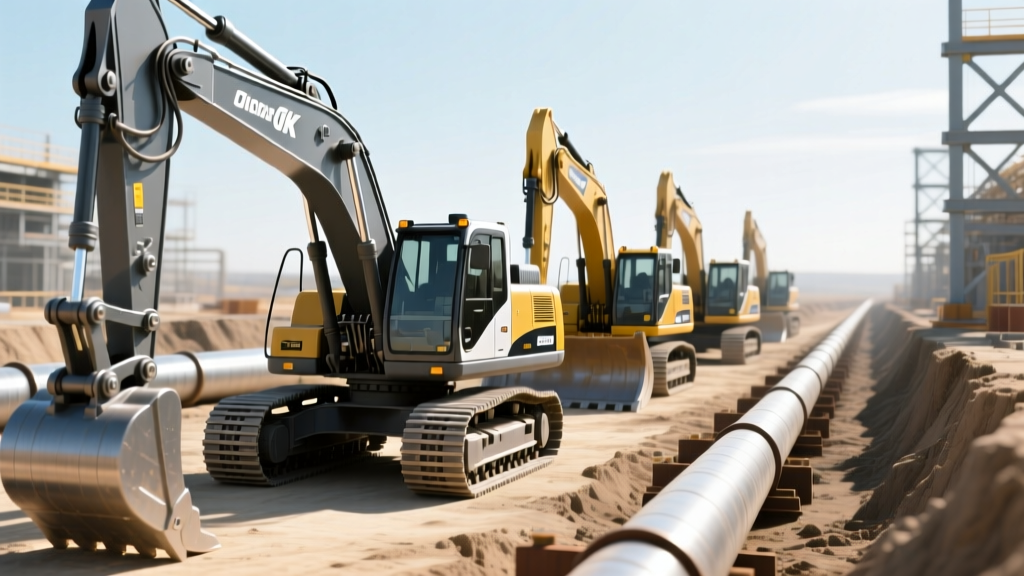
Budgeting for a mid-to-large diameter pipeline spread (e.g., 24-inch to 42-inch steel transmission lines) requires precise forecasting of specialized machinery. Standard excavators and dozers are insufficient; the fleet demands pipelayers, automatic welding rigs, and continuous trenchers. Below are the benchmarked 2026 dry-hire monthly rates for Tier 4 Final compliant equipment in the North American market.
| Equipment Type | Reference Model (2024-2026 Specs) | Base Monthly Rate | Essential Attachment / Mod | Primary Contract Risk Factor |
|---|---|---|---|---|
| Sideboom (Pipelayer) | Caterpillar 587T / Liebherr PR 734 | $16,500 - $19,000 | Counterweight extensions, side-winch guards | Undercarriage wear on rocky ROWs |
| Continuous Trencher | Vermeer T1255X Terrain Leveler | $32,000 - $38,500 | Rock chain, spoil conveyor extensions | Cutting tooth consumption & gearbox shock |
| Pipeline Excavator | John Deere 850LC / Cat 390F L | $11,500 - $14,000 | V-buckets, quick-coupler padding clamps | Hydraulic cylinder scoring from abrasive soil |
| Pipe Bending Machine | CRC-Evans / Superion 42-inch Bender | $8,500 - $12,000 | Die sets matched to exact wall thickness | Pin and bushing deformation under max tonnage |
Allocating Maintenance and Breakdown Risk
When drafting the heavy equipment rental contract for pipeline spreads, the division of maintenance responsibility dictates your true operational cost. The industry standard bifurcates into 'Wet Hire' (lessor provides operator and maintenance) and 'Dry Hire' (lessee provides operator, assumes daily maintenance). For highly specialized pipeline equipment like automatic internal line-up clamps (ILCs) and sidebooms, a hybrid approach is mandatory.
The 4-Hour Swap Service Level Agreement (SLA)
Standard contracts offer a 24-to-48-hour repair window before a replacement machine is dispatched. On a remote transmission pipeline spread, a 48-hour delay on a primary lowering-in sideboom will cascade into $400,000+ in lost productivity. Your contract must include a strict SLA stipulating:
- 4-Hour On-Site Diagnostic Response: The lessor must have a field mechanic on the ROW within 4 hours of a reported critical failure.
- 12-Hour Swap Guarantee: If the unit cannot be repaired on-site within 12 hours, a replacement unit of equal or greater lifting capacity must be delivered to the exact chain-marker location.
- Liquidated Damages: A penalty of $1,500 per hour billed as a credit against the monthly invoice for every hour the replacement is delayed past the 12-hour threshold.
Navigating Right-of-Way (ROW) Equipment Restrictions
Pipeline ROWs frequently cross sensitive agricultural land, wetlands, and stabilized dunes. Landowner agreements and state environmental mandates strictly regulate ground pressure and track shoe configurations. Failing to specify these requirements in your procurement documents leads to massive retroactive costs when lessors deliver standard steel-grouser machines that tear up topsoil.
PROCUREMENT CHECKLIST: Track Shoe Specifications- Agricultural ROWs: Mandate rubber track pads (e.g., 24-inch to 32-inch width) to prevent topsoil compaction and deep rutting. Specify that the cost of replacing torn rubber pads due to hidden ROW debris is split 50/50 between lessor and lessee.
- Wetland / Muskeg Crossings: Require extra-wide swamp pads (minimum 36-inch) and specify that undercarriage cleaning (to prevent the spread of invasive aquatic species) is the lessor's responsibility upon demobilization.
- Rock / Desert Terrain: Standard single-grouser steel shoes are required, but the contract must cap the lessee's liability for track chain and sprocket wear at a fixed percentage (e.g., 15% of the undercarriage replacement value) to avoid end-of-lease surprise invoices.
Emissions Compliance and Fluid Cost Allocation
All heavy machinery deployed on modern utility and pipeline projects must adhere to strict emissions standards. According to the EPA's Nonroad Diesel Engine regulations, Tier 4 Final and Stage V engines are mandatory in most non-attainment zones and federally permitted pipeline corridors. These engines require Diesel Exhaust Fluid (DEF) and active regeneration cycles, which introduce new variable costs and operational quirks.
When negotiating the heavy equipment rental contract, explicitly define who bears the cost of DEF consumption and forced regeneration downtime. Tier 4 Final pipelayers operating at low loads (e.g., holding tension during stringing rather than driving) frequently suffer from DPF (Diesel Particulate Filter) soot buildup, requiring manual stationary regeneration. This process halts the machine for 45 to 90 minutes. The contract must state that forced regeneration downtime does not count against the lessee's daily utilization hours, and the lessor is responsible for supplying bulk DEF to the spread's central fueling truck.
Mobilization, Demobilization, and Permitting Liabilities
Pipeline spreads are highly mobile, but the equipment that builds them is exceptionally heavy and difficult to transport. A single Vermeer T1255X trencher can weigh over 130,000 lbs in operating condition, requiring multi-axle lowboy trailers, escort vehicles, and specialized routing permits. The Pipeline and Hazardous Materials Safety Administration (PHMSA) and local DOT authorities heavily scrutinize the logistics of moving this equipment across public highways to reach the ROW.
To prevent budget overruns, structure the mobilization clause using a 'Delivered to Chain-Marker' pricing model. Rather than paying a flat yard-to-yard freight rate, require the lessor to quote a fully burdened mobilization rate that includes:
- All state and county overweight/oversize permitting fees.
- Pilot car and escort vehicle costs for the entire route.
- Crane or winch-truck assistance required to offload equipment from the lowboy directly onto uneven ROW terrain.
- Track-rod and blade removal/reassembly for transport width compliance.
Strategic Sourcing for Linear Projects
Ultimately, budget planning for utility and pipeline construction requires treating the rental fleet as an integrated system rather than a collection of isolated assets. By embedding aggressive SLAs, precise ground-pressure stipulations, and Tier 4 maintenance allocations directly into the heavy equipment rental contract, project managers insulate their spreads from the catastrophic financial bleed associated with linear infrastructure delays.