How to Move a Shipping Container Without Heavy Equipment: Compact vs. Full-Size Compliance
Learn how to move a shipping container without heavy equipment by comparing compact vs. full-size machinery through OSHA safety standards and compliance.
The Physics and Compliance Reality of Container Relocation
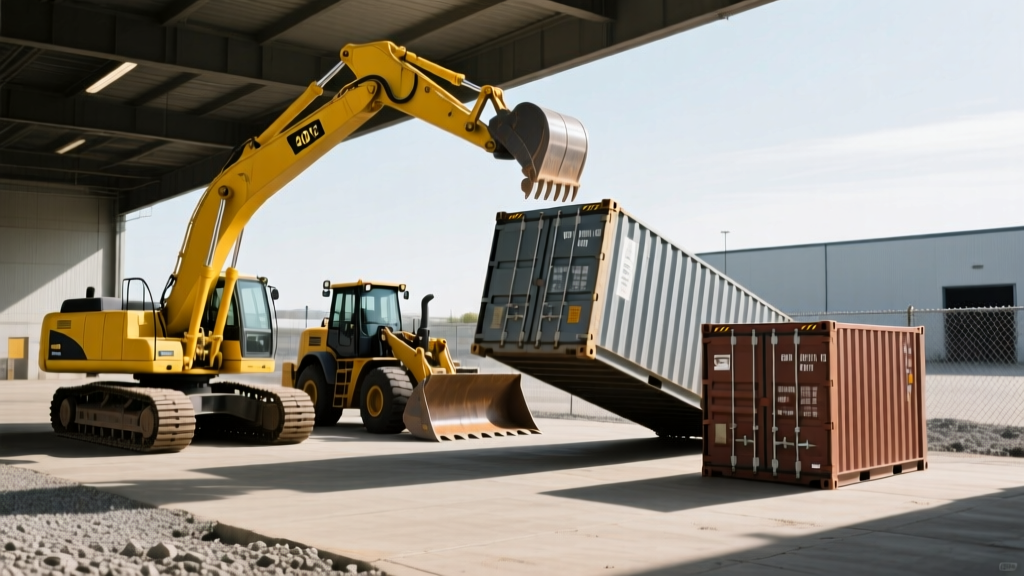
Relocating intermodal freight containers on confined job sites presents a severe logistical and safety challenge. An empty 20-foot ISO container weighs approximately 4,900 lbs, while a 40-foot High Cube unit tips the scales at 8,700 lbs. When site constraints prevent the use of traditional heavy lifting machinery—such as 60-ton rough-terrain cranes or full-size mast forklifts—site managers must answer a critical question: how to move a shipping container without heavy equipment while maintaining strict adherence to OSHA safety standards?
The solution lies in leveraging compact construction equipment paired with specialized rigging and skating systems. However, substituting full-size machinery with compact track loaders (CTLs) or mini excavators fundamentally alters the center of gravity, ground bearing pressure, and load dynamics. This guide breaks down the compliance frameworks, equipment matrices, and step-by-step rigging protocols required to execute this maneuver safely in 2026.
⚠ OSHA Compliance Warning: Under OSHA 29 CFR 1926.602 (Material Handling Equipment), it is a direct violation to use a compact skid steer or CTL to lift and carry a shipping container on standard pallet forks. The 5,000+ lb load exceeds the Rated Operating Capacity (ROC) of nearly all compact loaders, creating an imminent tipping hazard. Containers must be skated or dragged using approved rigging.Compact vs. Full-Size Equipment: A Safety & Capability Matrix
Selecting between compact and full-size equipment is not merely a matter of spatial constraints; it dictates the entire safety plan, rigging requirements, and ground preparation protocol. Below is a compliance-focused comparison matrix.
| Parameter | Compact Track Loader (e.g., Bobcat T770) | Full-Size Telehandler (e.g., JCB 509-42) |
|---|---|---|
| Max Lifting Capacity | 3,475 lbs (ROC at 35% tipping load) | 9,000 lbs (Max capacity at 24" load center) |
| Tipping Load Threshold | 9,928 lbs | 25,000+ lbs |
| Ground Bearing Pressure | ~4.5 PSI (Excellent for soft soil) | ~80+ PSI (Requires compacted gravel/concrete) |
| Container Move Method | Drag/Skate via winch or snatch block | Lift and carry via specialized spreader bar |
| OSHA Rigging Req. | ASME B30.9 (Slings) + B30.10 (Hooks) | ASME B30.20 (Below-the-Hook Lifting Devices) |
How to Move a Shipping Container Without Heavy Equipment: The Skating Protocol
When full-size telehandlers cannot access the site, the compliant method for moving a container involves hydraulic jacking, heavy-duty skates, and a compact loader acting as a horizontal winch. This method keeps the load's center of gravity inches from the ground, neutralizing the tipping hazards outlined in OSHA 1926.251 (Rigging Equipment).
Step 1: Hydraulic Lifting and Skate Placement
- Deploy Hydraulic Toe Jacks: Use four 10-ton capacity hydraulic toe jacks (e.g., Simplex or Enerpac) at the corner castings. Never lift the container from the side corrugated panels, which will buckle under point loads.
- Insert Container Skates: Place heavy-duty omnidirectional container skates (rated for a minimum of 20,000 lbs per set) directly under the corner castings. Ensure the skate wheels are aligned with the intended direction of travel.
- Lower the Load: Slowly release the jack pressure until the container's weight rests entirely on the skates.
Step 2: Rigging the Compact Loader
Do not attach a tow strap directly to the loader's bucket teeth or standard quick-attach plate. This creates a shock-load risk that can snap synthetic slings.
- Anchor Point: Route a 3/4-inch Grade 70 transport chain or a 20,000 lb Working Load Limit (WLL) synthetic roundsling through the rear tow eyelet or the designated tie-down points on the compact loader's chassis.
- Snatch Block Deflection: If pulling at an angle, anchor a 12-ton snatch block to a certified ground anchor (e.g., a driven earth anchor or a deadman anchor) to redirect the pull force, preventing the CTL from sliding laterally.
- Connection to Container: Attach the rigging to the container's bottom corner castings using a certified shackle (e.g., Crosby G-2130 bolt-type shackle). Never use screw-pin shackles for dynamic horizontal dragging.
Compact loaders lack the mass to absorb sudden load shifts. Use a kinetic recovery rope (which stretches up to 30%) rather than a static nylon strap or wire rope. This elasticity absorbs the breakaway force required to overcome the static friction of the skates, protecting both the loader's drivetrain and the rigging hardware.
Ground Bearing Pressure & Site Compliance
Moving an 8,700 lb 40-foot container on skates concentrates the entire load onto four small contact patches. If the ground is uncompacted fill or saturated clay, the skates will sink, causing the container to list and potentially slide off the skates—a major crush hazard.
"The employer shall ensure that the ground or surface upon which material handling equipment operates is firm, level, and capable of supporting the equipment and the load."
— OSHA 29 CFR 1926.1402 (Ground Conditions)
Site Prep Requirement: Lay down a track of 3/4-inch steel road plates or 12-inch thick timber crane mats along the entire path of travel. This distributes the point load of the skates across a wider surface area, maintaining compliance with ground bearing capacity limits and preventing environmental damage to the site.
Rigging Hardware: Working Load Limits (WLL) and Inspection
Compliance with ASME B30.9 requires daily inspection of all slings and hardware before the drag operation begins. When utilizing compact equipment to move containers, the rigging is subjected to high-abrasion horizontal dragging.
| Hardware Type | Specification | Minimum WLL Required | Inspection Criteria (ASME) |
|---|---|---|---|
| Synthetic Roundsling | Polyester, Double Jacket | 10,000 lbs (Vertical) | Check for cuts, snags, or UV degradation on the outer jacket. |
| Alloy Steel Chain | Grade 100, 3/8" | 12,000 lbs | Measure for stretch (>5% elongation requires immediate discard). |
| Shackle | Bolt-Type, Grade 8 | 17,000 lbs | Ensure cotter pin is seated; check pin threads for galling. |
Decision Framework: When to Halt and Call for Full-Size Machinery
While compact equipment paired with skates is highly effective for flat, confined relocations, site conditions can quickly render this method non-compliant and unsafe. Halt operations and mobilize a full-size rough-terrain forklift or crane if any of the following red flags are present:
- Gradient Exceeds 5%: Dragging a 9,000 lb mass on skates down even a slight incline overrides the braking capacity of a compact track loader, leading to runaway load scenarios.
- Wind Speeds > 20 MPH: A 40-foot High Cube container acts as a massive sail. Lateral wind loads can push the container off its skates, crushing personnel in the drop zone.
- Obstacles > 2 Inches: Container skates feature small-diameter polyurethane or steel wheels. They cannot traverse curbs, trench grates, or large debris. Full-size telehandlers with pneumatic tires are required for rough terrain traversal.
- Required Lift > 6 Inches: If the container must be placed onto a chassis or raised foundation, the skating method is invalid. You must transition to heavy lifting equipment.
By strictly adhering to these load dynamics, rigging specifications, and OSHA frameworks, site supervisors can safely execute complex container relocations using compact machinery, maintaining both operational efficiency and uncompromising safety compliance.