Heavy Equipment Land Clearing Best Practices for Solar Farms
Master heavy equipment land clearing for utility-scale solar farms. Expert operator training, fleet selection, and 2026 grading tolerances.
The Renewable Energy Clearing Paradigm
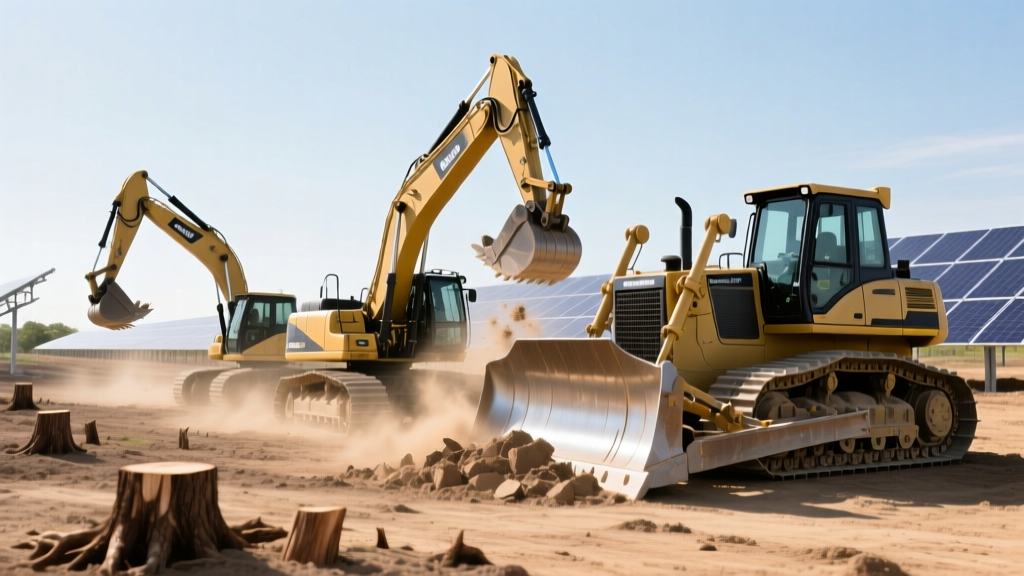
Utility-scale renewable energy projects have fundamentally altered the economics and execution of heavy equipment land clearing. Unlike traditional residential or commercial site preparation—where topsoil is aggressively stripped, hauled off-site, and the subgrade is heavily compacted—solar and wind farm preparation requires a delicate balance of biomass removal, topographical precision, and soil preservation. As of 2026, with the rapid expansion of agrivoltaics (dual-use solar and agriculture), preserving the top 6 to 8 inches of topsoil is no longer just an environmental preference; it is a strict contractual mandate for many utility-scale developers.
Operator training for renewable site prep must pivot from traditional 'cut-and-fill' mentalities to precision grading and low-ground-pressure mulching. This guide details the exact fleet configurations, GPS grading tolerances, and operational protocols required for modern solar and wind farm land clearing.
Solar vs. Wind: Clearing Parameters Matrix
The clearing requirements for solar arrays and wind turbine pads are vastly different. Solar farms demand vast, continuous acreage with strict vegetation height limits, while wind farms require targeted, high-load-bearing clearing for crane pads and access roads.
| Parameter | Utility-Scale Solar Farm | Wind Turbine Pad & Access |
|---|---|---|
| Clearing Depth | Surface vegetation only; topsoil preserved | Full grubbing; 24-36 inch topsoil strip |
| Stump/Root Tolerance | Flush cut or mulched; roots left in place | Complete root ball extraction required |
| Grade Tolerance | +/- 2 inches over 100-foot spans | +/- 0.10 feet on crane pad surfaces |
| Soil Compaction Limit | Low (to preserve agrivoltaic drainage) | High (95% Proctor density for 500-ton cranes) |
| Primary Fleet | Track mulchers, low-PSI dozers | Large excavators, rock trucks, compactors |
Core Fleet Selection & Operator Specifications
Selecting the right machinery is only half the battle; configuring it for renewable energy sites dictates project profitability. According to the National Renewable Energy Laboratory (NREL), utility-scale solar requires between 5 and 10 acres per megawatt of capacity. Clearing 500 acres efficiently requires specialized, high-production attachments.
1. The Mulching Fleet: FAE PT-300 & Caterpillar D6 XE
For biomass-heavy solar sites, traditional grubbing with excavators is too slow and destroys the topsoil layer. The industry standard has shifted to dedicated tracked mulchers like the FAE PT-300 equipped with the UMM/DT or RSL/DT heads.
Operator Insight: Ground Pressure MattersOperators must be trained to monitor ground conditions. The FAE PT-300 operates at approximately 5.5 PSI. If soil moisture exceeds 22%, operators must switch to wider 36-inch grouser pads to prevent rutting, which will violate the site's Stormwater Pollution Prevention Plan (SWPPP) and delay solar pile driving.
2. Precision Dozing: Cat D6 XE with Trimble Earthworks
Once vegetation is mulched, the site must be graded to ensure water runoff does not pool under solar arrays. The Caterpillar D6 XE dozer, utilizing its electric drive system for high torque at low speeds, is paired with Trimble Earthworks 3D GPS machine control. Operators must be certified in 'Auto-Grade' modes to maintain the strict +/- 2-inch tolerance required to prevent structural racking stress on solar panel mounts.
Operator Training Protocols: Step-by-Step Execution
Training operators for renewable land clearing requires a phased approach that integrates machine control with environmental compliance.
- Phase 1: SWPPP Perimeter Establishment
Before a single tree is mulched, operators must use compact track loaders (CTLs) with trenching attachments to install silt fences and wattles along all drainage breaks. Training must emphasize that heavy equipment land clearing cannot begin until the EPA-mandated Stormwater Pollution Prevention Plan (SWPPP) perimeters are verified by the site environmental officer. - Phase 2: Topsoil Stripping and Stockpiling
For sites requiring topsoil removal (typically wind pads or non-agrivoltaic solar inverters), operators are trained to use GPS-guided scraper pans or motor graders to strip exactly 6 inches of topsoil. Windrows must be kept under 6 feet in height to prevent soil compaction and anaerobic decomposition of the organic matter. - Phase 3: Biomass Mulching vs. Hauling
Operators must learn to differentiate between 'grind-and-leave' zones and 'haul-away' zones. In solar array fields, woodchips are left as a natural weed barrier. However, operators must be trained to keep mulch depth under 3 inches; deeper piles generate excessive heat during decomposition, which can smolder and create fire hazards near high-voltage combiners.
Real-World Edge Cases & Troubleshooting
Renewable energy sites are often built on marginal land, presenting unique subsurface challenges that require immediate operator adaptation.
Encountering Shallow Bedrock in Solar Fields
The Problem: Solar pile-driving requires 6 to 10 feet of embedment. Hitting limestone or granite at 18 inches halts production and threatens the structural integrity of the racking system.
The Fix: Blasting is rarely permitted due to environmental permits and vibration risks to nearby structures. Instead, deploy a rock shredder attachment (e.g., FAE RSL/DT) on a high-horsepower carrier. Operators must be trained to grind the bedrock down to a 6-inch minus aggregate to a depth of 36 inches, creating a drillable substrate for helical piles without fracturing the deeper geological shelf.
Wetland Buffer Encroachment
The Problem: GPS boundaries on machine control displays often lag by 2-3 feet, leading to accidental clearing of protected wetland buffers, resulting in massive EPA fines.
The Fix: Implement a 'Soft Boundary' protocol. Operators must be trained to set a 15-foot virtual offset in the Trimble or Topcon software. When the dozer or mulcher hits this 15-foot warning zone, the cab alarm sounds, and the operator must switch from GPS auto-grade to manual line-of-sight clearing, using physical flagging placed by the site surveyor.
2026 Cost & Productivity Benchmarks
Understanding the financial metrics of heavy equipment land clearing is vital for fleet managers and site superintendents to benchmark operator performance. Based on Q1 2026 industry data for the Southeast and Midwest US markets:
Solar Farm Clearing Metrics (Light to Medium Biomass)
- Average Cost per Acre: $2,200 – $3,800 (mulching and rough grading)
- Production Rate (FAE PT-300): 8 to 12 acres per 10-hour shift
- Production Rate (Cat D6 XE Grading): 15 to 20 acres per 10-hour shift
- Fuel Consumption (Mulcher): 14 – 18 gallons per hour under heavy load
Wind Farm Pad Clearing Metrics (Heavy Timber & Rock)
- Average Cost per Pad (150x150 ft): $18,000 – $28,000 (including topsoil strip and rock excavation)
- Production Rate (Cat 390F Excavator): 1.5 to 2 pads per week (including access road clearing)
Safety & Environmental Compliance Directives
Operator training must heavily emphasize the intersection of heavy machinery safety and environmental compliance. The US Department of Energy's solar siting guidelines strictly dictate how land disturbance is managed. Operators must conduct daily 360-degree walkarounds specifically checking for hydraulic leaks, as a single quart of hydraulic fluid leaking onto mulched topsoil can contaminate a 500-square-foot area, triggering a mandatory environmental remediation hold that can cost $15,000+ in soil removal and testing.
Furthermore, when operating on sloped wind farm access roads (often exceeding 15% grades), operators must be trained in proper track tensioning and blade-loading techniques to prevent track de-tracking, which remains one of the most common and costly downtime events in renewable site preparation. Always maintain the blade angled slightly uphill when traversing, and never pivot the machine on steep grades without first lifting the tracks entirely off the ground using the blade and ripper.