Marine Maintenance: Top 100 Heavy Equipment Manufacturers Guide
Explore marine port maintenance schedules, OEM intervals for STS cranes and reach stackers, and insights from the top 100 heavy equipment manufacturers.
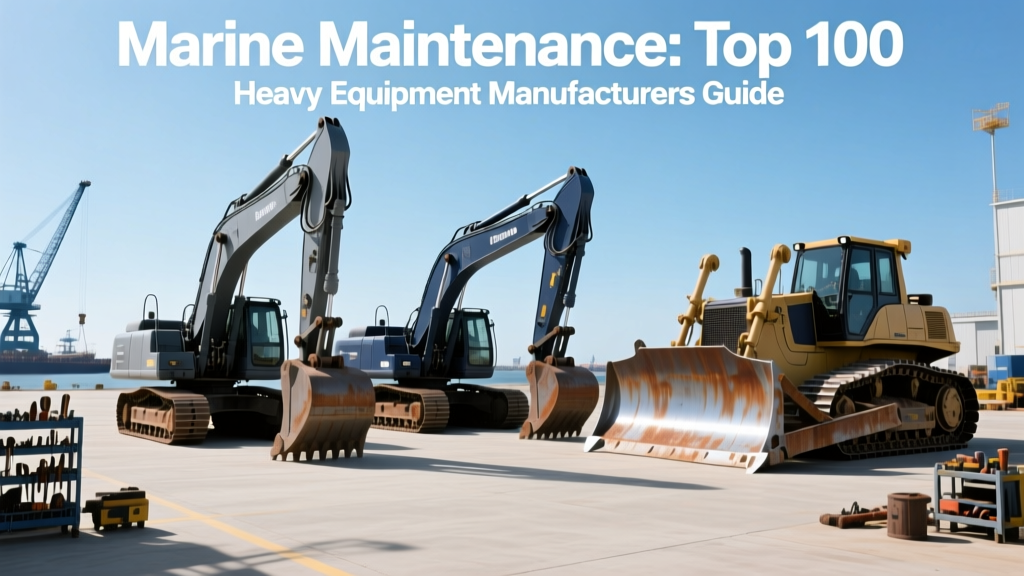
When benchmarking service protocols across the top 100 heavy equipment manufacturers, marine and port machinery demands a fundamentally different approach to maintenance scheduling. Unlike standard earthmoving equipment operating in temperate, terrestrial environments, port infrastructure—specifically Ship-to-Shore (STS) gantry cranes, Mobile Harbor Cranes (MHC), and heavy-duty reach stackers—battles continuous saltwater aerosol exposure, extreme dynamic loading, and 24/7 high-cycle fatigue. As of 2026, the industry has largely transitioned from rigid calendar-based servicing to condition-based monitoring, though baseline Original Equipment Manufacturer (OEM) intervals remain the legal and operational foundation for port authorities.
Environmental Extremes: C5-M Marine Corrosion Categories
Maintenance schedules for port equipment are dictated primarily by the ISO 12944-9 standard, specifically the CX and C5-M (Marine) corrosivity categories. Equipment operating within 500 meters of a saltwater coastline experiences zinc and steel degradation rates up to 400% faster than inland machinery. According to the Port Technology International engineering reports, structural micro-cracking accelerated by hydrogen embrittlement and chloride-induced pitting is the leading cause of unplanned downtime in STS cranes.
To combat this, OEMs mandate strict coating inspection schedules. Epoxy-polyurethane marine coating systems (typically 320 to 400 microns thick) require ultrasonic thickness testing every 18 months. Any reading below 250 microns triggers an immediate localized blast-and-recoat protocol. Failure to adhere to this interval results in structural steel section loss, which compromises the crane's dynamic load rating and violates OSHA Maritime Crane Inspection Standards (29 CFR 1917.45).
Ship-to-Shore (STS) Gantry Cranes: Hoist and Trolley Systems
STS gantry cranes, such as those engineered by ZPMC and Konecranes, represent the highest capital expenditure in any terminal. The hoist mechanism is the most critical failure point. Modern STS cranes utilize 8xK36WS-EPIWRC (Independent Wire Rope Core) hoist ropes, designed for high crush resistance and tensile strength.
Hoist Rope and Sheave Intervals
- Visual & Magnetic Rope Testing (MRT): Every 250 operating hours or monthly. MRT detects internal wire breaks and loss of metallic cross-sectional area (LMA) that visual inspections miss.
- Sheave Groove Inspection: Every 1,000 hours. Worn sheave grooves cause rope spinning and premature fatigue. Groove gauges must verify the radius remains within 0.05mm of the nominal rope diameter.
- Complete Rope Replacement: Typically between 4,500 and 6,000 operating hours, heavily dependent on the payload profile. In 2026, a full main hoist rope replacement on a Panamax STS crane costs between $65,000 and $95,000, factoring in specialized labor, marine-grade lubricants, and 36 hours of operational downtime.
Service Matrix: STS vs. Mobile Harbor Cranes
The following matrix contrasts the critical OEM baseline intervals for the two primary quayside lifting assets.
| Component / System | STS Gantry Crane (e.g., Konecranes STS) | Mobile Harbor Crane (e.g., Liebherr LHM 550) |
|---|---|---|
| Main Hoist Wire Rope | MRT every 250 hrs; Replace at 5,000 hrs | MRT every 200 hrs; Replace at 4,000 hrs |
| Gearbox Oil Analysis | Every 500 hrs (ISO 4406 target: 16/14/11) | Every 250 hrs (ISO 4406 target: 18/16/13) |
| Slewing Bearing Grease | N/A (Linear trolley motion) | Auto-lube continuous; Manual purge every 500 hrs |
| Structural NDT (Welds) | Magnetic Particle every 24 months | Ultrasonic/Magnetic Particle every 12 months |
| Trolley/Roller Path | Alignment check every 1,000 hrs | Roller bearing temp check every 100 hrs |
Mobile Harbor Cranes (MHC): Slewing Bearings and Dynamic Loads
Mobile Harbor Cranes, notably the Liebherr LHM series, introduce complex rotational forces that STS cranes do not experience. The slewing bearing—a massive roller or ball bearing connecting the upper carriage to the undercarriage—is subjected to extreme eccentric loading during grab operations.
Liebherr LHM Slewing Bearing Protocol
The slewing bearing requires a specialized lithium-complex EP2 grease fortified with PTFE (Polytetrafluoroethylene) to resist saltwater washout. While automated centralized lubrication systems (such as SKF ProFlex) inject grease continuously during operation, manual verification is non-negotiable. Maintenance crews must manually purge the grease galleries every 500 hours to expel moisture and metallic particulates trapped in the seals.
Furthermore, slewing bearing bolt tension must be verified using ultrasonic bolt elongation measurement tools every 1,000 hours. A single loose high-tensile bolt (often M36 or M48 grade 10.9) alters the load distribution across the raceway, leading to spalling and catastrophic raceway failure—a repair that frequently exceeds $400,000 and requires a 3-week dry-dock period.
Ground Handling: Reach Stackers and Spreader Fatigue
Equipment operating on the terminal yard, such as the Kalmar DRG450-35S5 reach stacker, faces high-cycle shock loading. The spreader and twist-lock mechanism is the highest liability point in the entire port ecosystem.
CRITICAL WARNING: Twist-Lock Metallurgical Fatigue
Spreader twist-locks are forged from high-yield alloy steel (typically 34CrNiMo6). They are subjected to severe torsional stress when handling unevenly loaded containers. OEMs mandate that twist-locks be replaced unconditionally after 100,000 operating cycles or 5 years, whichever comes first. Relying solely on visual inspection is a critical failure mode; internal micro-fractures propagate rapidly under dynamic yard conditions, leading to dropped containers and fatal yard accidents.
Kalmar Reach Stacker Drivetrain & Hydraulics
For hydrostatic drivetrains in heavy yard equipment, fluid cleanliness is paramount. The hydraulic system in a reach stacker lifting 45 tons requires continuous offline filtration. Maintenance schedules dictate hydraulic fluid replacement every 4,000 hours, but condition-based oil analysis can extend this to 6,000 hours if the ISO 4406 particulate code remains below 18/16/13 and the Total Acid Number (TAN) stays under 0.5 mg KOH/g.
Condition Monitoring and Predictive Analytics in 2026
The most significant shift among the top manufacturers is the integration of IoT sensor arrays directly into the maintenance schedule logic. Rather than pulling a crane out of service for a 500-hour teardown, ports now utilize tri-axial vibration sensors on trolley drive motors and hoist gearboxes.
"Transitioning from preventive to predictive maintenance in marine environments isn't just about saving money on premature parts replacement; it's about avoiding the catastrophic secondary damage caused by a $50 bearing failing inside a $200,000 gearbox while suspended 40 meters above a vessel."
— Terminal Engineering Director, Rotterdam World Gateway
Key Sensor Integrations for Port Fleets
- Acoustic Emission (AE) Sensors: Mounted on STS hoist drum bearings to detect sub-surface fatigue cracking weeks before traditional vibration sensors register an anomaly.
- Inline Oil Debris Monitors: Installed on MHC hydraulic return lines to quantify ferrous and non-ferrous particle counts in real-time, triggering automated alarms if spike thresholds are breached.
- Strain Gauge Networks: Welded to the primary boom chords of reach stackers to log cumulative fatigue damage (Miner's Rule), providing an exact mathematical prediction of remaining structural life.
Actionable Directives for Terminal Maintenance Managers
To align with the highest standards set by leading global manufacturers, terminal operators must enforce the following protocols:
- Mandate MRT over Visual Inspections: Ban reliance on visual wire rope inspections alone. Invest in electromagnetic NDT equipment to map internal rope degradation.
- Standardize Lubricant Chemistry: Do not mix marine grease formulations. Ensure all automated systems are loaded with NLGI Grade 2 lithium-complex greases specifically rated for C5-M saltwater washout resistance.
- Implement Digital Twin Logging: Utilize OEM-provided digital twin software to correlate operating hours with actual load spectra. A crane lifting 80% of its Safe Working Load (SWL) accumulates fatigue exponentially faster than one lifting 40% SWL, necessitating accelerated structural NDT intervals.