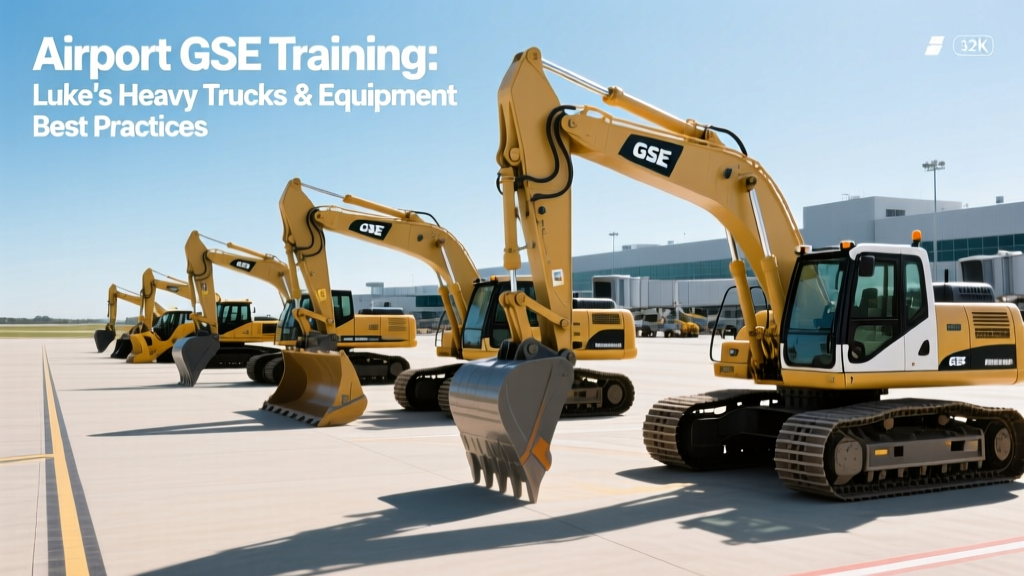
Airport GSE Training: Luke's Heavy Trucks & Equipment Best Practices
Master airport ground support equipment safety with Luke's Heavy Trucks & Equipment training protocols, telematics, and pre-flight inspection checklists.
The High-Stakes Environment of Airport Ground Support Equipment
Airport ramps are among the most unforgiving industrial environments on earth. Ground Support Equipment (GSE) operators navigate a congested matrix of jet bridges, fueling hydrants, baggage carts, and multi-million-dollar aircraft fuselages. According to the International Air Transport Association (IATA), GSE-related ramp incidents account for over 25% of all ground damage events, with a single aircraft radome strike costing upwards of $150,000 in repairs and flight delays.
When aviation authorities and ground handlers partner with specialized fleet suppliers like Luke's Heavy Trucks & Equipment, the focus shifts from basic vehicle operation to rigorous, OEM-aligned risk mitigation. Training protocols must address the unique kinematics of pushback tractors, the hydraulic sensitivities of belt loaders, and the spatial awareness required for towbarless tugs.
⚠️ Ramp Safety Warning: The average cost of an aircraft skin puncture caused by a belt loader impact is $45,000, exclusive of AOG (Aircraft on Ground) downtime penalties. Operator certification is not a one-time event; it requires continuous telemetry monitoring and annual recertification.Core GSE Fleet: Specifications and Training Requirements
Effective training begins with understanding the mechanical limitations of the iron. Luke's Heavy Trucks & Equipment categorizes ramp machinery into three primary risk tiers based on blind-spot geometry and kinetic energy transfer potential.
| Equipment Type | Example Model | Max Ramp Speed | Blind Spot Radius | Primary Training Focus |
|---|---|---|---|---|
| Conventional Pushback Tractor | TLD TPX-200 | 20 mph (unladen) | 12 ft (rear) | Towbar shear-pin limits, braking distances on wet tarmac |
| Towbarless (TBL) Tractor | Goldhofer AST 1X | 18 mph | 8 ft (cradle) | Nose-gear cradle alignment, hydraulic clamping pressure |
| Motorized Belt Loader | JBT Husky 280 | 12 mph | 18 ft (front) | Auto-leveling hydraulics, 3-inch fuselage clearance rule |
| Aircraft Cargo Loader | JBT Commander 15i | 10 mph | 22 ft (platform) | Scissor-lift stabilization, ULD (Unit Load Device) locking |
The 4-Phase Certification Framework
Standard forklift certification does not translate to the airport ramp. The training matrix utilized by Luke's Heavy Trucks & Equipment follows a stringent four-phase onboarding process designed to build muscle memory and spatial cognition before an operator ever approaches a live aircraft.
- Phase 1: Kinematics & Spatial Cognition (Classroom)
Operators study the turning radius charts and approach angles of specific GSE models. This includes calculating the swing-out tail radius of a TLD TPX-200 when executing a 90-degree turn around a fuel hydrant. - Phase 2: Virtual & Closed-Course Simulation
Using augmented reality (AR) headsets or closed-course mock fuselages, operators practice the '3-inch rule'—stopping the belt loader exactly 3 inches from the aircraft door sill to allow for aircraft suspension shifts during loading. - Phase 3: Shadowing & Telematics Baseline
Trainees ride with senior ramp agents for 40 hours. During this phase, the GSE telematics system records their braking harshness and cornering G-forces to establish a behavioral baseline. - Phase 4: Live Aircraft Integration
Under direct supervision, the operator performs pushbacks and cargo loading on live, out-of-service aircraft, focusing on communication protocols with the flight deck via headset.
Pre-Operation Walkarounds: Beyond the Basic Checklist
A generic 'kick the tires' checklist is insufficient for heavy aviation machinery. The pre-shift walkaround must target specific failure modes that lead to catastrophic ramp incidents.
Critical Failure Modes to Monitor
- Towbar Shear Bolt Inspection: On conventional pushback tractors, the shear bolt is designed to snap if the aircraft brakes are locked during a pushback, preventing the nose landing gear from snapping. Operators must visually inspect the shear bolt for micro-fractures and verify it is the exact OEM-specified grade (usually Grade 8 steel). Never replace a shear bolt with a standard hardware store bolt.
- Belt Loader Hydraulic Drift: Start the JBT Husky 280 and raise the belt to maximum height. Shut off the engine and measure hydraulic cylinder drift over 5 minutes. A drop of more than 0.5 inches indicates internal seal failure, which could cause the belt to drop onto the fuselage mid-loading.
- TBL Cradle Sensor Calibration: Towbarless tractors use proximity sensors to align with the nose gear. Operators must wipe the ultrasonic sensor arrays with isopropyl alcohol to remove de-icing fluid residue, which can cause false alignment readings and crush the landing gear.
'The integration of Ultra-Wideband (UWB) proximity sensors on GSE has reduced aircraft strikes by 42% since 2024. However, technology cannot replace the operator's physical verification of the towbar shear pin and hydraulic lines before every single pushback.'
— FAA Airport Safety Division, Ground Operations Advisory Guidelines
Telematics and Real-Time Operator Coaching
In 2026, modern GSE fleets are heavily integrated with IoT telematics. Luke's Heavy Trucks & Equipment outfits their serviced fleets with UWB geofencing modules that interact directly with the airport's surface movement radar.
How Geofencing Enforces Best Practices:
- Speed Zoning: When a pushback tractor enters the 50-foot 'Equipment Restraint Area' (ERA) around an aircraft, the telematics unit automatically throttles the engine's RPM, limiting top speed to 3 mph regardless of pedal position.
- Impact Detection: Accelerometers calibrated to detect forces as low as 2.5 Gs instantly transmit a ramp control alert if a baggage tractor collides with a cargo container, preventing hit-and-run damage reporting.
- Seatbelt Interlocks: Engine start circuits are hardwired to seatbelt tension sensors. If the operator unbuckles while the transmission is in gear, the parking brake automatically engages.
Winter Operations & De-Icing GSE Protocols
Cold weather introduces severe variables to GSE operation. De-icing trucks (like the JBT Tempest) and pushback tractors operating on glycol-coated tarmac require specialized training modules.
❄️ Winter Operations Tip: Type IV de-icing fluid (green) is highly viscous and creates a frictionless layer on concrete. Operators must increase following distances by 300% and avoid braking while turning the steering wheel, which induces immediate understeer on heavy pushback tractors.Furthermore, operators must be trained on the cold-weather startup procedures for GSE batteries and block heaters. Attempting to force a cold hydraulic system on a cargo loader can blow the primary O-rings, resulting in a $2,500 repair bill and a ruined cargo schedule. Luke's Heavy Trucks & Equipment mandates a 10-minute hydraulic warm-up cycle at 1,200 RPM before applying load to any scissor-lift mechanism when ambient temperatures drop below 20°F (-6°C).
Frequently Asked Questions (FAQ)
How often should GSE operators be recertified?
While OSHA standards require forklift recertification every three years, aviation industry best practices dictate annual recertification for all aircraft-adjacent GSE, with mandatory retraining following any near-miss incident or telematics-flagged harsh braking event.
What is the most common cause of towbarless tractor damage?
Improper cradle alignment. If the operator fails to center the nose landing gear perfectly within the TBL cradle before applying clamping pressure, the lateral force can bend the aircraft's steering actuator rods, resulting in damages exceeding $80,000.
Can standard automotive winter tires be used on airport belt loaders?
No. GSE requires specialized solid polyurethane or heavy-duty pneumatic tires with specific load ratings to handle the extreme point-loads of concentrated cargo. Automotive tires lack the sidewall stiffness required and will fail under the static weight of a fully loaded belt system.