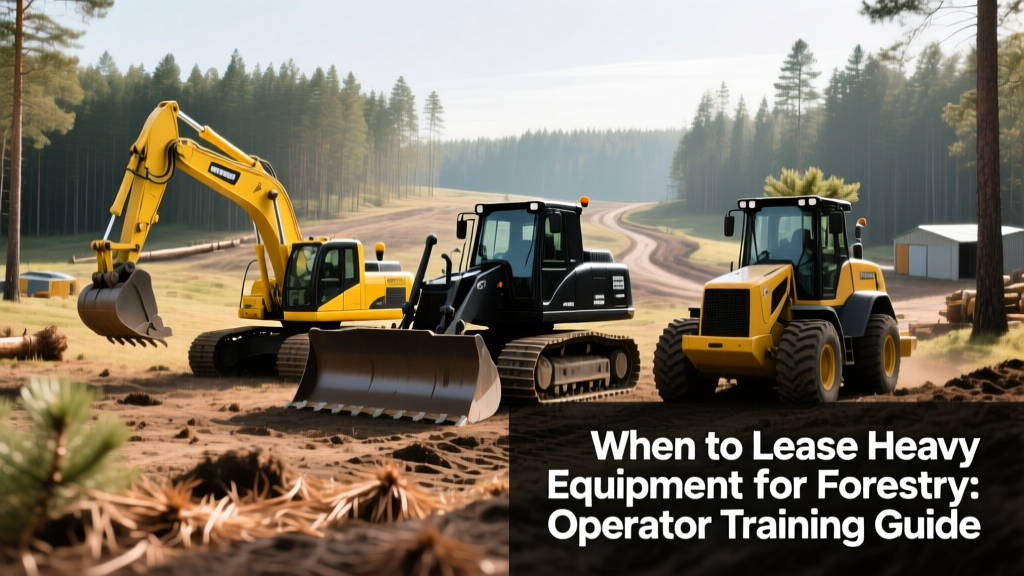
When to Lease Heavy Equipment for Forestry: Operator Training Guide
Master operator training when you lease heavy equipment for forestry. Learn cab orientation, control mapping, and safety protocols for logging machinery.
Logging contractors frequently opt to lease heavy equipment to manage capital expenditure, swapping out feller bunchers, harvesters, and forwarders every 36 to 60 months. However, introducing leased forestry machinery creates a distinct operator training challenge. Muscle memory built on a leased Komatsu forwarder does not seamlessly transfer to a newly leased John Deere or Tigercat model. When logging contractors decide to lease heavy equipment, the focus often shifts entirely to monthly payments and hourly caps, leaving a critical blind spot: operator onboarding and lease-return preservation.
The Leased Fleet Dilemma: Training Operators on Unfamiliar Iron
Forestry environments are unforgiving. Steep grades, dense underbrush, and erratic weather demand absolute precision from both the operator and the machine. When a contractor signs an operating lease for a single-grip harvester—typically ranging from $14,000 to $22,000 per month depending on the model and region—the equipment must generate immediate revenue. Downtime for 'familiarization' directly impacts the lease's return on investment.
Furthermore, leased machines come with strict return conditions. Leasing companies rigorously inspect hydraulic cylinders, boom pivots, and undercarriages at the end of the term. Improper operation by an untrained logger can lead to cylinder scoring, blown hoses, and structural micro-fractures, resulting in chargebacks that can exceed $15,000 per machine. Effective training is not just about productivity; it is a vital financial safeguard against lease-end penalties.
⚠️ WARNING: Hydraulic Cylinder Scoring on Leased UnitsOperators accustomed to older, owned equipment often 'bottom out' hydraulic cylinders or hold maximum pressure against the relief valve when grappling large timber. On modern leased machines with tight-tolerance hydraulics, this practice causes microscopic metal shavings to enter the system and scores the cylinder rods. Leasing companies will flag this during the return inspection, classifying it as 'abuse' rather than 'normal wear,' voiding the wear-and-tear clause and billing the contractor for full cylinder replacement.
Forestry Machine Profiles: Control Mapping & Cab Orientation
Transitioning an operator to a leased unit requires targeted training on the specific control architecture of the new machine. Modern forestry equipment relies heavily on proprietary joystick logic and automated boom systems.
Feller Bunchers: The Tigercat 845D and ER Crane Systems
If your fleet lease includes a Tigercat 845D feller buncher, operators must be trained on the Energy Recovery (ER) crane system. Unlike traditional hydraulic cranes that rely solely on pump flow for swing and boom extension, the ER system captures energy during the deceleration of the swing cycle and stores it for the next acceleration. Operators must be taught to use smooth, sweeping motions rather than jerky, stop-and-go inputs. Jerky inputs defeat the ER system's efficiency and cause excessive heat buildup in the hydraulic oil, which can trigger thermal derating on the leased machine.
Harvesters: John Deere 1270G and Intelligent Boom Control (IBC)
The John Deere 1270G harvester features Intelligent Boom Control (IBC), which automates the boom's geometry. Instead of operating three separate hydraulic functions (lift, stick, extension) simultaneously, the operator moves the joystick in the direction they want the grapple to go, and the IBC software coordinates the cylinders. Training veteran loggers to trust IBC is notoriously difficult. Instructors must enforce a 'one-week IBC lock-in' period, disabling the manual override in the cab software to force the operator to rely on the automated geometry, ultimately increasing processing speed by up to 15% and reducing fuel consumption.
Training Matrix: Lease Timelines and Operator Onboarding
| Machine Type | Control System Focus | Required Training Hours | Primary Lease-Return Risk |
|---|---|---|---|
| Single-Grip Harvester | IBC / Automated Geometry | 24 - 40 Hours | Rotator motor burnout from excessive spinning |
| Track Feller Buncher | ER Crane / Swing Recovery | 16 - 24 Hours | Boom pivot pin galling from shock-loading |
| Forwarder | Bogie suspension / Load sensing | 8 - 16 Hours | Bunk stake deformation from overloading |
| Knuckleboom Loader | Swing torque / Grapple rotation | 4 - 8 Hours | Slew ring gear tooth shearing |
Step-by-Step: Onboarding a Veteran Logger to a Leased Machine
Veteran operators often resist new equipment, relying on the habits that kept them productive on older, owned machines. Follow this structured onboarding framework to ensure compliance and protect the lease agreement.
- Day 1: Cab Ergonomics and Software Configuration (2 Hours)
Before starting the engine, spend two hours in the cab configuring the seat suspension, joystick resistance, and monitor layouts. Map the secondary auxiliary functions (e.g., saw chain oiler, water wipers) to the operator's preferred joystick buttons. Document the machine's baseline hour meter and fluid levels with timestamped photos to establish a pre-existing condition record for the leasing company. - Day 2: Low-Load Boom Articulation (4 Hours)
Operate the machine in a cleared landing area without timber. Practice extending the boom to its maximum reach and retracting it without hitting the mechanical stops. Teach the operator to feel the hydraulic detents and rely on the machine's load-sensing hydraulics rather than forcing the joysticks past the detent points. - Day 3: Supervised Production with Telemetry Review (8 Hours)
Begin normal felling or forwarding operations under the supervision of a lead hand. At the end of the shift, pull the telemetry data from the machine's onboard modem (e.g., JDLink or Tigercat RemoteLog). Review the fault codes, hydraulic temperature spikes, and RPM drops. Use this data to correct inefficient operating habits immediately. - Day 4: Pre-Trip Inspection and Lease Preservation Protocol (2 Hours)
Train the operator on the specific daily inspection required for leased units. This includes checking the slew ring grease distribution, inspecting the harvester head feed roller hoses for chafing, and verifying the ROPS/FOPS (Roll-Over/Falling Object Protective Structures) mounting bolts for any loosening caused by high-frequency vibration.
OSHA Compliance and Daily Pre-Trip Protocols
Safety regulations do not differentiate between owned and leased equipment. Under OSHA 1910.266 Logging Operations, employers are strictly liable for the safety of the machinery provided to their workers. When leasing, the contractor assumes the responsibility for daily safety checks, even if the leasing company handles major scheduled maintenance.
According to data from the CDC National Institute for Occupational Safety and Health (NIOSH), logging remains one of the most hazardous occupations, with transportation and struck-by incidents leading the fatality rates. Operators of leased forwarders must be explicitly trained on the machine's specific parking brake engagement sequence and the location of the secondary boom lowering valves in the event of a catastrophic hydraulic hose failure on a steep grade.
"The biggest mistake contractors make with leased forestry equipment is assuming the OEM dealer will handle all safety-related maintenance. The lease agreement covers mechanical failure, but it does not cover daily OSHA compliance. If a FOPS grate is damaged by a falling widow-maker and the operator fails to report it, the contractor is liable for the safety violation, and the leasing company will bill them for the replacement."
FAQ: Leasing Forestry Equipment and Training Liabilities
Can we require the leasing company to provide operator training?
Yes, but it must be negotiated into the lease agreement upfront. Many OEM dealers (such as John Deere or Komatsu) offer 8 to 16 hours of on-site operator training as part of the delivery package for new leases. If not included, contractors should budget approximately $1,200 to $1,800 per day for a certified OEM application specialist to conduct site-specific training.
Who is responsible if an operator damages the harvester head on a leased unit?
The contractor is financially responsible. Standard forestry equipment leases classify damage to the harvester head (such as bent feed rollers, cracked tilt cylinders, or damaged saw motors from striking rocks) as 'operator abuse' or 'consumable wear,' which falls outside the standard mechanical warranty. Training operators to properly utilize the head's auto-leveling and anti-drop features is critical to avoiding these chargebacks.
How do hourly caps on forestry leases affect training time?
Most forestry operating leases cap usage at 1,800 to 2,200 hours per year. Exceeding this cap results in severe per-hour penalties (often $25 to $45 per excess hour). Training hours count toward the machine's total engine hours. Contractors should conduct as much stationary cab-orientation and software training as possible before the engine is fired up, and utilize machine simulators if provided by the OEM to preserve the leased machine's hourly allowance for revenue-generating production.