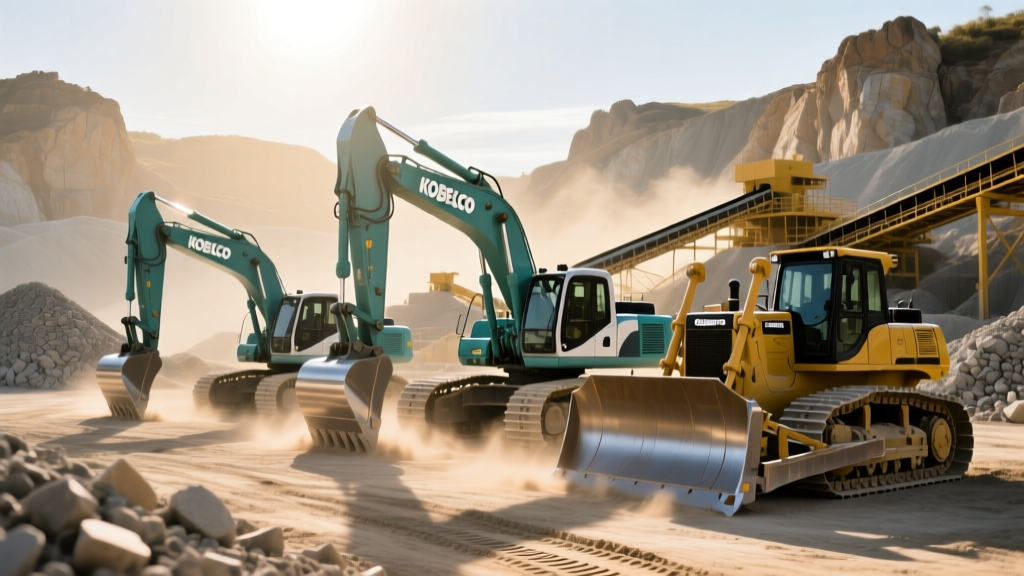
Troubleshooting Kobelco Heavy Equipment for Quarry Processing
Diagnose and repair Kobelco heavy equipment in aggregate quarries. Expert troubleshooting for SK-series hydraulics, boom fractures, and undercarriage wear.
Hydraulic System Overheating in High-Silica Environments
Quarry and aggregate processing environments subject machinery to extreme particulate matter, specifically crystalline silica and limestone dust. When operating Kobelco heavy equipment like the SK380SCL or SK500 excavators for continuous rock breaking and sorting, hydraulic fluid temperatures frequently exceed the critical 95°C (203°F) threshold. This overheating is rarely a failure of the main hydraulic pumps; instead, it is a heat exchange and fluid viscosity issue exacerbated by micro-particulate clogging.
Warning: Silica Dust and Cooler CoresAccording to CDC NIOSH guidelines on silica exposure, fine silica dust is not only a severe respiratory hazard but also a mechanical abrasive. In quarry specs, silica dust mixes with hydraulic oil micro-leaks to form a concrete-like paste on the radiator and hydraulic oil cooler fins, reducing thermal dissipation by up to 40%.
Diagnostic and Repair Protocol for Thermal Overload
- Verify Fan Pump Pressure: Connect a 600-bar (8,700 psi) flow meter to the hydraulic fan motor circuit. The fan pump should deliver a minimum of 2.9 MPa (420 psi) at 2,000 RPM. If pressure drops below 2.4 MPa, the fan pump internal gear clearances are worn and require a $2,500–$3,500 cartridge rebuild.
- Ultrasonic Cooler Cleaning: Standard compressed air blow-outs are insufficient for aggregate dust. Remove the hydraulic oil cooler and utilize an ultrasonic cleaning bath with an alkaline degreaser. Expect to pay $800–$1,200 for professional off-site ultrasonic flushing.
- Fluid Viscosity Upgrade: If ambient quarry temperatures consistently exceed 35°C (95°F), drain the standard ISO VG 46 hydraulic fluid and replace it with a synthetic ISO VG 68 fluid. This maintains the optimal 15–25 cSt viscosity range required by the Kobelco Intelligent Total Control System (ITCS) under high-heat shock loading.
Boom and Arm Micro-Fractures from Hydraulic Hammer Shock Loads
In secondary rock breaking applications, Kobelco excavators are frequently fitted with heavy hydraulic hammers (e.g., NPK E212A or Atlas Copco HB 4700). The repetitive shock loads—often exceeding 1,500 blows per minute—transfer immense kinetic energy back through the bucket linkage into the boom foot and arm cylinder mounts. Over time, this induces micro-fractures in the high-tensile steel plates.
Magnetic Particle Inspection (MPI) Protocol
Do not wait for visible weeping of hydraulic oil to indicate a crack. Implement an MPI schedule every 1,500 operating hours for quarry-dedicated machines. Focus specifically on the boom-to-frame pivot pin bores and the arm-to-bucket linkage plates. MPI will reveal subsurface fatigue cracking that dye penetrant testing misses.
Weld Repair Specifications for High-Tensile Steel
If a fracture is detected, standard SMAW (stick) welding with generic E6011 electrodes will result in immediate re-cracking due to hydrogen embrittlement and mismatched yield strength. Follow these strict repair parameters:
- Preparation: V-groove the crack to a 60-degree angle using a plasma cutter. Grind 50mm past the crack tip to relieve stress concentration.
- Pre-Heating: Heat the surrounding base metal to 150°C (300°F) using induction blankets or rosebud torches to slow the cooling rate and prevent martensite formation.
- Filler Metal: Use low-hydrogen E7018 electrodes (baked at 260°C for two hours prior to use) or ER80S-G MIG wire. This matches the 70,000+ PSI tensile strength of the Kobelco boom steel.
- Post-Weld Heat Treatment (PWHT): Peen the weld beads with a needle scaler while hot to induce compressive residual stresses, then wrap in thermal blankets to cool slowly over 12 hours.
Troubleshooting the Intelligent Total Control System (ITCS)
Kobelco's ITCS relies on a network of pressure transducers and solenoid valves to optimize fuel consumption and hydraulic flow. In aggregate processing, machines often idle while waiting for haul trucks or primary jaw crushers to clear. A malfunctioning auto-idle system can burn up to 15% excess fuel annually.
| Sensor Location | Function | Idle Voltage (0 MPa) | Max Load Voltage (34.3 MPa) | Common Quarry Failure Mode |
|---|---|---|---|---|
| Pump Delivery Pressure | Regulates engine RPM drop | 0.5V - 0.8V | 4.5V - 4.8V | Silica ingress in wiring harness connector causing 2.1V ghost signal |
| Boom Cylinder Head | Triggers auto-idle when lowered | 0.5V - 0.8V | 4.5V - 4.8V | Diaphragm rupture from hydraulic hammer shock wave feedback |
| Swing Motor Pressure | Modulates swing priority | 0.5V - 0.8V | 4.5V - 4.8V | Corrosion on signal pin due to acidic basalt dust and moisture |
To troubleshoot a failure to auto-idle, back-probe the pump delivery pressure sensor connector with a digital multimeter. If the resting voltage reads above 1.2V with all control levers in neutral, the sensor diaphragm is permanently deformed from shock loads and must be replaced. A genuine Kobelco transducer typically costs between $180 and $240.
Undercarriage Wear Profiling in Abrasive Basalt and Granite
Aggregate quarries featuring basalt, granite, or quartzite act as massive grinding wheels on excavator undercarriages. Operating a Kobelco SK330-10 or larger on loose, fractured rock accelerates track chain pitch elongation and sprocket wear. Proper troubleshooting requires precise measurement rather than visual estimation.
Track Chain Elongation Decision Framework
Use a calibrated track tension gauge or a steel tape measure across four consecutive track pins to calculate the average pitch stretch. Standard pitch on heavy-duty quarry chains is typically 216.0mm.
- 1.5% to 2.0% Stretch (219.2mm - 220.3mm): Normal wear. Continue standard operation. Ensure track tension is set to 35-45mm of sag to prevent excessive idler wear.
- 2.5% Stretch (221.4mm): Action Required. Pull the track chain and rotate the pins and bushings 180 degrees. This exposes the unworn internal surfaces to the sprocket teeth, extending undercarriage life by 30% for a labor cost of roughly $1,200 per side.
- 4.0%+ Stretch (224.6mm+): Critical Failure Imminent. The bushings are worn through the hardened outer casing. Sprocket teeth will begin to hook and climb the chain. Full undercarriage replacement is mandatory. Budget $25,000–$35,000 for OEM or premium aftermarket heavy-duty rock pads and chains.
Centralized Auto-Greasing System Failures
Quarry-spec Kobelco machines are equipped with centralized auto-greasing systems (typically Lincoln or SKF) to lubricate the boom, arm, and bucket pins continuously. In aggregate processing, these systems frequently fail due to grease hardening and line ruptures.
Expert Insight: Never use standard NLGI #2 lithium-complex grease in a quarry auto-lube system during winter months or in high-vibration rock breaking applications. The oil separation rate is too high, leaving solid soap plugs in the distribution lines. Always specify an NLGI #1 or #2 Molybdenum Disulfide (Moly) fortified grease with a synthetic base oil. The moly provides a solid-film boundary lubrication that survives the extreme shock loads of bucket curling in blasted rock, while the lower NLGI grade ensures the pump can push the grease through 10-meter lines in cold weather.
If the system fault light illuminates, check the primary distribution block. The metering pins inside the block often seize when contaminated with rock dust that bypasses the reservoir breather cap. Replace the reservoir breather with a high-efficiency desiccant breather (ISO 12103-A2 fine dust rating) to prevent moisture and silica from entering the grease supply. Adhering to OSHA earthmoving and material handling standards requires strict maintenance of all pivot points to prevent catastrophic pin ejection during heavy lifting and sorting operations.
Summary of Quarry Maintenance Intervals
Troubleshooting Kobelco heavy equipment in aggregate processing requires shifting from reactive repairs to predictive condition monitoring. By utilizing ultrasonic oil analysis every 250 hours to track silica contamination (measured via ISO 4406 cleanliness codes), enforcing MPI boom inspections, and strictly managing ITCS sensor health, operators can reduce unplanned downtime by up to 35%. For comprehensive machine specifications and OEM part cross-referencing, consult the official Kobelco America excavator lineup and technical service bulletins.