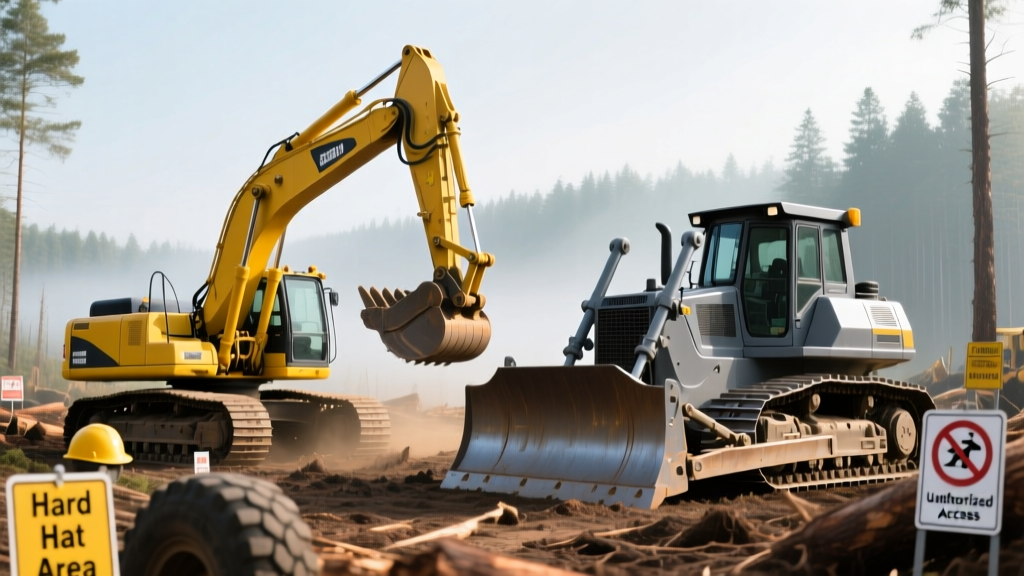
Safety Compliance When Buying New Heavy Equipment for Logging
Ensure OSHA and ANSI compliance when deploying new heavy equipment in forestry. Explore safety specs for feller bunchers, skidders, and forwarders.
The Lethal Reality of Logging: Why Equipment Spec'ing is a Compliance Issue
Logging consistently ranks as one of the most hazardous industrial sectors, with fatal injury rates historically hovering around 30 times the national average for all workers. When fleet managers procure new heavy equipment for forestry operations, the focus frequently defaults to horsepower, hydraulic flow rates, and fuel efficiency. However, from a regulatory and liability standpoint, the structural safety packages and active compliance features integrated at the factory are the most critical specifications on the build sheet.
Navigating the intersection of OSHA regulations, ISO structural standards, and manufacturer-specific safety telematics requires a granular understanding of what constitutes legal compliance in the woods. Spec'ing a machine incorrectly doesn't just risk a citation; it risks catastrophic failure modes unique to steep-slope harvesting and high-tension winching.
Core Regulatory Framework for Forestry Machinery
Before signing a purchase order for a new feller buncher or forwarder, procurement teams must align the machine's build with OSHA's 29 CFR 1910.266 Logging Operations standard. This standard explicitly dictates the structural and mechanical safeguards required on heavy forestry machinery.
- Cab Protection (1910.266(d)(3)): Operator cabs must be equipped with Falling Object Protective Structures (FOPS) and Roll-Over Protective Structures (ROPS). OSHA mandates that cab windows utilize materials that will not shatter into dangerous fragments upon impact—typically requiring 12mm to 19mm polycarbonate (Lexan) backed by heavy-gauge steel mesh.
- Hydraulic Safety: While OSHA governs the workplace, hydraulic systems on new heavy equipment must comply with ISO 4413 standards, specifically regarding burst valves and accumulator lockouts to prevent uncontrolled boom drops if a high-pressure hose ruptures.
- ROPS Certification (SAE J1040): According to SAE International's J1040 standard, ROPS cages must absorb specific kinetic energy levels during a simulated rollover. This certification is tied to the exact machine weight and cab configuration at the time of manufacture.
Never authorize aftermarket welding, drilling, or cutting on a certified ROPS/FOPS cab frame. Adding a custom radio bracket or welding a secondary light bar mount directly to the ROPS pillars alters the steel's metallurgical properties and instantly voids the SAE J1040 certification. If a rollover occurs and an investigator finds unapproved welds on the cage, the company faces willful negligence charges, regardless of whether the weld caused the failure.
Machine-Specific Compliance & Spec'ing Guide
Different classes of forestry machinery present unique kinetic and environmental hazards. Here is how to spec the safety packages on the three primary categories of new heavy equipment used in modern logging.
1. Track Feller Bunchers (e.g., Tigercat 880D, John Deere 903M)
Feller bunchers operate at the stump, dealing with massive sheer forces and the danger of 'barber-chairing' (when a tree splits vertically and kicks back toward the cab).
- Window Specs: Demand the OEM heavy-duty FOPS package. This includes 19mm polycarbonate windows with interior steel mesh grates. Standard construction-grade FOPS is insufficient for the kinetic energy of a snapping 24-inch diameter hardwood stem.
- Boom Accumulator Lockouts: Ensure the machine is spec'd with manual hydraulic lockout valves located inside the cab. Operators must be able to mechanically lock the boom hydraulic circuit before exiting the cab to clear a jammed saw head, satisfying OSHA's Lockout/Tagout (LOTO) requirements without relying solely on electronic solenoids.
2. Clambunk Skidders (e.g., CAT 545 GC, Tigercat 635E)
Skidders pull multiple tons of timber up steep, uneven grades using high-tension winches and grapples.
- Winch Line Deflectors: OSHA 1910.266(i)(1) requires that winch lines be guarded to protect the operator in the event of a cable snap. Spec the factory-installed heavy-duty fairlead deflector guard. A snapping 1-inch wire rope under 40,000 lbs of tension carries enough kinetic energy to shear through an unguarded cab rear window.
- Grapple Pressure Retention: Ensure the grapple circuit includes load-holding valves. If a hose blows while the grapple is suspended over the bunk, the load must remain clamped rather than dropping onto the machine's articulation joint or nearby ground workers.
3. Forwarders (e.g., Komatsu 951, John Deere 1510E)
Forwarders feature complex hydraulic cranes that operate in a 360-degree radius, often near public roads or active landing zones.
- Slew Torque Limiters: Modern 2026-model forwarders can be spec'd with electronic slew limits that prevent the crane from swinging into the operator's blind spots or over the cab.
- Load Moment Indicators (LMI): Essential for compliance when operating on slopes exceeding 15 degrees. An LMI prevents the operator from extending the boom to a point where the center of gravity shifts outside the machine's stability triangle, preventing catastrophic tip-overs.
The Financial Reality: OEM Safety Packages vs. OSHA Penalties
Many independent logging contractors attempt to save capital by declining OEM safety upgrade packages, planning to retrofit guards in their own shops. This is a severe financial and legal miscalculation. As of 2026, OSHA's maximum penalty for a willful or repeated violation exceeds $161,000 per instance. Furthermore, NIOSH investigations into logging fatalities frequently cite inadequate machine guarding as a primary contributing factor, opening the door to massive civil litigation.
| Safety Feature / Scenario | OEM Factory Upgrade Cost (Est.) | OSHA Penalty / Liability Risk | ||
|---|---|---|---|---|
| Heavy-Duty FOPS Cab (19mm Poly + Mesh) | $12,500 - $16,000 | $161,000+ (Willful Violation) | ||
| Winch Fairlead Deflector Guard | $2,800 - $4,200 | Hydraulic Boom Burst Valves (ISO 4413) | $1,500 - $3,000 | $16,000+ per unguarded circuit |
| Aftermarket ROPS Welding (Voiding Cert.) | $500 (Shop Labor) | Uncapped Civil Liability / Manslaughter |
2026 Telematics and Active Compliance Systems
The integration of active safety systems into new heavy equipment has shifted compliance from a passive structural requirement to an active, monitored workflow. When ordering new machinery, fleet managers should evaluate the following telematics packages:
- Proximity Detection Radar (LiDAR): Systems that automatically throttle down or halt the machine's swing and travel functions if a ground worker's RFID tag or physical mass enters a predefined 15-foot danger zone around the feller buncher tail-swing.
- Seatbelt Interlocks & PTO Lockouts: Factory programming that prevents the hydraulic PTO (saw head or grapple) from engaging unless the operator's seatbelt is latched and the cab door is fully closed and latched.
- Tilt & Slew Telematics: Cloud-logged data that tracks when an operator runs a forwarder or skidder beyond the manufacturer's maximum recommended slope gradient (typically 30-35 degrees for tracked, less for wheeled). This data is invaluable for defending against negligent entrustment claims in the event of an accident.
Pre-Delivery Inspection (PDI) Decision Matrix for Fleet Managers
Do not accept delivery of new heavy equipment until the following compliance matrix has been verified on the landing. Sign-off on the PDI constitutes acceptance of the machine's safety state.
✅ The 5-Point Forestry PDI Checklist
- Verify ROPS/FOPS Placards: Locate the stamped metal certification plates on the cab pillars. Ensure the serial numbers match the factory build sheet and show no signs of grinding or repainting.
- Polycarbonate Integrity Check: Inspect all cab windows. Polycarbonate degrades under UV exposure. Ensure the OEM protective film is still intact and there is no yellowing or micro-crazing from sitting on the dealer lot.
- Hydraulic Lockout Test: With the machine running and boom elevated, engage the manual hydraulic lockout valves. Attempt to lower the boom using the joysticks. The boom must not drift or drop.
- Winch Guard Clearance: On skidders, measure the clearance between the winch fairlead guard and the fully spooled cable. Ensure the guard cannot pinch or fray the wire rope during extreme angle pulls.
- Fire Suppression Activation: If spec'd with an automatic AFFF or dry chemical fire suppression system, verify the pull-cable routing in the cab is unobstructed and the pressure gauge on the main cylinder is in the green zone.
Procuring new heavy equipment for forestry is a high-stakes investment. By prioritizing OEM-certified structural protections, adhering strictly to OSHA 1910.266, and leveraging modern active-safety telematics, fleet managers can protect their operators from the extreme hazards of the woods while insulating their businesses from crippling regulatory and civil liabilities.