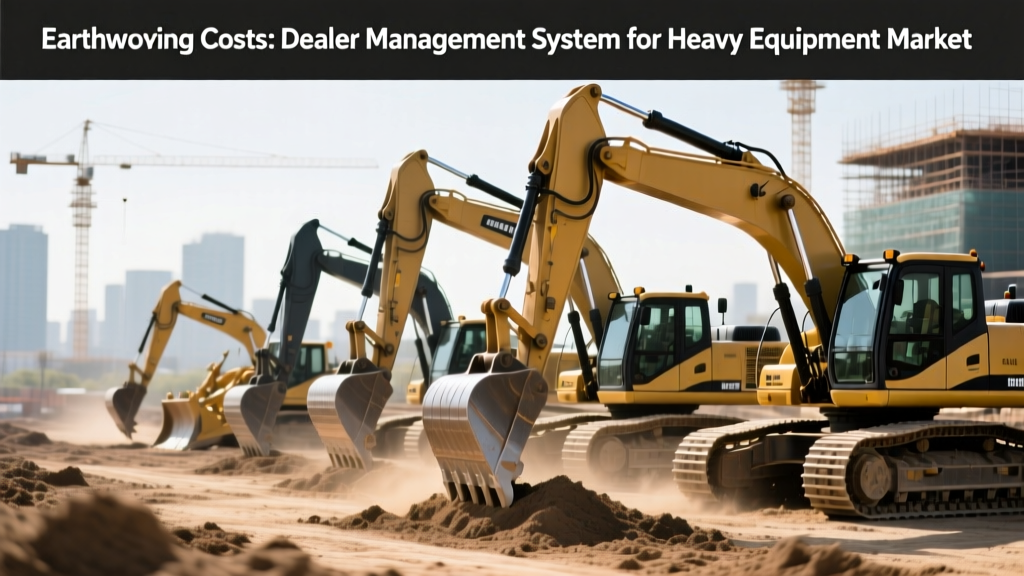
Earthmoving Costs: Dealer Management System for Heavy Equipment Market
Analyze 2026 earthmoving equipment TCO, from Cat 336 excavators to Deere dozers, using dealer management system data for precise fleet budget planning.
The Financial Reality of Earthmoving Fleets in 2026
Capital allocation for earthmoving equipment requires moving beyond baseline MSRP calculations. Fleet financial officers and procurement managers must model Total Cost of Ownership (TCO) across a 5,000 to 10,000-hour lifecycle. In 2026, volatile diesel prices, advanced emissions control system maintenance, and localized supply chain variables dictate that operating expenditures (OpEx) frequently eclipse initial capital expenditures (CapEx) within the first four years of heavy utilization.
To achieve precise budget forecasting, modern fleets are abandoning static spreadsheet models. Instead, they are integrating live telemetry and warranty data directly from OEM portals. According to industry data tracked by the Association of Equipment Manufacturers (AEM), fleets that synchronize their ERP with OEM diagnostic portals reduce unplanned downtime costs by up to 22%.
⚠️ Budget Warning: The Hidden Cost of Emissions SystemsWhen budgeting for Tier 4 Final / Stage V earthmoving assets, allocate an additional 4% to 6% of your annual fuel budget specifically for Diesel Exhaust Fluid (DEF) and anticipated Selective Catalytic Reduction (SCR) maintenance. Dosing module crystallization in cold climates remains a leading cause of unplanned derates, costing roughly $4,500 per replacement event.
Categorizing Earthmoving Assets: Baseline CapEx & OpEx Projections
Earthmoving equipment spans multiple weight classes and applications, each with distinct wear profiles and financial footprints. Below is a breakdown of primary asset categories, utilizing 2026 market pricing and 5,000-hour operational projections.
| Equipment Class | Representative Model | 2026 Est. CapEx | 5,000-Hr OpEx Projection |
|---|---|---|---|
| 36-Ton Excavator | Caterpillar 336 | $580,000 - $640,000 | $215,000 |
| Large Crawler Dozer | John Deere 1050K | $680,000 - $750,000 | $285,000 |
| Motor Grader | Cat 14M | $710,000 - $780,000 | $195,000 |
| Wheel Loader (4.5 yd³) | Komatsu WA380-8 | $420,000 - $470,000 | $160,000 |
Note: OpEx projections include scheduled preventative maintenance (PM), fluid consumption, ground engaging tools (G.E.T.), and undercarriage wear, but exclude operator labor and insurance.
Excavators: The Undercarriage Variable
For track-type excavators like the Caterpillar 336 or Komatsu PC360LC, the undercarriage represents up to 50% of total lifetime maintenance costs. Budget planners must account for the 4,000-hour undercarriage overhaul cycle. Replacing chains, rollers, idlers, and sprockets on a 36-ton class machine currently averages $28,000 to $35,000. Operating in highly abrasive environments (e.g., shot rock or quartzite) can accelerate this interval to 2,500 hours, devastating quarterly maintenance budgets if not modeled correctly.
Dozers and Graders: Hydrostatic and Drivetrain Wear
Unlike excavators, dozers and motor graders endure continuous high-load drivetrain stress. The John Deere 1050K utilizes a hydrostatic drive system that eliminates the torque converter and transmission found in older models, but requires stringent hydraulic fluid purity. Budgeting for hydraulic fluid analysis and kidney-loop filtration servicing every 500 hours is non-negotiable to prevent pump cavitation, which carries a $22,000 replacement cost.
Integrating a Dealer Management System for Heavy Equipment Market Analytics
Static budget models fail because they rely on historical averages rather than real-time machine health. When evaluating a dealer management system for heavy equipment market applications, fleet financial officers must look beyond basic inventory tracking. Modern DMS platforms (such as CDK Heavy Duty, WMS, or proprietary OEM portals) act as the financial bridge between the service bay and the back office.
"A properly configured dealer management system doesn't just track parts inventory; it ingests machine telemetry to predict component failure. By aligning DMS warranty utilization data with your fleet's ERP, you can recover up to 14% in missed warranty claims on major powertrain components."
— Fleet Procurement Director, National Earthworks Consortium
How DMS Data Optimizes TCO Budgeting
- Warranty Capture: Automated flagging of premature component failures (e.g., a hydraulic pump failing at 2,800 hours against a 5,000-hour warranty threshold) ensures the DMS prompts the dealership to file OEM claims, directly reducing your OpEx.
- Dynamic PM Scheduling: Instead of rigid 500-hour oil changes, DMS platforms integrated with oil-sampling labs allow fleets to safely extend intervals to 750 or 1,000 hours based on actual fluid degradation, saving $3,200 annually per machine in fluid and labor.
- G.E.T. Inventory Optimization: Tracking the wear rates of bucket teeth and cutting edges across different soil types allows the DMS to automate just-in-time parts ordering, eliminating expensive emergency freight charges.
Step-by-Step Budget Planning Framework for Earthmoving Assets
To build a resilient financial model for earthmoving procurement, follow this four-step framework, leveraging data insights from industry equipment analyses and OEM telemetry.
- Calculate True CapEx (Landed Cost): Base MSRP + 8-12% for freight and rigging + 5% for initial attachments (e.g., heavy-duty rock buckets, hydraulic thumbs, GPS machine control masts). A $600,000 excavator often lands on-site at $690,000.
- Model Fluid & Filter Burn Rates: Calculate exact consumption. A Cat 336 burns approximately 7.5 gallons of diesel per hour. At $4.10/gallon, fuel costs $30.75/hour. Add DEF consumption (roughly 4% of diesel volume) at $3.50/gallon. Total hourly fluid burn is ~$32.00.
- Allocate Ground Engaging Tools (G.E.T.) Reserves: For trenching in mixed clay and gravel, budget $1.85 per hour for bucket teeth and adapter replacements. For ripping shale with a dozer, budget $4.50 per hour for ripper tips and shank protectors.
- Factor in Telemetry & Software Subscriptions: Advanced 3D machine control (e.g., Trimble Earthworks or Topcon) requires annual software licenses and RTK base station corrections, averaging $6,500 to $9,000 per machine, per year.
Real-World Edge Cases: When Standard Budget Models Fail
Financial models built on ideal conditions frequently collapse in the field. Budget planners must account for these specific operational edge cases:
1. Cold Climate DEF Crystallization
In sub-freezing environments, DEF fluid can crystallize inside the dosing lines and injector nozzles if the machine is not properly purged during shutdown. Standard warranties often exclude environmental damage. Financial Impact: Budget $1,200 per machine annually for specialized DEF line flush kits and winterization labor.
2. High-Altitude Derating
Operating turbocharged earthmoving equipment above 8,000 feet results in air density loss, causing the engine control module (ECM) to derate horsepower to protect the turbo and EGR system. This reduces production volume by 12-18%. Financial Impact: You must budget for 15% more machine hours (and corresponding fuel/maintenance) to move the same yardage of material at high altitudes.
3. Abrasive Dust and Radiator Clogging
Working in arid, silty environments (like demolition or dry-summer quarrying) causes fine particulate to bypass standard air filters and clog hydraulic oil coolers. Overheating leads to premature hydraulic hose degradation. Financial Impact: Upgrading to heavy-duty turbine pre-cleaners and reversing cooling fans costs $4,800 upfront but prevents $18,000 in hydraulic system overhauls.
✅ Strategic TakeawaySuccessful earthmoving fleet budgeting in 2026 requires abandoning static MSRP-plus-10% formulas. By categorizing assets by their specific wear profiles and integrating live lifecycle data via a dealer management system for heavy equipment market operations, financial officers can transform maintenance from an unpredictable liability into a precisely modeled operational variable.