Demolition Equipment Types: Hazards and Heavy Equipment Injury Lawyer NYC Cases
Explore demolition equipment types, attachment failure modes, and liability case studies requiring a heavy equipment injury lawyer NYC.
Urban Demolition Machinery: High-Stakes Equipment and Catastrophic Failure Modes
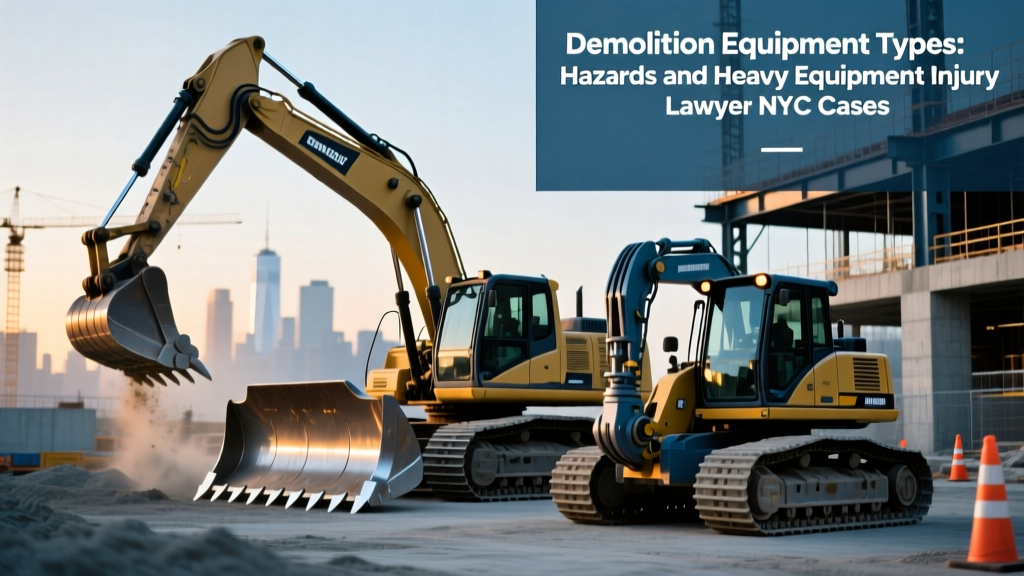
Demolition in high-density urban environments like Manhattan or Brooklyn requires a highly specialized fleet of heavy machinery. Unlike open-land clearing, urban teardowns operate within inches of active roadways, pedestrian zones, and adjacent structures. The primary equipment used—ultra-high-reach (UHD) excavators, remote-controlled demolition robots, and heavy-duty skid steers—relies on high-pressure hydraulic attachments that introduce severe kinetic and pneumatic hazards. When these systems fail, the resulting trauma often triggers complex multi-party litigation, making the expertise of a heavy equipment injury lawyer NYC critical for navigating New York’s stringent labor laws and third-party liability claims.
This analysis examines the specific demolition equipment types, their mechanical failure points, and real-world liability matrices based on recent urban construction case studies.
Primary Demolition Equipment Types in Dense Urban Zones
The selection of demolition carriers is dictated by structural height, material density (reinforced concrete vs. structural steel), and footprint constraints.
1. Ultra-High-Demolition (UHD) Excavators
Machines like the Caterpillar 340 UHD or Komatsu PC490LC-11 are engineered for tearing down multi-story structures. The Cat 340 UHD features a maximum reach of 20 meters (65 feet) and an operating weight exceeding 90 tons when fully configured with its modular counterweight system.
- Application: Top-down demolition of commercial buildings, shearing steel I-beams, and crushing concrete columns.
- Specific Hazard: Center-of-gravity shifts. If the operator over-extends the boom with a heavy shear attachment without deploying the variable-gauge undercarriage, the machine can tip, crushing the cab or striking ground workers.
2. Remote-Controlled Demolition Robots
For interior demolition, asbestos abatement, or confined-space teardowns, electric or diesel-powered robots like the Brokk 500 are standard. Weighing just over 5 tons, they can fit through standard double doors and operate via a 300-foot radio remote.
- Application: Selective demolition, refractory removal, and basement teardowns.
- Specific Hazard: Signal interference and structural collapse. In dense urban areas with heavy RF interference, remote signals can drop, causing the machine to default to its last command (e.g., continuing to swing a breaker into a load-bearing pillar).
Critical Attachments and Mechanical Failure Profiles
The base carrier is only half the equation; the hydraulic attachments do the actual destruction. These attachments operate at extreme hydraulic pressures (often exceeding 5,000 psi) and endure massive torsional stress.
| Attachment Type | Common Models | Operating Pressure | Primary Failure Mode | Injury Risk Profile |
|---|---|---|---|---|
| Hydraulic Shears | Genesis GXP 335, NPK HDS | 5,070 psi | Jaw pin shearing, hydraulic hose whip | Amputation, high-pressure fluid injection |
| Concrete Pulverizers | Trevi Benne PVD, Atlas Copco | 4,350 psi | Quick-coupler gravity drop, jaw fracture | Crush injuries, fatal blunt force trauma |
| Hydraulic Breakers | Epiroc HB 4700, Montabert | 2,300 - 2,900 psi | Tool bit shattering, nitrogen chamber blowout | Shrapnel lacerations, acoustic trauma |
| Wrecking Balls / Drop Weights | Custom forged steel (5-12 tons) | N/A (Mechanical) | Cable snap, swing-radius pendulum effect | Massive blunt force, sweeping crush injuries |
A pinhole leak in a hydraulic shear hose operating at 5,000 psi can inject hydraulic fluid directly through the skin and into the underlying tissue. This is a severe surgical emergency. Never use bare hands to check for hydraulic leaks; always use a piece of cardboard. If fluid breaches the skin, the victim must be transported to an emergency room immediately, as delayed treatment often results in limb amputation.
Case Study: Quick-Coupler Failure and the Liability Matrix
In a recent high-profile Manhattan demolition project, a 45-ton excavator was utilizing a mechanical quick-coupler to switch between a 6,500 lb concrete pulverizer and a hydraulic shear. The operator failed to manually verify that the secondary locking pin had engaged the attachment's rear boss. During a high-vibration concrete cracking cycle, the primary locking wedge vibrated loose. The pulverizer detached from 35 feet in the air, striking a ground-level spotter.
Untangling the Legal Web
When catastrophic equipment failures occur on New York construction sites, the legal landscape is uniquely complex. Victims and their families typically retain a specialized heavy equipment injury lawyer NYC to pursue claims beyond standard workers' compensation. Under New York Labor Law § 241(6), owners and contractors are required to provide reasonable and adequate protection for workers engaged in demolition. Furthermore, Section 240(1) (the 'Scaffold Law') imposes absolute liability on owners and general contractors for gravity-related hazards—such as a falling 6,500 lb attachment.
'In urban demolition, the general contractor cannot delegate away their safety responsibilities. If a sub-contractor's quick-coupler fails due to deferred maintenance, the site owner and GC are frequently held strictly liable under NY Labor Law, regardless of the operator's direct negligence.' — Construction Liability Legal Framework, 2025 Review
The Third-Party Product Liability Angle
Beyond site liability, an experienced legal team will investigate the equipment manufacturer. If the quick-coupler's secondary lock mechanism was defectively designed (e.g., lacking a visual or auditory 'locked' indicator in the cab), a product liability claim is filed against the attachment manufacturer. According to the NIOSH construction safety guidelines, automated quick-hitch systems with redundant mechanical locks and in-cab visual confirmations reduce accidental attachment drops by over 85% compared to manual semi-automatic hitches.
Pre-Shift Demolition Equipment Inspection Protocol
To mitigate catastrophic failures and the subsequent legal fallout, site superintendents and operators must adhere to a rigid, documented inspection protocol compliant with OSHA Standard 1926.850 for demolition operations.
- Quick-Coupler Verification: Engage the attachment. Curl the bucket/shear inward to apply downward pressure. Visually confirm the secondary locking pin is fully seated. Attempt to disengage the attachment using only the in-cab release; if it drops, the mechanical lock has failed.
- Hydraulic Hose Integrity: Inspect all hoses for abrasion, bubbling, or weeping. Ensure all hoses within 6 feet of the operator cab or ground workers are wrapped in Kevlar or steel spiral protective sleeving to prevent whip-lash in the event of a blowout.
- Structural Pin & Bushing Check: Check the boom-to-stick and stick-to-attachment pivot pins for lateral play. Excessive play (greater than 1/8 inch) alters the cutting geometry of hydraulic shears, leading to jaw misalignment and catastrophic pin shearing under load.
- Swing Radius Barricading: Verify that the physical barricades match the machine's maximum tail-swing radius plus a 10-foot buffer. UHD excavators like the Komatsu PC490LC have massive rear counterweights that extend significantly beyond the tracks.
Summary: Aligning Equipment Specs with Site Safety
Demolition equipment represents the pinnacle of hydraulic force and mechanical leverage. However, the extreme forces required to shear structural steel and pulverize reinforced concrete create an inherently volatile work environment. Understanding the exact failure modes of hydraulic shears, the kinetic risks of UHD excavators, and the legal ramifications of quick-coupler negligence is mandatory for modern construction management. When preventative protocols fail, the intersection of heavy machinery physics and New York labor law dictates that specialized legal intervention is required to secure justice and enforce industry-wide safety accountability.