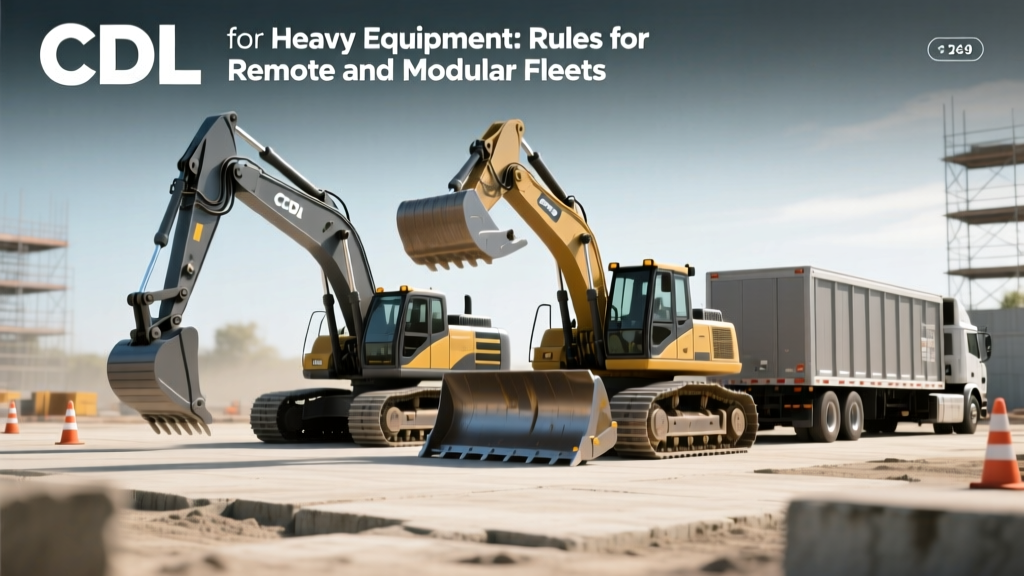
CDL for Heavy Equipment: Rules for Remote and Modular Fleets
Discover when a CDL for heavy equipment is legally required for remote-controlled demolition robots and modular transporters. Real case studies inside.
The Legal Gray Area of Tele-Operated and Modular Machinery
Fleet managers and site supervisors are increasingly deploying remote-controlled and modular heavy machinery to improve safety and precision in hazardous environments. However, this technological shift has created significant regulatory friction regarding operator licensing. Securing a CDL for heavy equipment is standard practice for traditional earthmovers and haul trucks, but the legal requirements become highly complex when the operator is standing 50 feet away with a wireless pendant or sitting in a remote command center.
The core of the confusion lies in the intersection of Federal Motor Carrier Safety Administration (FMCSA) regulations and Occupational Safety and Health Administration (OSHA) site-specific rules. As of 2026, DOT enforcement agencies are actively clarifying how Commercial Motor Vehicle (CMV) definitions apply to self-propelled modular transporters and tele-operated demolition fleets. Understanding these boundaries is critical to avoiding six-figure compliance fines and insurance claim denials.
⚠️ Compliance Warning: If a piece of remote-controlled equipment crosses a public right-of-way—even at 5 MPH—the FMCSA generally classifies the machine as a Commercial Motor Vehicle if it exceeds 26,001 lbs. The individual holding the wireless remote pendant is legally considered the 'driver' and must possess a valid CDL with appropriate endorsements, regardless of whether they are inside a cab.Case Study 1: Modular Self-Propelled Transporters (SPMTs) in Heavy Haul
Modular Self-Propelled Transporters (SPMTs), such as the Goldhofer PST-E/SL or Scheuerle SPMT series, are the backbone of modern heavy-haul logistics. These multi-axle, computer-steered platforms move everything from 400-ton power transformers to offshore oil rig modules. Because they are modular, they can be linked together to distribute weight across dozens of axles.
Operation vs. Transport Licensing
When an SPMT is operating entirely within a private, closed-off facility (like a shipyard or refinery), OSHA jurisdiction applies. Operators need specialized internal certifications for the Goldhofer or Scheuerle control software, but a CDL is not legally mandated.
However, the moment the SPMT transitions to a public highway to cross an intersection or travel between sites, FMCSA rules trigger. According to the official FMCSA CMV definition, any self-propelled vehicle used on a highway in interstate commerce to transport passengers or property that has a gross vehicle weight rating (GVWR) of 10,001 pounds or more qualifies as a CMV. Because SPMTs vastly exceed this weight, the pedestrian operator walking alongside the load with the remote control unit must hold a Class A or Class B CDL, often accompanied by a Heavy Haul or specialized rigging endorsement depending on state-level DOT interpretations.
| Equipment Scenario | Jurisdiction | CDL Required? | Specific Endorsements / Certs |
|---|---|---|---|
| SPMT moving inside private refinery | OSHA / Private Site | No | Manufacturer-specific pendant cert |
| SPMT crossing public highway | FMCSA / State DOT | Yes | Class A/B CDL, Oversize permits |
| Brokk 700 Demolition Robot on-site | OSHA | No | OSHA heavy equipment operator card |
| Towing Brokk 700 on trailer (GCWR > 26k) | FMCSA | Yes | Class A CDL (Towing vehicle driver) |
Case Study 2: Remote-Controlled Demolition Robots in Urban Environments
Remote-controlled demolition robots, such as the Brokk 700 or Husqvarna DXR 300, are ubiquitous in 2026 urban tear-downs and nuclear decommissioning projects. These machines weigh between 7,000 and 22,000 lbs and are operated via waist-mounted wireless control panels.
A common misconception among mid-sized demolition contractors is that because the machine itself is not driven on the road, no CDL for heavy equipment is necessary for the crew. While the operation of the robot on the demolition site does not require a CDL, the logistics of moving these modular units between urban job sites frequently triggers CDL mandates.
'We had a contractor fined $14,000 in a single week because their operators were using Ford F-350s to tow Husqvarna DXR units on equipment trailers. While the F-350 alone is under the threshold, the combined Gross Combination Weight Rating (GCWR) of the truck, trailer, and 7-ton robot exceeded 26,001 lbs. The drivers lacked Class A CDLs, resulting in immediate out-of-service orders.' — 2025 Specialized Carriers & Rigging Compliance Report
The Transport Loophole and How to Close It
To maintain compliance without forcing every demolition technician to obtain a Class A CDL, leading contractors in 2026 are utilizing dedicated Class B CDL transport drivers with rigid-body knuckle-boom trucks (like the Hino XL Class 8 equipped with a Fassi crane). This isolates the CDL requirement to the logistics team, allowing the remote-operators to focus purely on OSHA-mandated demolition certifications.
Decision Matrix: Do Your Remote Operators Need a CDL?
Use this operational logic flow to determine licensing requirements for your modular and tele-operated fleet. For deeper regulatory context on highway work zones and equipment transit, refer to the Federal Highway Administration Work Zone guidelines.
- Step 1: Weigh the Equipment. Does the remote-controlled machine or the towing combination (truck + trailer + machine) exceed a GVWR or GCWR of 26,001 lbs?
- If No: Standard state driver's license is sufficient for transport; no CDL required.
- If Yes: Proceed to Step 2.
- Step 2: Define the Operating Environment. Will the machine propel itself across any public road, highway, or publicly accessible right-of-way?
- If No (Strictly private property/closed site): No CDL required for the remote operator. OSHA training applies.
- If Yes: Proceed to Step 3.
- Step 3: Identify the 'Driver'. Who is controlling the movement of the machine across the public space?
- If it is a pedestrian with a remote pendant: The pendant operator MUST hold a valid CDL corresponding to the vehicle weight class, plus any required oversize/overweight permits.
- If it is a tethered or towed load pulled by a tractor: The tractor driver must hold the CDL; the pedestrian spotter/remote operator does not need a CDL unless they are also steering the modular axles via remote.
The 2026 Shift: Autonomous Haulage and CDL Obsolescence
The most significant disruption to heavy equipment licensing is the deployment of fully autonomous, site-contained modular haulers. Systems like the Caterpillar Command for Hauling and Komatsu FrontRunner operate without any human in the loop, whether in a cab or holding a remote.
📊 Real-World Compliance Costs (2026 Data)
- Class A CDL Training & Testing: $4,500 - $6,200 per operator.
- Heavy Haul / Specialized Endorsement Training: $1,200 additional.
- Insurance Premium Impact: Fleets utilizing non-CDL pendant operators on public right-of-ways face an average 34% premium surcharge or outright coverage denial from major commercial underwriters.
- Autonomous Fleet Supervisor Cert: $2,800 (OEM specific, replaces CDL requirement for closed-site mining operations).
Because these autonomous haul trucks never leave the private boundaries of the mine or quarry, they are entirely exempt from FMCSA CDL requirements. The licensing burden shifts from the DOT to the OEMs and OSHA. Fleet managers are no longer hiring traditional CDL drivers for these modular autonomous fleets; instead, they are hiring 'Autonomous Fleet Controllers' who require specialized software certifications, network latency management training, and emergency remote-takeover drills.
Strategic Takeaways for Fleet Procurement
When procuring remote-controlled or modular heavy equipment in 2026, the initial purchase price is only a fraction of the total cost of ownership. You must map the exact transit routes and operational boundaries of the equipment before signing the PO. If your modular transporters or demolition robots will frequently cross public infrastructure, budget an additional $6,000 per operator for CDL acquisition and heavy-haul endorsements. If your operations can be strictly geofenced to private property, you can bypass the FMCSA CDL mandate entirely, relying instead on rigorous, documented OSHA-compliant training programs for your remote-control technicians.