How the Biggest Construction Equipment Manufacturers Build Pipelines
Explore how the biggest construction equipment manufacturers deploy specialized sidebooms, excavators, and HDD rigs for complex utility and pipeline projects.
The Economics of Linear Infrastructure Spreads
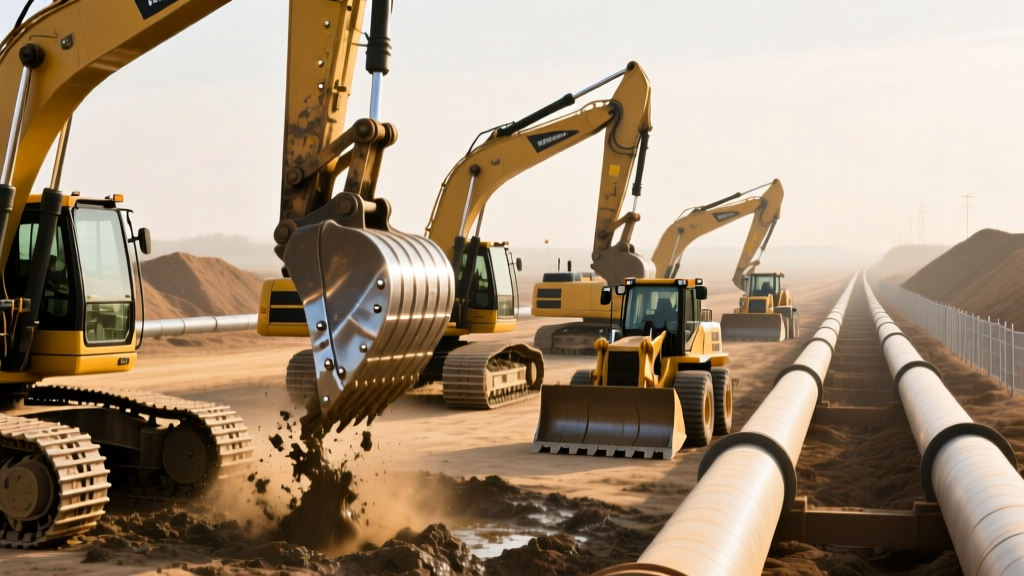
Cross-country pipeline and municipal utility construction operate on a fundamentally different economic model than vertical building or road paving. A heavy civil pipeline spread moving 42-inch API 5L X70 steel pipe through mountainous or wetland terrain can incur operational costs exceeding $150,000 per day. When a critical machine fails, the cascading delay across welding, coating, and lowering-in crews results in downtime penalties ranging from $12,000 to $28,000 per hour. Consequently, the biggest construction equipment manufacturers—primarily Caterpillar, Komatsu, and John Deere—engineer their pipeline and utility fleets around extreme reliability, synchronized lifting capabilities, and low-ground-pressure (LGP) mobility.
Spread Downtime Cost Matrix:- Minor Hydraulic Leak (Excavator): $4,500/hr (Single station delay)
- Sideboom Winch Failure: $14,000/hr (Halt of lowering-in operations)
- Mainline Tractor Track Roll-off: $28,000/hr (Complete right-of-way traffic freeze)
Right-of-Way (ROW) Preparation: Earthmoving Giants
Before a single pipe joint is unloaded, the right-of-way must be cleared, graded, and benched. In steep terrain, such as the Appalachian or Rocky Mountain corridors, standard bulldozers are insufficient. Contractors rely on heavy-duty tractors like the Caterpillar D8T and Komatsu D375A-8 equipped with winches and specialized ripping shanks. These machines are tasked with cutting bench roads into 30-degree slopes to allow the pipeline spread to traverse safely.
For wetland and muskeg environments, ground pressure is the limiting factor. Environmental permits often restrict ground pressure to below 5 psi to prevent rutting and hydrological disruption. To meet this, the biggest construction equipment manufacturers offer LGP configurations. A standard Komatsu PC490LC-11 excavator exerts roughly 11.5 psi. By swapping standard 24-inch track shoes for 36-inch or 44-inch swamp pads and utilizing wider track frames, ground pressure drops to 6.2 psi. For ultra-soft terrain, contractors deploy amphibious excavators or timber mats, but OEM LGP packages remain the first line of defense.
The Lowering-In Phase: Why Sidebooms Dominate
The most technically demanding phase of pipeline construction is the "lowering-in" process. After 40-foot pipe joints are welded, X-rayed, and field-coated into continuous strings spanning several miles, they must be lifted and gently lowered into the trench. Standard excavators lack the lateral reach, side-hill stability, and synchronized boom control required for this task.
The Caterpillar 583 Pipelayer (sideboom) remains the industry standard for mid-to-large diameter pipelines. With a lifting capacity of 170,000 lbs (77,110 kg) at a 5-foot side reach, a fleet of six to eight Cat 583s will work in tandem to lift a multi-million-pound string of 36-inch pipe. The operator sits in a sideways-facing cab, utilizing a specialized winch and boom configuration that keeps the machine's center of gravity low while the load is suspended laterally.
| Equipment Type | OEM / Model Example | Lifting Capacity (Side Reach) | Primary Limitation | Approx. Base Price (2026) |
|---|---|---|---|---|
| Dedicated Sideboom | Caterpillar 583 | 170,000 lbs @ 5 ft | Low travel speed; poor versatility off-spread | $950,000 - $1,150,000 |
| Heavy Excavator w/ Pipelayer Attachment | Komatsu PC490LC-11 | 85,000 lbs @ 12 ft | Higher center of gravity; side-slope limits | $520,000 - $580,000 |
| Compact Track Loader (Utility) | John Deere 333E | 3,200 lbs (Lift arm) | Restricted to small-diameter urban utility | $85,000 - $105,000 |
Urban Utility Routing: Compact Track Loaders and HDD
While cross-country pipelines rely on massive iron, urban utility construction (water, sewer, fiber-optic, and gas distribution) demands agility. The John Deere 333E and Caterpillar 299D3 compact track loaders (CTLs) are the workhorses of municipal utility spreads. Their vertical-lift arm designs provide the reach necessary to load material into dump trucks, while their low-profile cabs allow operation under dense tree canopies or low-clearance power lines.
For trenchless utility installation beneath highways and rivers, Horizontal Directional Drilling (HDD) is mandatory. While specialized brands like Vermeer and Ditch Witch dominate the HDD rig market, the biggest construction equipment manufacturers supply the critical support fleet: the excavators for mixing bentonite drilling fluid, the wheel loaders for handling drill pipe, and the dozers for reclaiming the exit pit. According to OSHA trenching and excavation standards, any open utility trench deeper than 5 feet requires engineered sloping, shoring, or shielding. CTLs equipped with hydraulic trench boxes and laser-guided grading attachments drastically reduce the footprint of open excavations in congested city centers.
Safety & Compliance Alert: Trench Collapse PhysicsOne cubic yard of soil can weigh between 2,000 and 3,000 lbs—equivalent to a mid-sized sedan. Utility contractors utilizing compact excavators like the Bobcat E85 or Deere 50G must strictly adhere to soil classification (Type A, B, or C) as defined by OSHA. Relying on the machine's counterweight to stabilize a trench wall is a fatal error; OEM hydraulic quick-couplers must be routinely inspected for micro-fractures, as a sudden loss of hydraulic pressure while holding a trench shield can result in catastrophic collapse.
Procurement Strategy: Fleet Acquisition for Pipeline Contractors
Acquiring heavy pipeline equipment requires a bifurcated strategy based on asset utilization rates. For core spread equipment that operates 2,000+ hours annually, direct purchase from the biggest construction equipment manufacturers is standard. However, Tier 4 Final and EU Stage V emission-compliant engines have increased the capital cost of a new Cat D8T dozer to approximately $850,000. To protect ROI, top-tier contractors utilize telematics (like Cat VisionLink or Komatsu KOMTRAX) to monitor idle times, hydraulic pump pressures, and undercarriage wear in real-time.
Edge Case: Karst Topography and Bedrock Trenching
When a pipeline route intersects karst topography or solid granite bedrock, standard ripping fails. Contractors must deploy excavators fitted with hydraulic hammers (e.g., Cat H180E) or specialized rockwheels. The failure mode in this scenario is rapid hydraulic overheating and boom-cracking due to high-frequency shockwaves. To mitigate this, OEMs recommend auto-greasing systems and accumulator-backed hydraulic circuits that absorb rebound energy. Blasting is often required, but strict environmental regulations regarding seismic vibration near municipal water mains make mechanical rock-breaking the preferred, albeit slower, method.
Frequently Asked Questions
- Why don't pipeline contractors use standard cranes for lowering-in?
Cranes require level ground and outrigger deployment, making them impossible to use on uneven right-of-way terrain or side-hills. Sidebooms are tracked, mobile, and designed to lift heavy loads laterally while moving continuously along the trench. - What is the role of PHMSA in equipment selection?
While the Pipeline and Hazardous Materials Safety Administration (PHMSA) regulates pipeline safety and incident reporting rather than construction equipment directly, their strict mandates on pipe coating integrity force contractors to use specialized nylon-slung sidebooms and padded trench beds to prevent micro-fractures in anti-corrosion coatings during installation. - How do utility contractors handle underground conflicts?
Before any Deere or Cat excavator breaks ground, subsurface utility engineering (SUE) and ground-penetrating radar (GPR) are deployed. Striking an existing high-pressure gas or fiber line results in massive liability, making non-destructive vacuum excavation (hydro-excavation) the mandatory first step in urban utility routing.
Understanding the specific mechanical advantages and limitations of the pipeline and utility fleets produced by the biggest construction equipment manufacturers is non-negotiable for project managers and heavy civil estimators. Matching the exact machine configuration—from swamp pads to sideboom counterweights—to the geological and regulatory realities of the job site is the primary differentiator between a profitable spread and a multi-million-dollar failure.