How Big Heavy Equipment Transforms Mega Earthmoving Projects
Explore how big heavy equipment like ultra-class excavators and mining trucks tackle mega earthmoving projects, featuring real-world cycle times and costs.
Moving 500,000 tons of overburden daily requires more than standard fleet sizing; it demands precision pairing of ultra-class hydraulic shovels and rigid haul trucks. In mega earthmoving projects—such as copper porphyry mine expansions and large-scale hydroelectric dam foundations—the deployment of big heavy equipment dictates the entire financial viability of the operation. A single percentage point increase in fleet utilization or a reduction in cost-per-ton metrics translates to millions of dollars in annual savings.
This analysis breaks down the operational mechanics, financial frameworks, and real-world applications of ultra-class earthmoving fleets, providing procurement and site engineers with actionable data for 2026 fleet planning.
The Ultra-Class Fleet: Core Earthmoving Titans
Standard 40-ton articulated dump trucks and 50-ton excavators are insufficient for mega-projects. The industry relies on ultra-class machinery characterized by operating weights exceeding 500 tonnes and payload capacities surpassing 300 tons. According to data from Caterpillar's global mining division, the integration of these machines is now heavily reliant on factory-installed telematics and autonomous-ready architectures.
| Equipment Model | Type | Operating Weight | Bucket / Payload | Est. 2026 Capital Cost |
|---|---|---|---|---|
| Caterpillar 6090 FS | Hydraulic Shovel | 1,000 tonnes | 53.0 m³ (90-ton pass) | $18M - $22M |
| Komatsu PC8000-6 | Hydraulic Shovel | 710 tonnes | 38.0 m³ (65-ton pass) | $14M - $17M |
| Liebherr R 9800 | Backhoe Excavator | 810 tonnes | 47.5 m³ (80-ton pass) | $15M - $19M |
| Caterpillar 797F | Rigid Haul Truck | 624 tonnes (Gross) | 400 tons (363 tonnes) | $6.5M - $8.5M |
| Belaz 75710 | Rigid Haul Truck | 810 tonnes (Gross) | 500 tons (450 tonnes) | $8M - $10M |
Case Study: Overburden Removal in Copper Porphyry Mines
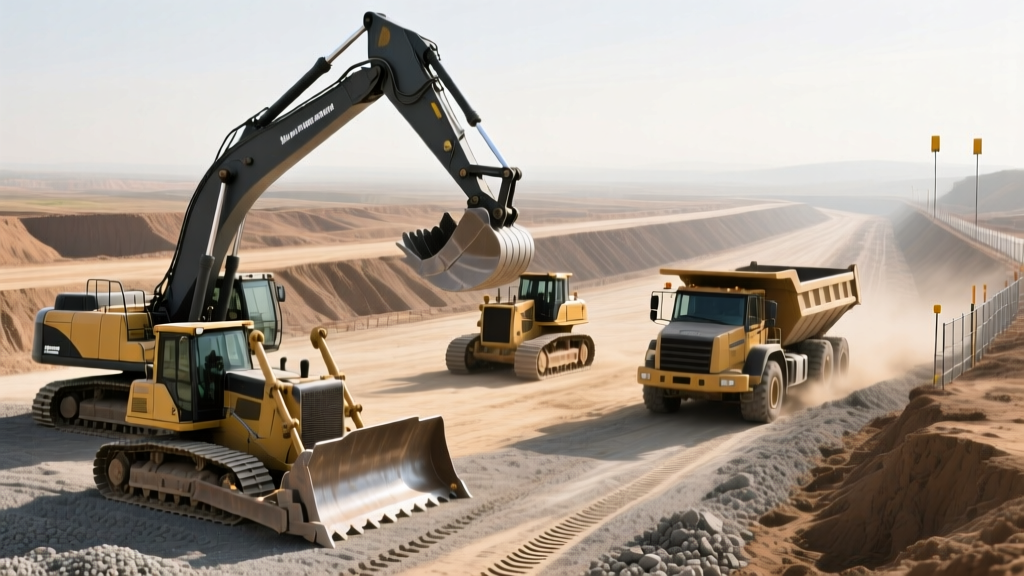
To understand the real-world application of big heavy equipment, consider a standard copper porphyry mine expansion requiring the removal of 250,000 tons of waste rock daily. The optimal fleet pairing frequently utilized in 2026 involves the Caterpillar 6090 FS hydraulic shovel matched with a fleet of Cat 797F haul trucks.
Operational Metrics and Cycle Times
- Swing Cycle: The 6090 FS achieves a swing cycle of roughly 25 to 30 seconds when operating in a 15-meter high bench.
- Truck Haul Cycle: Assuming a 3-kilometer haul road with an 8% average grade, a fully loaded 797F completes the round trip in approximately 18 minutes.
- Fuel Burn: Under heavy load, the 797F consumes between 150 and 190 gallons of diesel per hour. At $4.00 per gallon, fuel represents nearly 40% of the truck's hourly operating cost.
The 'Pass Match' Framework: Optimizing Load Cycles
The most critical inefficiency in mega earthmoving is a mismatched fleet. Procurement teams must adhere to the 'Pass Match' rule to maximize the utilization of both the loading tool and the haul truck. The golden standard is a 3-to-4 pass match.
Calculating the Pass Match
If a Cat 6090 FS is equipped with a 53 m³ bucket, it moves approximately 90 tons of blasted rock per pass (assuming a material density of 1.7 tons/bank cubic meter). To load a 360-ton capacity truck, the math dictates exactly 4 passes (4 x 90 = 360 tons).
- The 2-Pass Penalty: Loading a truck in two passes requires massive buckets that result in severe structural shock to the truck's suspension and frame upon the second drop, accelerating hoist cylinder and frame fatigue.
- The 5+ Pass Penalty: If it takes five or more passes, the truck spends excessive time idling in the loading zone. The shovel's tramming and spotting time increases, dropping overall fleet tons-per-hour (TPH) output.
'Fleet mismatch is the silent killer of mine profitability. A 5-pass match might seem like a minor inefficiency, but over 100,000 annual operating hours, it equates to millions in lost production and wasted diesel.' — Fleet Optimization Guidelines, Society for Mining, Metallurgy & Exploration (SME)
Predictive Maintenance & Critical Failure Modes
When big heavy equipment operates at this scale, catastrophic failures are not just repair issues; they are site-stopping events. Modern 2026 telematics suites focus on predicting specific failure modes before they breach critical thresholds.
Slew Bearing Grease Starvation
The slew ring on an 800-tonne excavator manages immense dynamic loads. Automated lubrication systems can fail silently if a distribution line blocks. Without real-time acoustic emission sensors monitoring the slew gear, pitting occurs within 50 hours of lubrication loss. Replacing a slew bearing on a Liebherr R 9800 requires a heavy-lift crane and takes the machine offline for 14 to 21 days, costing upwards of $1.5M in lost production.
Undercarriage Track Tension and Grouser Wear
Track tension on ultra-class shovels must be maintained within strict millimeter tolerances. Over-tensioning accelerates idler and sprocket wear, while under-tensioning risks track derailment during high-torque tramming. Site mechanics must utilize ultrasonic wear measurement tools on track shoes weekly. Replacing the undercarriage on a 1,000-tonne shovel costs between $800,000 and $1.2M; proactive tension management extends undercarriage life by 30%.
Financial Framework: Capital vs. Operating Expenditure
Acquiring big heavy equipment requires a rigorous total cost of ownership (TCO) analysis. The initial capital expenditure (CapEx) is often dwarfed by the operating expenditure (OpEx) over a 15-year lifecycle.
Tire Cost Warning: A single set of six 59/80R63 tires for a Cat 797F haul truck costs between $220,000 and $280,000. In abrasive rock conditions, these tires may only last 4,000 hours. Implementing automated tire pressure monitoring systems (TPMS) and maintaining haul road rolling resistance below 2% is mandatory to prevent premature tire blowouts.When evaluating fleet procurement, site planners must calculate the Cost Per Ton (CPT). For a matched fleet of ultra-class shovels and 400-ton trucks operating in hard rock, the target CPT for loading and hauling should range between $1.10 and $1.60 per bank cubic meter. If preliminary geotechnical surveys indicate highly abrasive or fractured rock that will increase bucket wear and tire degradation, planners must adjust the CPT model upward by 15% to 20% to account for accelerated ground engaging tool (GET) replacement cycles.
For further technical specifications on material handling and site safety protocols in mega-projects, operators frequently cross-reference guidelines published by the Mining Association of Canada, which provides rigorous frameworks for heavy equipment interaction and haul road design standards.
Strategic Fleet Deployment
Deploying big heavy equipment in mega earthmoving applications is an exercise in applied physics and financial engineering. Success relies on strict adherence to pass-match ratios, aggressive management of rolling resistance on haul roads, and the integration of predictive telematics to guard against catastrophic mechanical failures. By treating the loading and hauling fleet as a single, synchronized system rather than a collection of individual assets, site operators can secure the lowest possible cost-per-ton metric in the most demanding environments on earth.