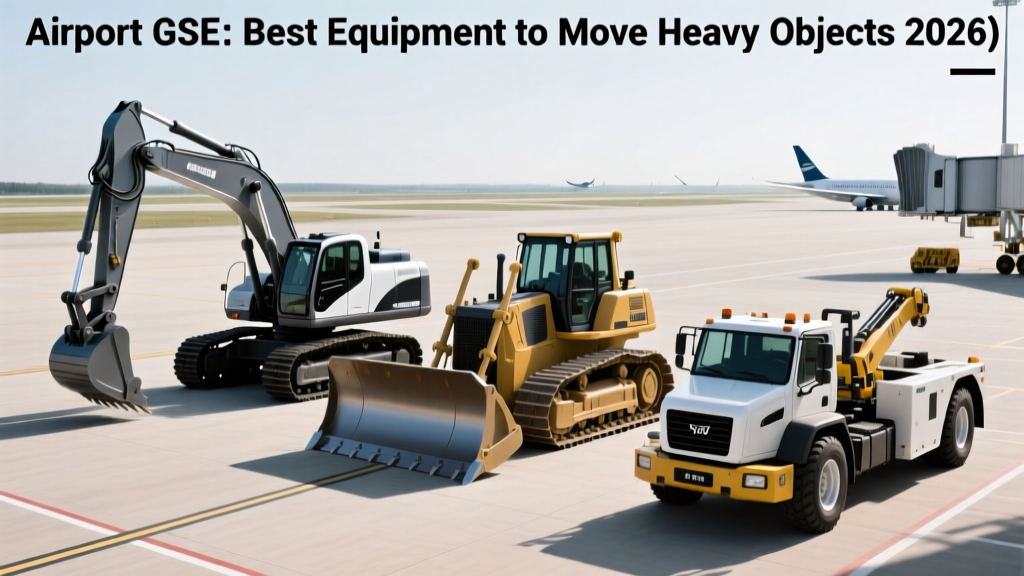
Airport GSE: Best Equipment to Move Heavy Objects (2026)
Discover the best airport ground support equipment to move heavy objects in 2026. Compare cargo loaders, pushback tractors, and eGSE costs.
Airport aprons operate under extreme temporal and spatial constraints. Sourcing the right equipment to move heavy objects in this environment means balancing aircraft turnaround times—often under 45 minutes for narrow-body jets—with strict tarmac weight limits, precise alignment tolerances, and aggressive 2026 emissions regulations. Whether you are handling 20,000-lb Unit Load Devices (ULDs) or pushing back a 300-ton wide-body aircraft, generic industrial forklifts and standard tow tractors will fail. This guide breaks down the specialized Ground Support Equipment (GSE) required for heavy airport logistics, detailing exact models, 2026 pricing, and the financial realities of the electric GSE (eGSE) transition.
The 2026 eGSE Mandate: What Buyers Must Know
As of 2026, major international hubs are enforcing strict zero-emission zones on the apron. According to IATA's eGSE transition guidelines, ground handlers are rapidly replacing diesel-powered heavy machinery with lithium-ion electric alternatives. Furthermore, the Airports Council International (ACI) Net Zero 2050 initiative has pressured airports to incentivize eGSE through reduced landing fees and priority charging infrastructure. When spec'ing new heavy equipment today, procuring Tier 4 diesel models is a stranded-asset risk; fully electric powertrains are now the baseline for fleet viability.
Main Deck and Lower Deck Cargo Loaders
Moving air cargo requires specialized scissor-lift loaders capable of elevating massive ULDs (like PMC pallets or LD3/LD6 containers) to aircraft door sills ranging from 8 feet (lower deck) to over 26 feet (main deck). Standard warehouse forklifts cannot accommodate the roller-deck friction coefficients or the micro-adjustments required to dock with an aircraft fuselage without causing catastrophic hull damage.
Top Tier Selection: JBT Commander Series
The JBT Commander series remains the industry benchmark for heavy cargo lifting. For lower-deck operations, the JBT Commander 15i offers a 15,000-lb lifting capacity with a dual-bridge design that allows operators to prep the next ULD while the current one is being loaded. For main-deck freighters (like the Boeing 777F), the JBT Commander 25i provides a 25,000-lb capacity and a lift height exceeding 26 feet.
- CapEx (2026): $180,000 - $220,000 (Lower Deck); $350,000 - $450,000 (Main Deck High-Lift).
- Key Feature: Auto-leveling platforms and side-shift capabilities (up to 12 inches laterally) to compensate for aircraft fuselage sway during loading.
- Powertrain: The 2026 electric variants utilize high-torque AC drive motors and regenerative lowering systems, which recapture energy during the scissor-lift descent, extending shift life by up to 18%.
Aircraft Pushback Tractors: Moving the Ultimate Heavy Object
The heaviest object on the tarmac is the aircraft itself. A fully loaded Boeing 777-300ER can exceed a Maximum Takeoff Weight (MTOW) of 775,000 lbs. Moving this mass requires immense breakaway torque, specialized traction control, and precise steering geometries to avoid exceeding the aircraft nose-gear torsional limits.
Conventional vs. Towbarless Technology
While conventional towbar tractors are still used for smaller regional jets, the industry standard for heavy wide-body and narrow-body pushbacks has shifted decisively to towbarless tractors. Models like the Goldhofer AST-1X or the Towmaster T-150 physically scoop and lift the aircraft's nose landing gear off the tarmac. This transfers a portion of the aircraft's weight onto the tractor's drive axles, maximizing traction without requiring massive concrete-counterweighted chassis.
Warning: Nose Gear Shear-Pin FailuresWhen buying conventional towbar tractors, operators must meticulously match the towbar's shear-pin rating to the specific aircraft fleet. A mismatched shear pin can snap during high-torque breakaway on icy tarmacs, causing the aircraft to roll uncontrolled. Towbarless tractors eliminate this risk entirely by utilizing hydraulic cradles and automated torque-limiting software, making them the superior choice for mixed-fleet hubs.
Heavy-Duty Baggage and Cargo Tugs
For moving chained dollies of bulk baggage or heavy maintenance equipment across the apron, heavy-duty tugs are the workhorses of GSE. The shift to electric tugs, such as the TLD TPX-100-E or the Eagle GT-35, has revolutionized ramp safety. Electric tugs deliver 100% of their torque at 0 RPM, providing immediate breakaway force for heavy dolly trains (often exceeding 20,000 lbs gross train weight) without the lag associated with diesel torque converters.
- Drawbar Pull: Look for a minimum of 3,500 lbs of continuous drawbar pull for heavy cargo trains.
- Braking Systems: Ensure the tug features automatic parking brakes and regenerative braking that actively slows the dolly train, preventing 'jackknifing' during emergency stops.
- 2026 Pricing: $45,000 to $75,000 per unit, heavily dependent on battery kWh capacity (typically 40kWh to 80kWh for multi-shift operations).
Procurement Matrix: 2026 GSE CapEx vs. OpEx
Financial modeling for heavy GSE must account for the 'Green Premium'—the higher upfront cost of electric machinery offset by drastic reductions in fuel and maintenance. Below is a comparative 7-year Total Cost of Ownership (TCO) matrix for heavy apron equipment.
| Equipment Category | Diesel CapEx (Avg) | eGSE CapEx (Avg) | 7-Year OpEx Savings (eGSE) | Primary Maintenance Focus |
|---|---|---|---|---|
| Main Deck Loader | $280,000 | $410,000 | $115,000 | Hydraulic fluid, roller bearings |
| Towbarless Pushback | $350,000 | $520,000 | $140,000 | Cradle sensors, tire wear |
| Heavy Cargo Tug | $35,000 | $65,000 | $28,000 | Battery thermal management |
Critical Edge Cases in GSE Procurement
Buyers frequently overlook environmental and infrastructural variables that dictate the real-world performance of heavy GSE. Address these edge cases before signing a purchase order:
1. Cold-Weather Battery Degradation
For hubs located in northern climates (e.g., Chicago O'Hare, Calgary, or Helsinki), standard lithium-iron-phosphate (LFP) batteries suffer severe capacity loss and charging throttling at temperatures below -10°C. If your operations face freezing winters, you must specify eGSE with integrated Battery Thermal Management Systems (BTMS) and battery pre-conditioning capabilities. Without BTMS, a tug rated for an 8-hour shift may fail at hour 4 during a January cold snap.
2. Tarmac Weight Restrictions and Pavement Classification
Heavy main-deck loaders and fully ballasted pushback tractors exert massive point-loads on the apron. Older regional airports or specific taxiway bridges have strict Pavement Classification Numbers (PCN). Procuring a 40,000-lb diesel pushback tractor might require costly tarmac reinforcement. Electric pushbacks, which rely on battery weight rather than steel ballast for traction, often feature a lower overall footprint and better weight distribution, mitigating PCN violations.
3. Charging Infrastructure Bottlenecks
Deploying a fleet of 20 electric cargo loaders and pushbacks requires megawatt-level charging infrastructure. Buyers must coordinate with airport authorities and local utility grids 18 to 24 months prior to eGSE delivery to install heavy-duty pantograph chargers or high-amperage CCS2 plug stations. Relying on standard depot charging will result in severe turnaround delays during peak travel windows.
Frequently Asked Questions
Can standard warehouse forklifts be used to load aircraft?
No. Standard forklifts lack the specialized roller-deck surfaces required to glide ULDs, do not possess the micro-hydraulic side-shift needed to align with aircraft doors safely, and their mast designs obstruct operator visibility at the 15-to-26-foot lift heights required for aircraft sills. Using improper equipment violates IATA ground handling safety regulations and risks severe fuselage damage.
What is the lifespan of an electric GSE battery?
Modern heavy-duty eGSE utilizes industrial-grade LFP (Lithium Iron Phosphate) battery packs designed for 3,000 to 5,000 full charge cycles. In a standard two-shift airport operation, this translates to an 8 to 10-year operational lifespan before the battery degrades to 80% of its original capacity, which usually aligns with the chassis depreciation schedule.
How do towbarless tractors handle different aircraft models?
Towbarless tractors feature adjustable hydraulic cradles and programmable logic controllers (PLCs). The operator selects the specific aircraft model (e.g., A320neo, B737 MAX 8) on an in-cabin touchscreen. The PLC automatically limits the cradle's clamping pressure and steering angle to match the exact torsional and geometric limits of that specific nose landing gear, preventing structural damage.