Heavy Equipment Telehandler Service: 2026 IoT & AR Innovations
Discover how IoT telematics, AR-guided diagnostics, and predictive sensors are transforming heavy equipment telehandler service and reducing downtime.
Telehandlers are the undisputed backbone of material handling on complex construction and agricultural job sites. When a primary lifting machine like a JCB Loadall 540-170 or a Manitou MT 1840 experiences an unplanned failure, the cascading delays can cost general contractors upwards of $1,200 per hour in lost productivity and idle crane crews. In 2026, the paradigm of heavy equipment telehandler service has fundamentally shifted from reactive wrench-turning to predictive, data-driven interventions powered by the Industrial Internet of Things (IIoT) and Augmented Reality (AR).
2026 Industry Benchmark: According to recent fleet management data aligned with ISO 55001 Asset Management standards, contractors utilizing predictive IoT telematics on telehandlers have reduced unplanned hydraulic failures by 42% and extended boom pivot pin lifespans by an average of 1,800 operating hours compared to traditional run-to-failure models.The Hidden Economics of Run-to-Failure Telehandler Maintenance
Historically, telehandler servicing relied on strict hour-based intervals (e.g., 500-hour fluid changes) or run-to-failure tactics. This approach ignores the actual operating conditions of the machine. A telehandler operating in a high-dust demolition environment degrades its hydraulic fluid and air filtration systems three times faster than one operating on a paved logistics yard.
Consider the financial impact of a catastrophic main hydraulic pump failure on a 14,000-lb capacity telehandler. The part alone costs between $4,500 and $7,200. When factoring in labor, hydraulic fluid flushing, system contamination cleanup, and three days of downtime, the total burden easily exceeds $12,000. Modern heavy equipment telehandler service mitigates this by monitoring the dielectric properties of the hydraulic fluid in real-time, allowing technicians to replace a $45 filter element before microscopic silica particles score the pump swashplate.
Core Technologies Redefining Telehandler Diagnostics
The integration of smart sensors and cloud analytics has created a new tier of diagnostic capabilities that go far beyond basic GPS tracking and engine fault codes.
Advanced Dielectric and Viscosity Sensors
Original Equipment Manufacturers (OEMs) and aftermarket retrofit kits now utilize inline dielectric sensors within the AW46 or AW32 hydraulic reservoirs. These sensors measure the fluid's permittivity, detecting water ingress and oxidation levels down to 0.1% water content. When a telehandler's boom cylinder seal begins to weep, allowing moisture into the system, the sensor triggers an automated work order in the fleet management software before the fluid loses its anti-wear zinc dialkyldithiophosphate (ZDDP) additive package.
Tri-Axial Accelerometers on Boom Assemblies
Wear pads and pivot bushings on the telescopic boom sections are notorious failure points. By mounting industrial tri-axial accelerometers near the boom pivot and mid-section, service teams can analyze vibration harmonics. An increase in high-frequency vibration during extension indicates insufficient lubrication or wear pad degradation, prompting a targeted $400 shim adjustment rather than a $3,500 emergency boom rebuild.
Service Methodology Comparison: Traditional vs. Tech-Enabled
The transition to smart servicing requires an upfront investment in hardware and software subscriptions, but the return on investment (ROI) is typically realized within the first prevented major failure.
| Component / System | Traditional Reactive Cost | Predictive Intervention Cost | Downtime Saved |
|---|---|---|---|
| Main Hydraulic Pump | $5,400 (Replacement) | $850 (Fluid flush/filter) | 3 Days |
| Boom Wear Pads | $2,800 (Pad & Cylinder repair) | $400 (Shim adjustment) | 1.5 Days |
| Tilt Cylinder Seal | $1,100 (Blown seal cleanup) | $250 (Early scheduled reseal) | 12 Hours |
| CAN Bus Wiring Harness | $1,800 (Full replacement) | $150 (Targeted pin repair) | 2 Days |
Augmented Reality (AR) for Remote Field Diagnostics
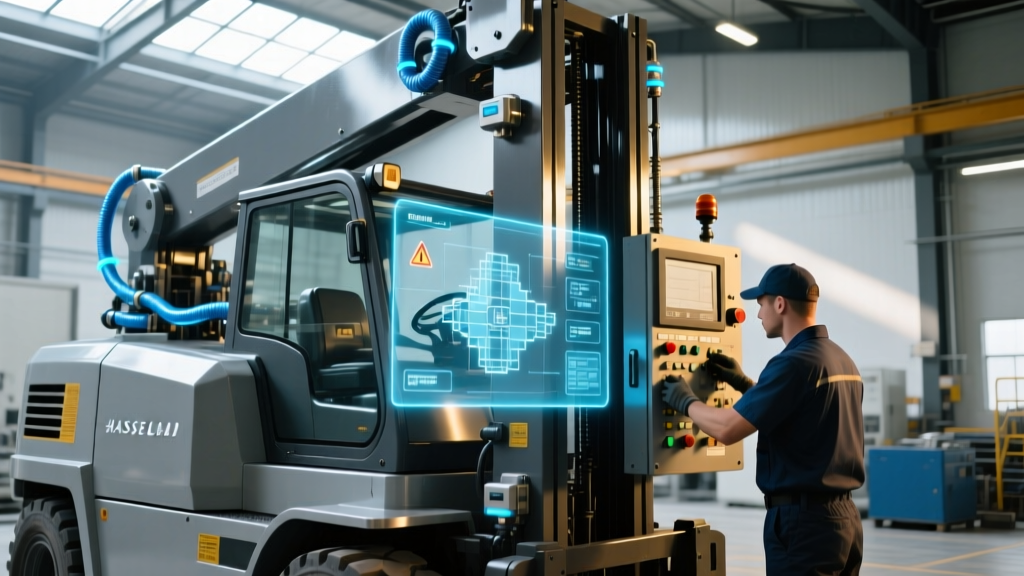
One of the most significant bottlenecks in heavy equipment telehandler service is the shortage of master-level OEM technicians. In 2026, AR headsets like the RealWear Navigator Z1 have become standard issue for field mechanics. When a technician encounters a complex proportional valve calibration issue on a Bobcat TL723, they don't wait three days for an OEM specialist to fly to the site.
"AR-assisted remote support has reduced our average telehandler diagnostic time from 4.2 hours to just 45 minutes. Our field techs wear the headset, and our master engineers back at the depot can see exactly what the tech sees, overlaying wiring diagrams and torque specs directly into their field of vision."
This remote collaboration ensures that complex tasks, such as recalibrating the load moment indicator (LMI) system or bleeding the hydrostatic drive loop, are performed correctly on the first attempt, adhering strictly to OSHA heavy equipment safety guidelines regarding load stability and hydraulic pressure release.
Practical Framework: Retrofitting Legacy Telehandlers
Not every contractor can afford to replace their fleet with the latest 2026 models. Retrofitting legacy machines (e.g., 2014-2018 models) with modern telematics is a highly cost-effective strategy. Here is a proven 4-step framework for upgrading an older machine for predictive servicing:
- Install a CAN Bus Gateway: Tap into the machine's J1939 data bus using a ruggedized telematics gateway (such as the Geotab GO9 or Teltonika FMB140). This extracts real-time engine RPM, fuel burn, and active diagnostic trouble codes (DTCs) without voiding OEM warranties.
- Deploy Ultrasonic Flow Meters: Clamp non-invasive ultrasonic flow meters onto the main hydraulic supply and return lines. These devices detect internal pump slip and valve bypassing by measuring flow rate discrepancies that are invisible to standard pressure gauges.
- Integrate OEM Telematics Platforms: For mixed fleets, utilize API aggregators to pull data into a single dashboard. Platforms like JCB LiveLink and Manitou's Fleet Management can be unified via third-party software like EquipmentShare or Trackunit, providing a single pane of glass for service managers.
- Establish Automated Threshold Alerts: Configure the dashboard to trigger SMS alerts when critical parameters deviate. For example, set an alert if hydraulic oil temperature exceeds 180°F (82°C) while system pressure drops below 2,500 PSI, indicating imminent pump cavitation or relief valve failure.
Sourcing Smart Parts and Calibration Tools
As telehandlers become more digitized, the parts themselves are evolving. When sourcing replacement components for modern heavy equipment telehandler service, technicians must specify "smart" variants. For instance, replacing a standard Danfoss proportional spool valve with an integrated spool-position sensor variant allows the machine's ECU to detect mechanical binding in the valve body before the operator experiences jerky boom movements.
Furthermore, servicing these machines requires advanced calibration tools. Standard multimeters are no longer sufficient. Service departments must invest in OEM-specific diagnostic laptops equipped with active parameter rewriting capabilities, allowing technicians to perform automated boom bleed cycles and joystick deadband recalibrations directly from the cab.
Frequently Asked Questions
How much does an aftermarket IoT sensor kit cost for a telehandler?
A comprehensive aftermarket predictive maintenance kit—including a CAN bus gateway, hydraulic dielectric sensor, and tri-axial vibration monitor—typically costs between $1,800 and $2,500 per machine, plus a $15 to $30 monthly cellular data subscription. The ROI is usually achieved by preventing a single major hydraulic component failure.
Can AR diagnostics be used in environments with poor cellular coverage?
Yes. Modern AR field service applications allow technicians to record high-definition video and capture thermal imaging offline. Once the telehandler is moved to an area with Wi-Fi or cellular connectivity, the data is synced to the cloud for asynchronous review by OEM engineers, ensuring compliance with safety protocols even in remote locations.
Does installing third-party telematics void the OEM warranty?
Under the Magnuson-Moss Warranty Act and similar right-to-repair legislation, installing non-invasive, read-only telematics gateways on the J1939 CAN bus does not void the OEM powertrain or hydraulic warranty. However, splicing into critical safety circuits, such as the Load Moment Indicator (LMI) or anti-two-block systems, is strictly prohibited and will void safety-related warranties.