How Much Should Heavy Equipment Repair Cost Per Hour? Safety Factors
Discover how much heavy equipment repair should cost per hour when factoring in OSHA safety standards, AWS welding compliance, and OEM certifications.
When fleet managers and owner-operators ask, how much should heavy equipment repair cost per hour, the baseline answer for 2026 typically falls between $145 and $185 for standard dealership rates. However, viewing hourly labor rates strictly through a financial lens ignores the massive liability and operational risks tied to safety standards and regulatory compliance. A repair rate that seems like a bargain often reflects a shop that cuts corners on critical protocols like AWS D14.3 welding specifications or OSHA-mandated post-repair load testing.
Heavy equipment operates in high-stress, high-liability environments. When a 40-ton excavator experiences a structural weld failure or a crane suffers a hydraulic line rupture, the resulting downtime, property damage, and workplace injury claims dwarf any hourly savings. This guide breaks down the true cost of heavy equipment repair per hour by analyzing the compliance overhead required to keep your fleet legally and structurally sound.
The Compliance Premium: Hourly Rate Matrix
Not all repair facilities bear the same overhead. Shops that invest in certified personnel, calibrated testing equipment, and strict environmental compliance must price those investments into their hourly labor rates. Below is a breakdown of what you should expect to pay per hour based on the facility's safety and compliance tier.
| Shop Tier | Typical Hourly Rate (2026) | Compliance & Safety Profile | Best Use Case |
|---|---|---|---|
| Tier 1: Independent / Mobile | $95 - $130 | Minimal overhead. Rarely employs AWS-certified welders or NDT (Non-Destructive Testing) technicians. High LOTO (Lockout/Tagout) variance. | Emergency field fixes, minor hose replacements, non-structural component swaps. |
| Tier 2: OEM Dealership Standard | $145 - $185 | Follows OEM repair manuals. Employs factory-trained techs. Standard environmental compliance for fluid disposal. Basic LOTO adherence. | Powertrain rebuilds, electrical diagnostics, standard hydraulic cylinder resealing. |
| Tier 3: Heavy Safety & NDT Certified | $195 - $260+ | Employs AWS D14.3 certified welders, NDT inspectors, and OSHA 30-hour certified safety managers. Full EPA and OEM structural compliance. | Boom/stick structural welding, crane modifications, undercarriage rebuilding, ROPS/FOPS certification repairs. |
Structural Welding: The AWS D14.3 Cost Factor
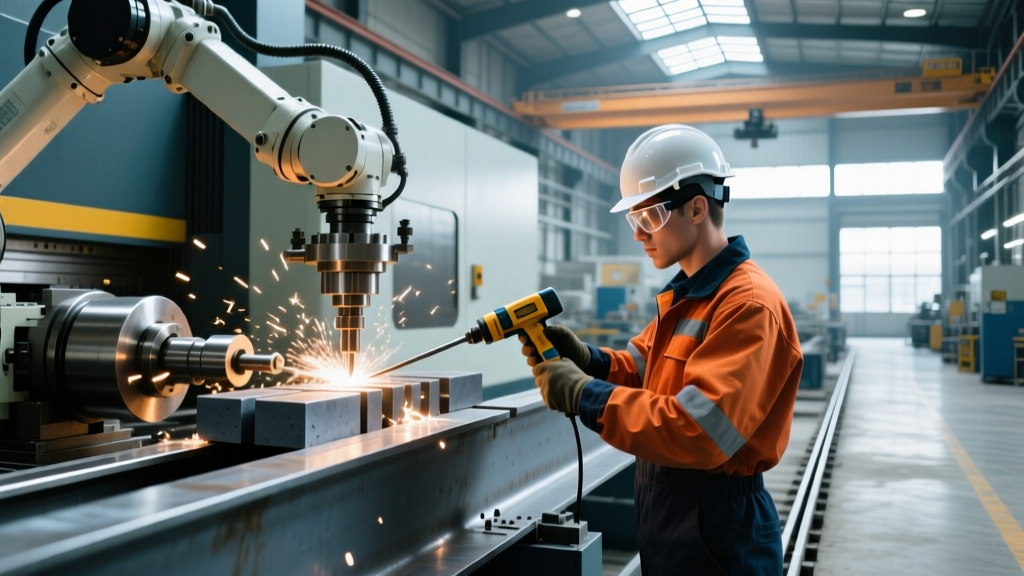
If your repair involves structural components—such as an excavator boom, a loader frame, or a dozer blade—the hourly rate must reflect adherence to the American Welding Society (AWS) D14.3 specification for earthmoving and construction equipment. High-strength low-alloy (HSLA) steels, like AR400 or T1, are standard in modern heavy equipment to reduce weight while maintaining yield strength.
Why Certified Welding Drives Up the Hourly Rate
- Pre-Heating and Interpass Temperature Control: Welding HSLA steel without proper pre-heating (often 200°F to 300°F) leads to hydrogen-induced cracking (HIC). Certified shops use temperature-indicating crayons and infrared thermometers, adding billable time to the prep phase.
- Specialized Consumables: Compliance requires matching the exact tensile strength of the base metal using low-hydrogen electrodes (e.g., E11018M). These consumables cost significantly more than standard mild steel rods and require specialized heated storage ovens.
- Post-Weld Heat Treatment (PWHT): For thick-section repairs, PWHT is required to relieve residual stresses. This requires specialized induction heating equipment and extended technician monitoring time.
OSHA Mandates and Inspection Overhead
For lifting equipment and cranes, the OSHA 29 CFR 1926.1412 standard dictates strict inspection protocols following any modification or major repair. When calculating how much heavy equipment repair should cost per hour, you must account for the billable hours dedicated purely to compliance documentation and testing.
Billable Compliance Hours in Heavy Repair
- Magnetic Particle Inspection (MPI): After a structural weld on a crane boom is completed, an NDT technician must perform MPI to check for subsurface defects. This adds 2 to 4 billable hours at specialized NDT rates ($180–$250/hr).
- Load Testing and Calibration: If a repair involves the hydraulic system governing a crane's load moment indicator (LMI) or rated capacity limiter (RCL), the equipment must be physically load-tested with certified test weights. This requires a rigger, a test weight set, and a certified inspector, easily adding 6 to 10 hours to the final invoice.
- ROPS/FOPS Recertification: If a cab or Roll-Over Protective Structure is damaged and repaired, OSHA and MSHA require recertification. Shops that offer this service charge a premium hourly rate to cover the engineering sign-offs and destructive testing data analysis required to prove the repair maintains the original safety factor.
Environmental Compliance and EPA Standards
Safety standards extend beyond the physical machine to the environment in which it operates and the facility where it is repaired. Modern heavy equipment repair facilities must comply with stringent EPA regulations regarding hazardous waste, volatile organic compounds (VOCs), and diesel particulate matter.
Shops that illegally "delete" Diesel Particulate Filters (DPF) or disable Diesel Exhaust Fluid (DEF) systems to save time and money expose fleet owners to massive EPA fines, which can exceed $45,000 per violation. A compliant repair facility factors the cost of proper hazardous fluid disposal, DEF system diagnostics, and emissions compliance testing into their standard hourly shop rate. When a shop quotes an unusually low hourly rate for an engine overhaul, verify that their pricing includes the legal recalibration of the Engine Control Module (ECM) to maintain Tier 4 Final emissions compliance.
Lockout/Tagout (LOTO) and Technician Safety
According to the Associated Equipment Distributors (AED) and OSHA guidelines, heavy equipment repair facilities must maintain rigorous Lockout/Tagout (LOTO) procedures. Heavy machinery stores immense kinetic and potential energy in hydraulic accumulators, suspended components, and torsion springs.
Compliant shops dedicate billable time to:
- Depressurizing hydraulic systems safely using OEM-specified bleed-down procedures.
- Physically locking out battery disconnects and storing kinetic energy in accumulators.
- Using engineered support stands rather than relying solely on hydraulic cylinders to hold suspended booms or buckets during undercarriage work.
While a non-compliant mechanic might skip the 45-minute LOTO and depressurization protocol to start wrenching immediately, the risk of a high-pressure hydraulic injection injury or a crushed limb is unacceptable. The hourly rate of a compliant shop pays for the discipline to execute these life-saving protocols on every single job.
How to Audit a Repair Shop's Safety Compliance
Before signing a purchase order based solely on the lowest hourly rate, fleet managers should audit the facility's safety and compliance infrastructure. Use this checklist to ensure the shop's rate reflects genuine expertise rather than dangerous corner-cutting.
Fleet Manager's Audit Checklist:- Request copies of AWS D14.3 certifications for any technician performing structural welding.
- Verify the shop has an active, calibrated crane scale or certified test weights for post-repair load testing.
- Ask for their written LOTO (Lockout/Tagout) policy specific to heavy equipment hydraulic depressurization.
- Confirm they use OEM-approved software for ECM flashes and do not offer illegal DPF/DEF delete services.
- Check if they employ an in-house or contracted Level II NDT (Non-Destructive Testing) inspector.
The True ROI of Paying for Compliance
When determining how much heavy equipment repair should cost per hour, the lowest bidder is rarely the most economical choice in the long run. Paying $195 per hour for a Tier 3, safety-compliant facility ensures that structural welds will not crack under dynamic loading, that hydraulic systems will not fail due to contaminated fluid, and that your company will not face catastrophic OSHA fines following a workplace accident.
By aligning your repair budget with the actual costs of safety standards, environmental compliance, and certified labor, you protect your capital assets, your operators, and your corporate liability profile. Always demand itemized invoices that clearly separate standard mechanical labor from specialized NDT, load testing, and compliance documentation, allowing you to see exactly what your safety premium is funding.