Heavy Equipment Market News Today: 2026 AI & EV Innovations
Tracking heavy equipment market news today reveals a massive 2026 shift toward battery-electric excavators, AI autonomy, and predictive telematics.
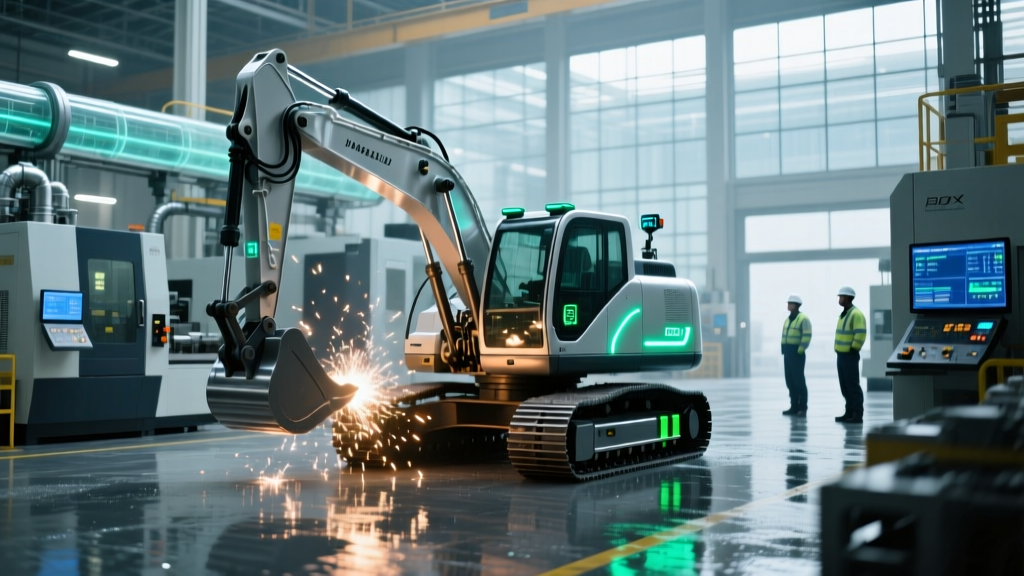
The 2026 heavy equipment sector is defined by the rapid convergence of battery-electric powertrains, autonomous earthmoving algorithms, and standardized fleet telematics. Tracking heavy equipment market news today requires looking past quarterly sales volumes to the underlying technological shifts altering total cost of ownership (TCO) and job site logistics. The transition from diesel-hydraulic systems to electro-hydraulic and fully electric architectures is no longer a niche experiment; it is a baseline expectation for municipal contracts and large-scale commercial developers.
Battery-Electric Powertrains: The LFP Shift and Mid-Size Expansion
Early electric excavators relied on NMC (Nickel Manganese Cobalt) lithium-ion batteries, which offered high energy density but posed thermal runaway risks and degraded rapidly under the heavy vibration of earthmoving. The most significant development in Volvo CE's electric machine lineup and competing 2026 models is the industry-wide pivot to LFP (Lithium Iron Phosphate) battery chemistry.
LFP cells sacrifice roughly 15% in volumetric energy density compared to NMC but provide a 300% increase in cycle life (often exceeding 4,000 full charge cycles) and eliminate the need for aggressive liquid cooling systems. For a 13-ton class electric excavator like the updated Caterpillar 301.9 EV equivalents, this translates to a 234 kWh pack that maintains 85% capacity after 8,000 operating hours. Furthermore, the elimination of cobalt has stabilized supply chains, reducing the upfront premium of mid-size electric excavators from 65% (in 2023) to approximately 32% in 2026.
The Electro-Hydraulic Pump Revolution
Battery capacity is only half the equation. The 2026 generation of electric excavators utilizes independent electro-hydraulic pumps rather than a single central pump driven by an electric motor. By assigning dedicated electric motors to the boom, stick, bucket, and swing functions, machines recover up to 28% of kinetic energy during the swing-braking phase, feeding it directly back into the LFP pack. This regenerative capability extends a standard 8-hour shift runtime to 10.5 hours without requiring a mid-day DC fast charge.
AI Autonomy: From Remote Control to Level 4 Earthmoving
Autonomy in heavy equipment has moved beyond simple GPS-guided grade control. The current market is dominated by Level 4 autonomy systems—machines that can execute complex, multi-step tasks within a defined geofence without an operator in the cab, supervised remotely by a single fleet dispatcher managing up to five machines simultaneously.
Companies like Built Robotics have refined their autonomous retrofit systems to integrate RTK (Real-Time Kinematic) GPS with 128-channel LiDAR arrays. These systems generate localized 3D point clouds at 20 Hz, allowing an autonomous dozer or excavator to detect and route around unmapped obstacles, such as buried utilities or shifting soil berms, in real-time. The cost of a full autonomous retrofit kit has stabilized between $140,000 and $185,000, yielding an ROI in under 14 months for high-volume grading contractors operating on double shifts.
'The bottleneck in 2026 is no longer the AI's ability to dig a trench; it is the edge-case logic for material variability. An autonomous excavator can perfectly execute a trench in uniform clay, but engineering the sensor fusion to recognize and adapt to sheer rock faces versus saturated topsoil remains the primary R&D focus for OEMs.'
— Lead Robotics Engineer, Off-Highway Automation Symposium, 2026
2026 Powertrain TCO Comparison: 15-Ton Excavator Class
Fleet managers evaluating capital expenditures must weigh the initial premium against operational savings. The following matrix outlines the projected 5-year TCO for a standard 15-ton excavator operating 1,500 hours annually.
| Metric | Tier 4 Final Diesel | Battery-Electric (LFP) | Hydrogen Fuel Cell (H2) |
|---|---|---|---|
| Base MSRP | $165,000 | $218,000 | $285,000 |
| Energy/Fuel Cost per Hour | $28.50 (Diesel @ $4.75/gal) | $9.20 (Industrial @ $0.18/kWh) | $34.00 (Green H2 @ $12/kg) |
| Annual Maintenance | $6,200 (Fluids, filters, DPF) | $1,100 (Grease, cabin filters) | $3,800 (Compressor, stack checks) |
| 5-Year TCO (Excl. Labor) | $378,500 | $294,500 | $484,000 |
Telematics and the AEMP 2.0 Standard
The era of proprietary, locked-down fleet data is over. The widespread adoption of the AEMP 2.0 (ISO 15143-3) telematics standard allows contractors to pull normalized data from Caterpillar's VisionLink, Komatsu KOMTRAX, and John Deere JDLink into a single, unified ERP dashboard. This API standardization provides access to over 40 distinct data points per machine, including hydraulic pump discharge pressure, swing motor torque, and DEF consumption rates.
Predictive Failure Modeling via Vibration Analysis
Advanced telematics in 2026 utilize edge-computing nodes mounted directly on the swing bearing and final drive motors. These nodes sample high-frequency vibration data (up to 10 kHz) and use onboard machine learning models to detect micro-fractures in gear teeth or bearing race degradation up to 300 hours before catastrophic failure. This shifts maintenance from scheduled intervals to strict condition-based interventions, reducing unplanned downtime by an average of 41% across large earthmoving fleets.
Edge Cases in Fleet Electrification: The Grid Bottleneck
While the machines themselves have achieved operational parity with diesel, the infrastructure required to support them remains the primary friction point. Deploying five 150 kW DC fast chargers on a remote commercial site requires a 750 kW dedicated utility drop, which can take 12 to 18 months to permit and install, costing upwards of $350,000 in transformer and trenching expenses.
To circumvent grid limitations, the market has seen a surge in mobile battery energy storage systems (BESS). Units like the 500 kWh mobile power banks act as buffer storage. They are charged slowly overnight from a standard 480V grid connection or via solar arrays, and then deployed to the active workface to deliver high-amperage DC fast charges to excavators during lunch breaks. This decoupling of grid capacity from charging speed is the critical workaround enabling electric fleets in rural and off-grid environments.
Actionable Framework: 2026 Fleet Upgrade Decision Matrix
Fleet managers should apply the following criteria when determining which assets to electrify or automate in the current fiscal year:
- Electrify First: Compact track loaders and mini excavators (under 5 tons) operating in enclosed spaces, noise-restricted urban zones, or municipal utility work. The TCO breakeven is typically under 18 months due to high diesel idle times and strict ventilation requirements.
- Automate First: 20-ton class dozers and motor graders engaged in repetitive, large-scale pad grading or highway berm work. The ROI is driven by eliminating overnight shift premium labor and achieving sub-inch grade accuracy without staking.
- Retain Diesel/Hybrid: Heavy-duty articulating haul trucks and 30-ton+ excavators operating in remote quarries. Until solid-state batteries achieve commercial viability for high-draw applications, the energy density of diesel remains mandatory for continuous, high-tonnage load-and-carry cycles.
Understanding these granular technological shifts is essential for interpreting heavy equipment market news today. The contractors who will dominate the latter half of the decade are those treating their fleet not merely as mechanical assets, but as networked, data-generating nodes within a broader digital construction ecosystem.